
|
|

Lauren Willig is the New York Times and USA Today bestselling author of over twenty-five works of...

Lee Rawles joined the ABA Journal in 2010 as a web producer. She has also worked for...
| Published: | July 23, 2026 |
| Podcast: | Modern Law Library |
| Category: | Legal Entertainment , Legal History |
In January 1800, Elma Sands’s dead body was found in a New York City well. The case has captivated people ever since, not least because in the resulting trial, defendant Levi Weeks was represented by Alexander Hamilton, Aaron Burr, and a future Supreme Court justice.
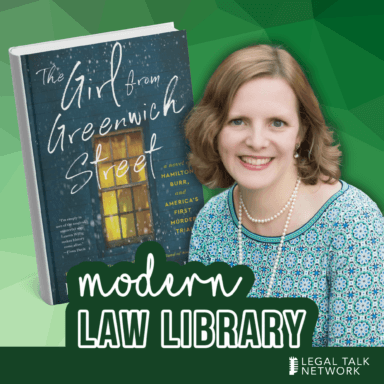
The Girl from Greenwich Street: A Novel of Hamilton, Burr and America’s First Murder Trial is a historical fiction novel by Lauren Willig. On this episode of the Modern Law Library, she explains how four years before their fatal duel, Hamilton and Burr came to be co-counsels on a murder case.
“The New York Bar was perishingly small in 1800. And in fact, Burr and Hamilton were co-counsel on a complex commercial litigation at the exact time,” says Willig. “So people were constantly–it’s like swing your partners, do-si-do. They were always working together, working against each other. It was just the way the bar worked in 1800.”
The defendant, Levi Weeks, lived in the same boarding house as Sands, a hatmaker whose cousin owned the house. The prosecution contended that Weeks had seduced Sands with a promise of marriage, then dumped her body in the Manhattan Well. His trial was the first murder trial in America to have a court transcript, thanks to a clerk who’d recently learned shorthand. This transcript gave Willig a wealth of witness testimony to draw on when fleshing out her characters.
“One of the things that drove me nuts when I was researching this case was how little attention has been expended over the years in trying to figure out anything about Elma Sands, the murdered woman,” Willig tells Rawles. “There are some big personalities and really big names involved in the trial itself. And people are so eager to get into the courtroom with Hamilton and Burr that they just trample over Elma. And she gets flattened into one of two archetypes. Either she’s the innocent young maiden who’s been seduced and betrayed, which is how the prosecution portrays her in the trial, or she’s a melancholy laudanum-addicted nymphomaniac, which is how the defense tries to portray her.”
“And I think the reality of Elma was a lot more complicated than those flat depictions would have us believe.”
Willig and Rawles also discuss her time at Harvard Law, where she signed a contract to write her popular Pink Carnation series as a 1L, and then her time at Cravath, Swain & Moore, trying to balance being a published romance writer and lawyer.
“I had to make a choice, try to continue to juggle or go all in on being an author. And I left Cravath and my partner mentor came up to me and said, ‘Well, what took you so long? I would’ve left sooner.’ ”
Lee Rawles:
Welcome to the Modern Law Library. I’m your host, Lee Rawles, and today I’m joined by Lauren Willig, author of the historical novel, The Girl from Greenwich Street, a novel of Hamilton, Burr, and America’s First Murder Trial. Lauren, thanks so much for joining us.
Lauren Willig:
Thanks so much for having me on the show.
Lee Rawles:
So right off the bat, people might think, oh, murder trial, Hamilton, Burr, this is about the duel. No, no, no. Something I didn’t know or realize Hamilton and Burr were co-counsel in a murder case. This is true history. So tell me, how did you first hear about this murder trial?
Lauren Willig:
Oh, through a very serious scholarly source, I saw it on Instagram.
Lee Rawles:
There we go.
Lauren Willig:
Because I’m a native New Yorker. I’ve always been interested in my local history. I spent a lot of time growing up sitting in the fake Dutch Fort at the Museum of the City of New York. And so I subscribed to a lot of New York history sites on Instagram. Largely I admit for the pretty pictures of gilded age houses. But around the time that Hamilton, the musical blew up and became a huge thing, of course, everyone was trying to find anything they could to post about Hamilton. And a post came up on one of these sites that usually showed pretty gilded age mansions about the Levi Weeks trial and Hamilton and Burr as co-counsel. And I though, oh my God, how strange and marvelous Hamilton and Burr working together just weeks before the intense and heated New York 1800 elections when they tear each other to shreds.
And so I knew I needed to know more. I will admit though, one of the first things I discovered was that their being co-counsel wasn’t unusual at all. They were co-counsel all the time. The New York Bar was perishingly small in 1800. And in fact, Burr and Hamilton were co-counsel on a complex commercial litigation at the exact time. I will not bore people with the details. And their opposing counsel in that case was their third co-counsel on the Levi Weeks trial. So people were constantly, it’s like swing your partners Josie Doe. They were always working together, working against each other. It was just the way the bar worked in 1800. Well,
Lee Rawles:
And I think any lawyers from rural communities might understand this little dance that there’s eight lawyers in this county, so we’re going to be seeing each other a lot.
Lauren Willig:
That’s exactly what it was. And in fact, thinking of it almost as a rural community is not a bad way to picture New York in 1800 because the population of the entire city in 1800 was 60,000 people, which admittedly is bigger than a small rural community, but is still absolutely tiny compared to the New York we know today.
Lee Rawles:
So let’s actually talk about the girl from Greenwich Street. Elma Sands. This is the young woman who was found murdered in the Manhattan well. You’ve got a lot of men with very big personalities. It’s 1800. So I’m sure there was a lot more information available about these. Now we look at them as historical giants than there was about Elma herself. How did you learn more about her, her background and her family?
Lauren Willig:
Well, you’ve actually hit on one of my hobby horses here. One of the things that drove me nuts when I was researching this case was how little attention has been expended over the years in trying to figure out anything about Elma Sands, the murdered woman. There has been so much ink spilled over this case. There are at least two full length supposedly nonfiction books on the topic, scads of articles, there have been podcasts. But I quickly discovered is when you open any of these books, often the facts about Elma are alighted or muddled. I think what happens is that, as you said, there are some big personalities and really big names involved in the trial itself. And people are so eager to get into the courtroom with Hamilton Burr that they just trample over Elma. And she gets flattened into one of two archetypes. Either she’s the innocent young maiden who’s been seduced and betrayed, which is how the prosecution portrays her in the trial, or she’s a melancholy lognum addicted nymphamaniac, which is how the defense tries to portray her.
And if you open any book or article about this case today, you’ll find one of these two archetypal Elmas. And so the big challenge for me in writing this book was to try to get past that flat cardboard. Well, those two flat cardboard visions of Elma and try to figure out who the real woman was. Because I don’t think you can understand who murdered her or why without first understanding who Elma was. And I think the reality of Elma was a lot more complicated than those flat depictions would have us believe. But of course, this still happens today. This is what happens to any rape or murder victim. They get flattened into an archetype. Anyway, your question was how I went about it. I tried to dig into her family situation, her past. I wound up going into obscure biographies of Quaker preachers because she had been raised by a rather eccentric and unpleasant uncle who was a born again Quaker preacher and an interesting character.
Census records, Quaker meeting house records, all sorts of things to try to recreate what Elma’s childhood and family relationships were like, to try to bring Elma back to life and give her some sort of voice in her own story.
Lee Rawles:
And one challenge Elma had right from the get – go is the same as what Alexander Hamilton had, which was illegitimacy. I think fortunately now I don’t believe that there is such a stigma, but back during that time, somehow there was this idea that shame attached to a baby who had nothing to do with their own conception.
Lauren Willig:
Oh, absolutely. It was this idea of inherited sin that the baby was tainted from the get –
Lee Rawles:
Go. So I can’t imagine being raised by this kind of nutty Quaker preacher. Uncle was a smooth sailing for poor Elma.
Lauren Willig:
No. How can we put this? Not beloved by her family. And in fact, the relatives she was living with in New York were her first cousin Kathryn, the oldest daughter of this born again Quaker preacher and Catherine’s husband, Elias Ring. And Catherine’s testimony in the trial is fascinating because Catherine is the archetypal oldest daughter. She is the good girl who always does the right thing, damn it, even when the circumstances are hard. And for her, they’re frequently very hard. Catherine Ring is raising four children under the age of four and running multiple businesses while her husband has an extended midlife crisis. But when she’s 16, she rides across the fields to personally get the nails for the new Quaker meeting house her father is building. She adores her father, Catherine Ring. And she has never liked her younger cousin Elma, who she views as a disruptor to the family circle.
Although you can tell she’s constantly trying to say nice things about Elma to make up for the fact that she doesn’t actually like her. And one of the things I discovered when I went delving into Elma’s childhood and past is that almost as soon as Elma’s mother fell pregnant with her as a 15-year-old girl, Elma’s uncle David Sands, who was a generation older than his younger sister, decided he needed to preach to the heathen of Rhode Island. His family was in Cornwall, New York on the Hudson River. And this is, by the way, the early days of the Revolutionary War. Everything is bustling. There’s soldiers all over. And he’s like, “Sorry, God, go preach to the heathens of New England.”
Lee Rawles:
Oh man, would love to stick around and help out my family, but those Rhode Islanders.
Lauren Willig:
He has a wife, he has a child of his own, and he just ups and leaves as soon as his sister’s pregnancy starts showing and doesn’t come back for a couple of years. The family’s being harassed by Patriot soldiers because they assume that the fact that he’s not fighting and he’s left means he’s a loyalist. And his wife writes to him saying, “We’re being attacked. We’re being harassed.” All of these things. “Please, please come back or at least send them a letter telling them that you’re preaching to the Heathan of Rhode Island and not that you’re a loyalist. “And his response is, ” Well, I’m doing what I have to do and I trust that God the Father will be a father and husband to you in these times and that’s it.
Lee Rawles:
I’m sure that was a great comfort. Yes.
Lauren Willig:
Absolutely a great comfort. And Elma’s birth is very intimately mixed up in all this. And you can imagine how that impacts the family dynamic going forward.
Lee Rawles:
Yeah, I absolutely see how resentment could center on this child. And it does seem like she had a spark, at least in the book. Oh, in
Lauren Willig:
Real life. Yeah, too.
Lee Rawles:
And in real life too. You get the sense of this was an intelligent girl living a life with many, many restrictions and not many options for how to use that intelligence or drive. And she wasn’t interested in being a Quaker.
Lauren Willig:
Yeah, that’s one of the mistakes that often gets repeated about her was that she was a Quaker because of course that goes with the innocent maiden picture. The young woman in Dove Gray, the innocent Quaker girl. And while Elma refused to join the meeting, her family were Quakers, she wasn’t. And that I think says something about her incredible strength of character. And it’s very funny because one of the tactics the defense team, Hamilton Burr and Brockholst Livingston pursues to try to argue that maybe she was melancholy, maybe she committed suicide, maybe she flung herself in the Manhattan well. And witness after witness gets up to testify, actually Elma was quite lively, possibly a little too lively. And that sense of her liveliness, her vividness, her love of wearing bright colors, her skill in trimming fancy hats, they run one of the businesses Catherine Rings runs to try to make up for her husband’s uselessness a milliary and Elma is a champion hat trimmer.
It all gives you a sense of someone who is eager for life in so many ways.
Lee Rawles:
And she died at just 22?
Lauren Willig:
Yes. Yes.
Lee Rawles:
So how did the defendant in the case, Levi Weeks, how was he involved with the Sands family?
Lauren Willig:
Okay. Well, I realize we actually haven’t talked about the murder at all, which is a – No, you haven’t. Cause celebra in its own right. This case, I mean, it’s famous on multiple grounds. It’s famous both as the Manhattan Well murder here in New York where it’s one of those great unsolved crimes that always involves an atractive dead young woman. And it’s also famous as the Levi Weeks trial, which I mean is notorious not just for Hamilton and Burr being involved, but also because it’s America’s first fully recorded murder trial, which is a distinction in its own right. But to start with the Manhattan Well murder side of it, Levi Weeks was a young carpenter living in the same boarding house as Elma. It’s a boarding house run by her first cousin, Catherine Ring, and nominally also by Catherine’s husband Elias. Elma, on the evening of December 22nd, 1799, tells her cousin Hope that she’s eloping.
Sorry, it’s actually, she tells Hope a week before then, Hope, who’s a year younger than Elma and her friend and sometimes frenemy, spills the beans to Hope’s older sister Catherine. Catherine, interestingly enough, on that evening of December 22nd, helps Elma prepare for her elopement. She helps her tie in her gloves. She sends her across the street to borrow a muff from a neighbor because it’s a cold night in New York. And then she sends her off on her way. And the assumption is that she is eloping with Levi Weeks, who again is this carpenter who lives in the boarding house and whose older brother is a wealthy and upwardly mobile contractor who lives a few blocks away in his own lumberyard and who boards out his brother and a bunch of his journeymen at the ringboarding house because it’s convenient. There is a big debate about whether or not Elma left with Levi that night.
We don’t know. We don’t know if Elma left with Levi a little before Levi. There’s a lot of discussion with this. But what we do know is Elma left the boarding house that night and never came back. And when she had been missing for about a week, Elias Ring, her cousin’s husband, hired someone to dredge the docks around Ryan Linder’s battery, asserting that Elma must have thrown herself in, in a love
Lee Rawles:
Fit. Of course, a love fit. What’s a love fit? Yes.
Lauren Willig:
I mean, something that women do. They get overcome by their emotions and they fling themselves into the nearest body of water. Elias holds onto this love fit theory for a bit, even though they don’t find her there because a week later the muth shows up in the Manhattan well in Lis Bernard’s Meadow to the north of the city. Of course, to the north of the city then is what we would still call way downtown today. But they go running, they get a friend to come with them with long poles and they find Elma in the well. And within an hour of the discovery of her body, the city is buzzing with the news that Levi Weeks seduced her under promise of marriage and strangled her and flung her into the well to avoid putting a ring on it. And constables go and collect Levi almost immediately.
So that’s where Levi Weeks comes into it. The papers all carry these crazy over-the-top articles about Levi seducing and murdering Elma. Some are more flowery than others. And I mean, it all looks very bleak for Levi. Everyone is convinced he did it.
Lee Rawles:
Well, the story doesn’t end there. We’re going to take a quick break to hear from our advertisers. When we return, I’ll still be speaking with Lauren Willig about the girl from Greenwich Street. Welcome back to the Modern Law Library. I’m your host, Lee Rawles, here with Lauren Willig, author of The Girl from Greenwich Street. So things look pretty bleak for Levi, but there are benefits to being the little brother of a very wealthy, influential man. And one of them is you can afford representation. So who first signs on to the case and what’s their attack strategy when it comes to the defense?
Lauren Willig:
Well, that’s an interesting question and I’m going to pull back the curtain for a moment on the historical research here because the truth is we don’t know who’s the first person signed onto the legal team because none of the lawyers involved left any notes on the case. There is no documentation that’s turned up so far. I’m confident that someday somewhere in someone’s basement or attic or a forgotten corner of an archive where things have been mislabeled, someday we will find something, but it hasn’t turned up yet. So the crazy thing is as well known as Hamilton Burar, as well documented as they are, there are still huge gaps in the archive. And one of those gaps is their work on the Levi Weeks trial. My guess, and this is triangulating from what we do know, is that the first person that Ezra Weeks, Levi’s older brother, would’ve approached was Brockholst Livingston, who is probably the least familiar of the legal team to everyone listening.
Although since this is a law podcast, I will say the dissent in Pearson v. Post. If anyone remembers doing Pearson v. Post in law school and the crazy dissent, that was Brockholst. But the thing about Brockholst in 1800 before he rises to the Supreme Court is that he was hands down the most ruthless criminal defense lawyer in New York at the time. If I were up for murder in 1800, I would be hiring Brockholst hands down. He manages to get off a murderer who was found standing over the body holding the dripping knife, which I think tells you how good he was. And actually for those wanting another example of just how ruthless Brockholst was in the courtroom, I recommend John Wood Suites, The Sewing Girls Tale about a rape trial in which Brockholst was counsel for the defense a few years before. And you can see some of his, let’s just say, quite unpleasant tactics at work.
But anyway, so my guess is Brockholst came on board first and as for Burr, Ezra Weeks had a working relationship with Aaron Burr. And it seems quite likely, although Burr was not versed in criminal law, that Ezra Weeks would’ve called in Burr’s debts to him because Burr was in debt to everyone. And Burr had an interesting project going. Sorry, this might be a digression. Oh,
Lee Rawles:
I want to hear it.
Lauren Willig:
Okay. So the Manhattan well in which Alma was drowned has a connection to both Burr and Ezra Weeks. So about a year before the events of this story, Burr’s brother-in-law came to him with a proposal for alleviating the yellow fever epidemics that constantly struck New York. Yellow fever was a scourge. And at the time his brother-in-law, Dr. Thomas Brown, had this idea that maybe it was because of bad water. And if they could bring in fresh water to the city, well, maybe they could eradicate yellow fever. I mean, he was wrong, but it was still a good idea. And
Lee Rawles:
It can prevent some other stuff. You’re not going to get dysentery. Yeah,
Lauren Willig:
Exactly. Cholera. I mean, there was a lot of good to this plan, even if it was not actually how yellow fever is transmitted. But in any event, Burr goes to Hamilton and says, “Look, I have this idea for a water company that will bring fresh water to the city, help alleviate yellow fever.” And Hamilton is all on board with this. Hamilton helps Burr draft the documents.He helps push it through his federalist friends and the legislature who are otherwise skeptical of Burr. But what Hamilton doesn’t realize is right before this bill for the Manhattan Company goes up for vote. Burr adds a clause. And that clause enables the Manhattan company to lend out additional excess funds. It’s basically a clause that turns the water company from a water company into a bank, a bank to rival Hamilton’s own Bank of New York and provide a piggy bank for both Burr and his Republican party a slush fund.
In any event, the only person who notices this in protests is Hamilton’s federalist buy John Lansing, who by the way is the judge on the Levi Weeks trial because there are about 10 people in New York at the time. And Lansing protests, but Hamilton has done his work too well. The bill goes through and Burr gets his water company/bank. But because it was never about the water, they immediately abandoned all plans for bringing clean water from upstate. Instead they’re like, “Eh, we’ll just dig some wells and we’ll use this existing body of water in the city, the collect, which is according to many reports, hideously fouled. We’ll just bring water from the collect.” And they cheap out. They don’t even use metal pipes. They have Ezra Weeks put in board logs as pipes to these wells that Ezra Weeks’ people dig. So the well that Elma Sands drowns in part of this Burr venture to thwart Hamilton with Hamilton’s own help, which Ezra Weeks facilitates as contractor.
So it’s very logical that Ezra Weeks would then have signed up Aaron Burr, who’s a figure of some consequence in the city as counsel, which of course brings us to the final member of the legal team.
Lee Rawles:
Alexander Hamilton. His name was Alexander Hamilton.
Lauren Willig:
As we have heard. But he’s the big mystery on the legal team. And this is one of the things that fascinated me when I was researching this case is Hamilton doesn’t really do criminal law. I will spare you the details of how busy Hamilton was in early 1800. Let’s just say he was running the new army. He had a very busy private legal practice and he’s also thwarting Burr or attempting to thwart Burr and his Republicans because we’re approaching the presidential elections of 1800. And he knows that whichever way the New York elections go will determine the presidential election. And Hamilton has an apocalyptic horror of a Republican administration. In any event, he’s very, very, very busy. He’s always short of money so he is taking on private clients. He is working like a dog. He and Eliza have a zillion children, all of whom have school fees and so on.
And he’s promised Eliza he’ll build her a country house. Someplace they can get away together away from the hustle and bustle because of course his poor long suffering, Eliza has been begging him to take a step back, slow down. He’s like, “Don’t worry, I’ll build us this country house.” But of course, country houses also cost money and Hamilton doesn’t have any. And the story that’s always told about why Hamilton is on this defense team where he makes no sense that Ezra Weeks is the contractor for Hamilton’s country house, The Grange. And he owes Ezra money and can’t pay him back. And so Ezra calls in the debt. There’s a popular nonfiction book about this case that came out, oh, about a decade ago where there is a scene where Ezra Weeks comes to Hamilton’s office and calls in the debt and Hamilton reluctantly agrees to join the team even though he’s too busy really and this is not his thing.
I
Lee Rawles:
Know that we can’t diagnose historical figures with modern psychological things, but I would say it does seem like a raging case of untreated ADHD here, just flooding from one thing to another, all in, juggling more than he can handle. But I could absolutely see how, yes, he may have owed Ezra weeks, but also this was fascinating to him and so he dived in.
Lauren Willig:
Well, the problem is though, this was the issue with researching this case, is that this story has been so talked about over the centuries. And there are so many things about this case like Hamilton taking the case because he’s in debt to zero weeks for the range that everyone knows. But when you poke the things that everyone knows, they crumble to bits. And this was another one of those where while I was researching this book in the early stages still assuming this story was true, I took my then Hamilton obsessed six-year-old with me to The Grange. And I looked at the timeline they have up at The Grange of the building’s construction and had a panic attack because well, The Grange wasn’t built until 1802. Hamilton doesn’t hire the architect, John McCoom, until 1801, and he doesn’t buy the land on which The Grange stands or used to stand it’s been moved until August 1800 four months after the trial.
So I’m standing there thinking, oh my God, is there a mistake? And the people, the lovely park rangers at the Granges showed me, no, in fact, these are the correct dates. But that how on earth can Hamilton be in debt to a man for a house that hasn’t been built, hasn’t been designed, and for which he doesn’t own the land? It made no sense. And I went digging and digging and digging. And finally I found one amazing legal scholar from the 1950s and ’60s, Julius Gobel, who noted in a footnote in his chapter on the case that in fact, the story makes no sense. Hamilton couldn’t possibly have been debt to Ezra at this time, but Hamilton knows he wants to build a country house. Good contractors are hard to get. And if he gets Ezra’s brother off on a murder charge, Ezra’s going to have to build his house for him.
And on top of that, he knows that this case is going to be the OJ trial of 1800. I mean, obviously he doesn’t know about OJ, but he knows this is a cause Celebra and all eyes are on this case. It’s already been reported as far away as Philadelphia and Boston. And Burr and Brockhols are both Republicans. In fact, they’re allies in the upcoming elections and there is no way Hamilton is letting them bestry that courtroom in the lead up to the elections without him. And so if Goebel is right, and I think he is, it flips the entire story. Instead of Ezra Weeks coming to Hamilton, I think Hamilton went to Ezra Weeks and offered his services on this case, partly to Thwart Burr, partly because, well, he wants Ezra to build him a country house. And partly because as you said, he is Hamilton and he cannot resist having a finger in every pie.
And the fact that Hamilton inserts himself into this defense team explains, I think, a lot of the incredible dysfunction one then sees at trial. Because part of what makes this trial so much fun for the casual reader or even the very involved reader is that the defense team is at odds with itself and you watch them supposedly working together to save Levi from the gallows, but really cutting each other off at the knees at every opportunity while advancing mutually incompatible theories of the case.
Lee Rawles:
Well, we’re going to hear more about that case in just a second when we return from hearing from our advertisers. Welcome back to the Modern Law Library. I’m your host, Lee Rawles, here with Lauren Willig. So Lauren, in the title of the book, you call this America’s First Murder Trial, and it does have characteristics that there had not been in America before. And one of these is the transcript. So this is how we actually know so much about the case. Can you talk a little bit about why there’s a transcript, what the transcript tells us about these battling defense strategies and a character in the book who I have a real fondness for the prosecutor who is completely outshown Cadwallader.
Lauren Willig:
Poor darling Kedwalter. But anyway, as you said, so much good material there. I will admit first though, every time I see that subheading on the book, I cringe a little. A lot of people genuinely believe this is America’s first murder trial. And let me tell you, it’s not. There were so many murder trials in America before this, but such as the way of publishing. My publishing company did not want to put America’s first fully recorded murder trial on the cover and just shorthanded it to America’s first murder trial, which is in fact a common misconception about this case. But as you so ably said, this is America’s first fully recorded murder trial. It is the first case for which we have a full verbatim transcript because the clerk of the court, William Coleman, had just discovered this cool new thing called shorthand. And he decided to take down the trial verbatim or as close to verbatim as he could get, which is really pretty amazing.
It is a hundred pages of action-packed testimony. The sort of trial we see on TV, but as any litigator knows, seldom happens in real life. They did hear all sorts of insane stuff came out on the stand, lies, secrets, adultery, lots of high drama. It’s very much Law and Order 1800. And we have that because Coleman took everything down word by word. You get where people stammered. You get where people interrupted each other. And as you mentioned, the poor darling prosecutor, Kedwalter Colden, you get the bits where he is saying, “I am sorry, I am dropping with fatigue. I can’t go anymore. Please, please, can we adjourn for a day because I just can’t do this? ” So the characters of all the parts Participants, their voices come across so clearly through the centuries because of this remarkable document.
Lee Rawles:
One thing I really appreciated about the book, and just for listeners who have not yet picked it up, this is a book where you get to see many, many characters’ perspectives. And I was really reminded multiple times through the book that adage about everyone is a hero in their own story. And I really liked I would have one chapter of Alexander Hamilton’s perspective. And then the next chapter might be Aaron Burr, who of course has a very different idea about Alexander Hamilton. And one of the really heart-rending chapters for me was Elma’s cousin Katie’s court appearance. Because there is no way that Katie would’ve ever been in a court. She is a Quaker housewife and boarding room operator and hat maker, but why would she know what it was like to give testimony, to be in a courtroom, to face questioning? And she’s bewildered. She hasn’t had the opportunity to watch Law and Order.
How did you get yourself sort of in that mindset? I know you had the transcript to work off of.
Lauren Willig:
I will say I was very grateful to the transcript because among the voices it gives us are the voices of people we don’t hear that often in the historical record. Ordinary working women like Catherine Ring and her younger sister, Hope. And Catherine goes on and on and on. And for my lawyer listeners out there, I will say, do not think of this as the sort of trial we would see today where witnesses have been coached to give yes and no answers. Witnesses just go. Catherine speaks for solid pages. She goes on and on and on and you get such a sense of her life, her troubles, her resentments, all of that. So you get a sense of personality and of the details of people’s lives that you would not get in a modern trial in the same way today unless the witnesses had been really poorly coached.
But one of the reasons I decided to do multiple viewpoints in this book and as many viewpoints as I did was one of the things that struck me about this case was how upstairs, downstairs it was. And upstairs you have the lawyers, you have Brockholst and Burr and Hamilton and Kedwallader Colden, the prosecutor who we’ve mentioned a few times who is younger than the others. He’s a little bit hapless, but he is from an unbelievably wealthy, well-connected, aristocratic family. These men, they dwell in the same world of wealth, privilege, education, and they are constantly appearing in court with or against each other. They’re in a world that plays by different rules. And to them, this case isn’t personal. It’s something they’re doing for political advancement, for career advancement, for the attention, for whatever it is, but it is not something that impacts their lives personally in any real way.
Whereas for the women in the case, for Catherine Ring and her younger sister Hope, this is something that strikes to the heart of their lives. They are the downstairs. They are the ordinary people who are baffled by the legal rigmarole whose lives have been turned upside down by this murder. And now whose every action when they make tea, when they go to bed, all of this is suddenly they are subject to public scrutiny in a real and searching way and their lives will never be the same because of it. And so that bit you’re mentioning where Catherine goes to give her testimony, this was one of the bits in the trial testimony that really got to me. Catherine Ring gets on the stand prepared to tell her piece and boy, does Catherine have a lot she wants to tell. And she starts to tell what Elma told her about eloping that night with Levi and the defense team pounces.
And suddenly poor Catherine is sitting there mute on the stand while the lawyers get into a prolonged wrangle about the rules of hearsay and what precedents are valid. And the end result is Catherine is not allowed to tell what Catherine wants to tell. I mean, Catherin does go on to tell a lot of other things, but she is silenced by the mechanism of the law and it’s a very striking moment.
Lee Rawles:
It sure was. And one of the reasons I was so excited to talk to you this month, 250th America birthday, however we want to refer to it, it’s such an interesting time period that this takes place in. You mentioned it’s only weeks after George Washington’s death. The book starts in 1799 and we spend most of the book in the year 1800. And a lot of the country and its systems are still so new and in development. And they’re relying on this Anglo-American legal tradition, but there’s not much of a tradition yet. Okay, so maybe we can use England’s precedents, but not Scotland’s because that’s different. There’s just a lot of figuring out what will America’s governance be like. Hamilton spends a decent amount of the book really worried about will they let him have a standing army? There’s so much that has not yet been settled.
And I just found it such an interesting time period to read about. So I would love to hear from you researching this time period, is it as well documented as the battles of the Revolutionary War, et cetera? Or is this kind of more of a sausage making time where people maybe aren’t explaining as much what’s going on in the development of what becomes American tradition?
Lauren Willig:
That is a great question. And I think what struck me about this period that I had never thought about before, because my guilty secret is my background is actually in British history. And so I know a lot more about what went on in the same period on the other side of the pond. So it was fascinating going back to my own hometown in this time period and realizing that New York in 1800 was in many ways and the young Republic in 1800 was in many ways a different place than I had assumed because this is a time of incredible unease of growing pains in our republic. And for Hamilton and Burr in particular, for that revolutionary generation who were young during the highs of the revolution, this is a period of doubt and dismay. They’re in middle age, but the world around them does not look like what they thought it would be.
They have serious doubts and worries about the new republic. Everyone is bickering. President Adams, the president at the time is technically, he is a federalist like Hamilton. They hate each other. And Hamilton is concerned that Adams is actively working to undermine him and undermine the army he is so assiduously building. There’s a lot of backstory here, but there are a lot of worries about whether the Republic can survive and what on earth they’re doing. And I think this shows itself in all sorts of ways from one of the larger questions of the politics of the day, but down to the micro questions like as you mentioned, how on earth do we shape our legal system now that we are no longer actually part of the mother country? What do we keep? What do we reject? How do we build our own practices and our own country?
And the New York legislature legislates a bunch of things reforming litigation and criminal litigation in the years after the war, but there are still tons of open questions out there. And one of the things that I found so hard as a very brief former litigator was how different legal practice was at the time because there are so many things they’re still figuring out and it’s very trial and error.
Lee Rawles:
And one of the things that they were figuring out is, can a trial go more than one day?
Lauren Willig:
I know. We take so for granted that trials go multiple days and of course we have mechanisms in place for sequestering witnesses. But one of the incredible things about this trial that makes it so fun is that we’ve mentioned several times Kedwalder Colden without really explaining. So I’m going to digress slightly here and say Kedwalder Colden was a prosecutor. He is working alone against three titans of the New York Bar,
Lee Rawles:
Brock Holswick.
Lauren Willig:
He’s 32. Yeah, he’s 32. The other guys are in their mid – 40s. They were all heroes of the revolution. Kedwalader was a teenager in school in boarding school in England of all places during the revolution. He has huge revolutionary FOMO. His legal career has not to this point been hugely distinguished. He’s the assistant attorney general, which sounds pretty good until you realize his brother-in-law is the attorney general. And Kedwalader has lost a bunch of cases. And so this for him is a huge deal. This is his chance to really prove himself. Everyone is watching this case and Kedwalter is a romantic in the early 19th century sense of romantic. And he really genuinely deeply feels for poor murdered Elma. And so Kedwalader decides he’s going to prep the heck out of this case. Basically, Kedwalader is that kid in your law school section who read every single word 15 times, who underlined everything, who did the work and then did some more work, but then somehow missed whatever the intuitive leaps were that were required to really understand the thing.
I mean, in this case, he calls so many witnesses unlike everyone who migh have had a passing acquaintance with Elma Sands or with Levi Weeks gets called to the stand, including then a lot of kids who are disqualified for being too young to testify.
Lee Rawles:
Oh, that was one of my favorite parts where the judge asks the children, “Do you know what an oath is? ” I know
Lauren Willig:
It’s so embarrassing.
Lee Rawles:
And they’re like, “No.” It’s like, “Well, then you can’t swear one. Dismissed.”
Lauren Willig:
Poor Kedwalder. But that goes back to your initial question about the length of the trial because Kedwalder signs up over 70 witnesses. Now at the time, there had been no trials in New York up to now that had not been resolved within one day. And everyone assumes this trial will be resolved within one day too. And when they get to two in the morning on the first night and Kedwalader, the prosecutor, has not finished with his witnesses yet. We haven’t even got into the defense. No one knows what to do. And Judge Lansing basically is sitting there on the stand saying, “Hey, I can go all night.” And the jury rebels and they say they can’t. They want to go home. But they have a problem, which is that they know there is a common law rule that a jury once sworn cannot be disbanded until they’ve rendered a verdict.
But what do you do if it’s the middle of the night they’re nowhere near rendering a verdict and you can’t send them home? And so they come up with something on the spur of the moment. They’re in Federal Hall, which is the same building where Washington was sworn in. It’s the city hall. It was at one point also a lending library. It’s government administration. It’s a courthouse. It is a very multipurpose building. They put the jurors to bed on the floor of the picture room. They send someone out for blankets and snacks. It does not sound like it was a very comfortable night for anyone.
Lee Rawles:
I can’t imagine it was. No.
Lauren Willig:
And they’re doing this on the fly. And when you get to the wee hours of the second night and it’s still going, Ked Walader is exhausted. And to be fair, he’s been up there on the stand all alone holding his own… Well, not really, but trying to hold his own against Burr, Hamilton and Brockholz triple teaming against him and against each other. And anyway, he begs. He begs for another day and the jurors won’t do it and Judge Lansing won’t do it. And this is where there’s a great moment where Hamilton stands up and says that he seeds the defense’s closing argument because they need no labored elucidation. And there’s a longer story to that, but it’s a bit of flash on Hamilton’s part where he is like, “Yeah, we don’t need an extra day. We can just close now without saying another word because we’re so sure we’ve proved our defense case.” And they wind up the trial in lightning speed.
It’s like watching something on Fast Forward because no one wants to spend another night on the floor of the picture room. Had they had a mechanism in place for sequestration, I think you would’ve had a much longer trial.
Lee Rawles:
So it seems weird to talk about spoilers about a documented historical case that happened in 1800, but you certainly developed your own theory, or I think you did because of the way that the book was written about how Elma was killed and who might’ve been responsible. You don’t believe it was Levi Weeks.
Lauren Willig:
Yes, major spoiler there. I was very torn. There is an alternate universe in which I think I could make a really strong argument for it being Levi Weeks, but it depends on a couple of factors. Part of what I love about this trial is there is a strong CSI aspect to it where there is a whole long debate about sleighs and whether a sleigh could get from the weeks lumber yard to the Manhattan well and back in time for Alma to have been murdered. Did the sleigh leave that night? Did people see a sleigh resembling the sleigh? And you’ve got all these guys testifying about sleigh and horses, like guys testifying about cars now. It’s actually hilarious reading because the technology may change, but people really don’t. There is a rumor going around the city that a sleigh was spotted at the relevant time with a woman and two men.
A sleigh running without lights or bells, which is you do not run a sleigh without lights or bells. It’s like driving in the dark without your headlights on. And people claim that that was Ezra Weeks’ sleigh that Levi had taken out to abduct Elma and throw her in the well. I can see a world in which in conjunction with his brother’s apprentice Demas Mead, who would in this scenario be the second man in the sleigh, Levi gets Elma, they get her into the well, they get back in time for his alibi. But there are a couple of problems with this and on is the old saying that three can keep a secret if two are dead. It seems strange to me that I don’t think this would’ve been kept quiet that well. And it also rang untrue to what I read of Levi Weeks’ character in the various documents.
But I wish I had a good Ouija board or something where I could ask the principals involved what really happened. I was about three quarters of the way through writing this book when it hit me hard that this is a problem with true crime, especially historical true crime, that unless a voice suddenly emerges from on high or really convincing new evidence shows up, we will never know for sure who killed Elma Sands. I think I know. I have a theory. My theory is actually the same as Hamilton’s, but there will always be that little souson of doubt. And there are people who believe very strongly to this day that Levi Weeks did it. And of course there are lots of other candidates in the running as well. One of Hamilton’s biographers was convinced that Kathryn Ring had killed her cousin and got in away with it.
And so that’s one of the things that makes this case both so interesting and so frustrating is that while there are a lot of very believable suspects, there are a lot of people who had a reason for wanting Elma Sands dead and it might have been any one of them.
Lee Rawles:
So believe it or not, this is actually the second time you and I are talking about your writing. The first time was back in, I want to say 2014. I was recording an episode with several authors who were writing romance and were lawyers. And you say in your dedication that this is for Cravath and Harvard Law. I would love to hear a little bit more about your path to your writing career. And you have written many, many books. So why do Cravath and Harvard get a shout out? It
Lauren Willig:
Is so funny because I always get invited to speak to bar associations and all that about how not… Well, I call these my how not to be a lawyer talks. And people always ask me how I went from being a lawyer to being an author. And I find it all slightly disingenuous. I feel a bit of a fraud because the truth is the author bit happened first by a strange quirk of fate. I got my first book contract my first month at Harvard Law. And so what wound up happening was my first book came out my 2L year. And I’ll never forget, I was in corporations class, which is one of those huge classrooms at HLS. And the hypotheticals that day in corporations class were suddenly all about Gothic romance. Admittedly, my book was not a Gothic, but the professor who was the former dean of the law school, I don’t think had in mind the subtle genre distinctions of the romance world.
And the poor guy who was on deck that day was so confused because he kept being asked about gothic romance. And then finally the professor turns and says, “Where’s Lauren Willig?” I waved from the back row where I was writing dialogue in my notebook. And he asked me about the book and it was just one of those bizarre moments. And professors would siddle up to me in the hallways and be like, “I’ve always wanted to write a book.” Anyway, my second book came out my 3L year and my third book came out my first week at Cravath. So the writing thing actually wound up existing a little bit awkwardly and sometimes amusingly with my law career. And I left Cravath after a year and a half because I had signed on for a fifth and sixth book with my publisher and they wanted me to go on one of those two week long city a day book tours.
And I did not have enough vacation time left at Cravath to do it. And so I had to make a choice, try to continue to juggle or go all in on being an author. And I left Cravath and my partner mentor came up to me and said, “Well, what took you so long? I would’ve left sooner.” Over the years, I keep getting asked how my legal background has impacted my writing. And for the most part, my books have existed independently of my lawyer life. They have not been about legal topics at all except for my first standalone novel aftering the Pincarnation series, The Ashford Affair, where my heroine was a senior associate at a very thinly veiled version of Crevath. But other than that, I really have not used my law career in my writing. And this book, The Girl From Grade Street, is the first time I have brought my lawyer self back into conjunction with my writer self.
So the dedication is to Cravath and HLS because it’s been a long, strange road back to the courtroom. And this was me sort of stretching my lawyer brain again, working on the Burr, Brock, Holston, Hamilton side of this case.
Lee Rawles:
And reading trial transcripts.
Lauren Willig:
Trial transcripts. Although I had to turn off my modern litigator antennae because I kept being like, “Where’s discovery? Where’s production? Why are they just letting the witnesses go on like this? ” Because most of the rules modern litigators take for granted just didn’t exist yet. And I actually had to phone a friend quite literally. I called a friend of mine who’s named early Americanist who got me in touch with an expert on 18th century legal history to talk me through how different practice and trials were in the 1700s and early 1800s.
Lee Rawles:
Well, Lauren, I can’t thank you enough for coming on to talk about the girl from Greenwich Street. You have a new book that will be appearing soon. What’s the name of the book? What’s it about? When does it come out? Tell us everything.
Lauren Willig:
Well, funny story. I loved writing Girl from Gred Street so much. I loved the historical deep dive. I loved the lawyer aspect of it. And I had researched and started to write another book about a famous 18th century trial, the Nancy Randolph infanticide case, when I was having lunch with my agent and mentioned just randomly an idea I’d had about a contemporary paranormal romance set in Brooklyn’s Greenwood Cemetery. And then I got coffee up my nose when my agent out of the blue said, “Well, drop everything. Write that one.” And I was like, “Wait, I’m under contract for the next historical trial novel.” She’s like, “Don’t worry, I’ll call your editor.” And she did. And my editor also loved the idea of a contemporary paranormal romance set in Greenwood. So I have a large pile of research books about the Nancy Randolph case, which now have dust all over them.
And I have a book coming out in October called What Happens at Nightfall, which is a mad cap, fun, paranormal romance set in Brooklyn’s Greenwood Cemetery.
Lee Rawles:
And if people want to see your full book list or get in touch with you, what’s a website you could point them to?
Lauren Willig:
My website is www.laurenwilllig.com. And if you go to the Girl From Greenwich Street page on my books page, you will also find a reader’s guide, which has all sorts of background resources about this book, including historical recipes.
Lee Rawles:
Oh, I didn’t know about the historical recipes. Is the oil cakes in there? Yes,
Lauren Willig:
You can make oil cakes. Yes, you can make oil cakes like Catherine Ring.
Lee Rawles:
Well, thank you again, Lauren. And thank you listeners of the Modern Law Library. If you enjoyed this episode, please rate, review, and subscribe in your favorite podcast listening service. And if you have a book you think I should check out, you can always reach us at [email protected].
Notify me when there’s a new episode!

|
Modern Law Library |
Modern Law Library features top legal authors and their works.