
|
|

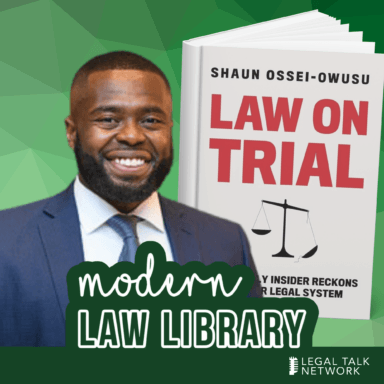
Shaun Ossei-Owusu is a legal scholar with expertise in legal history, criminal law and procedure, civil rights,...

Lee Rawles joined the ABA Journal in 2010 as a web producer. She has also worked for...
| Published: | May 27, 2026 |
| Podcast: | Modern Law Library |
| Category: | News & Current Events |
When Shaun Ossei-Owusu looked around at his classmates at UC Berkeley School of Law, there were many upper middle class children of lawyers who were coming straight from their undergraduate degrees. There were not many people like him, a child of Ghanaian immigrants who grew up in an impoverished South Bronx community and was now finishing his PhD as a returning student.
That background and his academic training gave him a different perspective on the law school curriculum. For example, his Property Law class was mostly focused on the ins and outs of titles and transfers.
“It was strange to me, particularly being going to school at Berkeley, how little the class said about homelessness,” Ossei-Owusu tells host Lee Rawles in this episode of the Modern Law Library. “We have about 750,000 people in this country who are unhoused in any given night. And this is the course, Property Law, that’s most directly concerned with how we organize access space and shelter. And the course doesn’t say much about homelessness. And so I felt that that was strange, but I didn’t want to be the student in class saying, ‘Well, why aren’t we talking about this?’ ”
Ossei-Owusu went on to practice healthcare enforcement law at Sidley Austin, and worked for the Legal Aid Society of the District of Columbia. His time as a litigator and public interest lawyer gave him a look at how law school principles fared in real world situations.
“Lawyers are implicated in many of the hot-button issues of the day, and much of that is tied to the ways that we train lawyers in law school to distance legal reasoning from social and moral consequences–and the ways they bring that habit into legal practice, whether it be BigLaw, public interest lawyering, or government lawyering,” Ossei-Owusu says.
It’s something he now thinks deeply about as a professor at the University of Pennsylvania Law School who focuses on criminal justice, social welfare and professional responsibility. In Law on Trial: An Unlikely Insider Reckons with Our Legal System, he calls out the ways this early training can result in further injustice and inequality for society.
“Professional ethics say your job is to primarily serve clients, which creates an inevitable distance between what lawyers do and who pays the price,” writes Ossei-Owusu in Law on Trial. “The result is a system that trains smart people to engineer brilliant solutions while staying disconnected from the human wreckage they may leave behind.”
In this episode of the podcast, Ossei-Owusu and Rawles talk about the hard truths of public interest legal work, how regulatory work can sometimes have more impact than litigation, and and how good intentions alone cannot erase harm.
Lee Rawles:
Welcome to the Modern Law Library. I’m your host, Lee Rawls, and today I’m joined by Shaun Ossei-Owusu, author of Law on Trial: An Unlikely Insider Reckons with our legal system. Shaun, thanks so much for joining us.
Shaun Ossei-Owusu:
Thanks for having me, Lee.
Lee Rawles:
So when you give people an elevator pitch for what law and trial is about, what do you tell them?
Shaun Ossei-Owusu:
I say that the elevator pitch is that lawyers are implicated in many of the hot button issues of the day and much of that is tied to the ways that we train lawyers in law school to distance legal reasoning from social and moral consequences and the ways they bring that habit into legal practice, whether it be big law, public interest lawyering, or government lawyering.
Lee Rawles:
And you have two interesting perspectives on this, on as a non-traditional law student and one as a law professor. Can you give people an idea about your own background?
Shaun Ossei-Owusu:
Sure. So I grew up in the Bronx in a working class neighborhood. I’m an 80s baby.That neighborhood is not an expected pipeline into an Ivy League law professorship. And that distance I think is part of the engine of the book. I went to Northwestern for college and taught at a charter school after college was trying to figure out if I wanted to do law school or grad school.
Lee Rawles:
So you picked both.
Shaun Ossei-Owusu:
I did, but I started with a PhD in part because I felt like I had a kind of intellectual curiosity that I didn’t think law school would satisfy just because the first years consists of required courses. And then after that, there are some classes that you probably should take. Whereas I thought a PhD would give me an opportunity to explore some of the questions that I was thinking about, many of which had to deal with law and ended up writing a dissertation about the history of public interest lawyering, which is the topic of my second book, but still kind of oriented around law. So I matriculated to the law school at Berkeley, which was also where I did my PhD, practiced at a law firm, did a short stint in public interest work and ended up coming into academia. And so the title of the book has the term unlikely insider.
I say that I’m an insider because I’m a law professor. I’m responsible for training the next generation of lawyers. But at the same time, in terms of demographics, I don’t come from where the typical law professor comes from, but I’ve also never lost that kind of outsider view that asks questions about why the law is working the way it does. And that’s also kind of one of the engines of the book.
Lee Rawles:
One of the things I found really fascinating and want to hear more from you about is that the genesis of much of this material also comes from a journal you started keeping with yourself to sort of, and I don’t want to put words in your mouth, but stay in touch with, this is what I am thinking about right in this time. They may not be thoughts I can say out loud in this law school classroom because my professor and the other students are coming from a really different spot in the way they consider this, but this is so weird to me. Can you talk a little bit about how you used that journal and what it helps tell you now about the experiences you were going through?
Shaun Ossei-Owusu:
Yeah. So I pretty much wrapped up my PhD the first year of law school. And so I came into it kind of differently situated than many of my classmates. I was a little older. I felt comfortable with a lot of the material intellectually and substance-wise it’s a different story, but I think I came in with a certain kind of intellectual maturity, but I also, I wrote a lot because I was in an academic and I had a fantastic time in law school at Berkeley Law and have relationships with many of the professors that I had there, but I noticed some oddities as it related to the curriculum in terms of some of the things we were discussing and didn’t discuss. And much of what I described in the book is just a byproduct of how these path dependent ways, the path dependent ways in which many of these courses are taught.
And so you take 1L criminal law, for example, much of the content focuses on street crime. So assault, robbery, homicide, these are serious crimes, but oftentimes the course says little about white collar crime and I don’t think that that silence is neutral. When you train an entire profession and think about crime in that lens, then you normalize the idea that wrongdoing looks like someone in the corner as opposed to someone in the boardroom. And that was something that in class we talked about a few white collar crimes, but to me it was interesting, not just in my class, but talking to classmates in other sections, how little we talked about white collar crime. So that was one example that came to mind as a journal. In property law, you spend much time talking about the rules that govern ownership of property. So who has title, how does it transfer, what you can do with land?
And it was strange to me, particularly being going to school at Berkeley, how little the class said about homelessness. We have about 750,000 people in this country who are unhoused in any given night. And this is the course property law that’s most directly concerned with how we organize access space and shelter. And the course doesn’t say much about homelessness. And so that felt that that was strange, but I didn’t want to be the student in class saying, “Well, why aren’t we talking about this? ” I think now that I’m on the other side of the podium, I recognize how students can sometimes lead a course astray in ways that a professor might not intend to. And so I figured I journal about this and I continued to journal about it in practice when I was at the law firm and when I worked at Legal Aid Society, just kind of writing about things that didn’t necessarily feel like they would be top of mind for everyone else, but were things that I wanted to return back to and ended up forming some of the substance of the book.
Lee Rawles:
And for listeners, I would say that the book breaks down into four main sections. You look at law school, government law, public interest lawyering, and big law. So those are all topics that Shaun has direct experience with and really dives into. But to stay with law school, I’ve never been to law school, but something that I’ve heard as legal journalists people say about it is law school is about teaching you how to think like a lawyer. And you talk about this in the book and you point out that some of this process where we’re telling students this is how you think as a lawyer is asking them to deny their human experiences or what they’re actually seeing with their own eyes and focus instead on a much tighter view. Can you talk about this idea that law schools have about how to teach students to think like lawyers?
Shaun Ossei-Owusu:
Yeah, I think this is one of the central arguments of the book and that is law schools endow students with what I call a tragically necessary skill and that’s the ability to separate legal reasoning and legal content from their social and moral consequences. And it’s I think tragically necessary is a right way to describe it because it’s a necessary skill. The analogy that I like to use is it’s kind of similar to a patient who comes into a doctor’s office describing pain to the doctor. The doctor then has to take the description. Sometimes the description is unsophisticated or clouded by the pain that the patient is in, but to take that language and translate it into symptoms, diagnoses, reimbursable insurance codes and law sometimes involves a similar process, but part of what I argue is that in some instances, not all, it can overcorrect and the kind of human background, the human content can fade into the background.
And so when you’re dealing with an example that I like to use is something like abortion, highly controversial issue and putting aside whether one is pro- choice or one is anti-abortion, legal analyses often require students and lawyers to understand abortion through the language of due process, privacy, as opposed to it being a deeply moral topic, whether it be people believing about the immorality of forcing a woman to carry a fetus to term or the immorality of proceeding with an abortion. That stuff fades into the background and we end up talking about abortion through the language of state’s rights and privacy. And so part of what I discuss in the book is how there are many issues like that that end up getting the kind of human element can fade into the background as legal categories and legal content take a certain kind of prominence.
Lee Rawles:
Yeah. One thing that registered with me was you describe sort of a client intake interview that I’m sure some of my lawyer listeners have had where the person comes in and you say essentially, why are you here? And they start telling you a long involved story that includes family history and then their brother-in-law did this. And you do need this skill to be able to discern, okay, what you are coming to me with is a bankruptcy law issue or this is trust in estates. So you do need to be able to do that as a lawyer, but then how do you keep from losing your humanity and your understanding of how the law is not necessarily neutral in its impacts? And yeah, so I thought that that was really interesting. And I wonder what you do as a law professor to help mitigate that for your students.
Shaun Ossei-Owusu:
Yeah. I mean, it’s a challenge. And one of the things that I describe in the book that I try to be pretty repetitive about is how I’m implicated in what I’m critiquing as a law professor and how I try to break out of some of those habits. In terms of what I do, I mean, I try to do a few things first in the beginning, I teach 1L criminal law. I would say that’s the class where you’re most likely to see some of what I’m describing in the book. And part of what I do in the beginning of the class is remind my students that we have, it’s hard to even call it a privilege, but we are here spending a semester learning criminal law by way of various kinds of trauma that’s been inflicted on people. We’re talking about assault. Well, we’re talking about homicide.
We’re talking about robbery. We talk about white collar crime as well. But I try to remind students just in the beginning as an anchor that these are all cases involving real human beings who have been harmed. And I think that’s easy to forget where you’re taking a class and trying to excel in it and get an A so that you can get the job that you like. So that’s one thing that’s important. Another thing that I try to do is I try to be pretty interdisciplinary in my teaching. And so I don’t rely just on court cases or case books like some professors do, but I try to be pretty aggressive about bringing in different kinds of material, whether they be reports, articles, YouTube videos, as well as bringing in different ideological perspectives, which I think can shake up the students’ priors about how the criminal legal system operates.
And so that’s what I would say would be the kind of primary ways, at least in that course, that I try to bring in that kind of human content.
Lee Rawles:
Well, we’re going to take a quick break to hear from our advertisers. When we return, I’ll still be here speaking with Shaun Osei Awusu about law on trial Welcome back to the Modern Law Library. I’m your host, Lee Rawls here with Shaun Osea Wusu talking about law on trial. So Shaun, we’ve discussed the law school part of your book, but you, as I said, also get into big law, government law, public interest law. And I would love for our listeners to hear a passage from your book that deals more with that subject. So would you mind reading an excerpt for us?
Shaun Ossei-Owusu:
Absolutely. So the passage that I’m going to read from is chapter 10, which is titled Transactional Violence, Healthcare and the Afterlives of Mergers and Acquisitions. And it’s about how big law attorneys shape our healthcare environment. For people who have the book, it’s page 229 of the book. Come with me to the 45th floor of a big law firm in downtown Chicago. We’re talking about the kind of building where you need a key card to ride the elevator past the 20th floor. You can see Millennium Park, Soldier Field, and Lake Michigan with ease. The conference room has floor to ceiling windows, pristine conference tables, comfy leather chairs, and technology that you didn’t even know existed. A partner from the Mergers and Aquisitions Group, M&A, is walking colleagues and his client through a PowerPoint presentation about a hospital acquisition that will affect how three million people access healthcare.
He sounds like a corporate poet. He tells a story of “improved efficiency” cost savings but conveniently underplays what might get lost in pursuing those gains. This wasn’t my world when I practiced. I was in litigation M&A’s louder, messier courtroom cousin, but this room isn’t foreign. I know this world as a distant observer, a practitioner, and as someone who teaches courses on the legal profession and law firms. Most of my Get Money lawyer friends practice in the transactional trenches, some conversant in the language. I know that quote strategic right sizing likely means mass layoffs.That portfolio optimization is code for shuttering services that don’t generate enough profit. How quote stakeholder value maximization can translate to shedding staff and squeezing every dollar possible out of what is supposed to be a place of healing. Legal education in the legal profession reward this kind of fragmentation. Law schools teach you to break down complex social problems and practice rewards lawyers who can move fast and bill hours without getting distracted by externalities like community harm.
Professional ethics say your job is to primarily serve clients, which creates an inevitable distance between what lawyers do and who pays the price. The result is a system that trains smart people to engineer brilliant solutions while staying disconnected from the human wreckage they may leave behind.
Lee Rawles:
Yes, that is powerful. One of the other sentences that has kind of stayed with me since reading the book and I’m paraphrasing here, but you say you don’t have to be evil to further injustice. Sometimes all you need to do is your assigned job. And I think about the way we do ask lawyers to defend things that they may find morally indefensible, but we have these principles about, well, everyone needs a sturdy defense and someone has to defend them. And it all feels very fraught. And the way that we ask lawyers to divorce themselves from the impact of the work they’re doing sometimes feels a little unfair to them as people. And I wonder how much of the mental health crises we see in legal profession have to do with this ask that we bifurcate our human caring and our professional responsibilities.
Shaun Ossei-Owusu:
Yeah. I mean, I would say there definitely seems to be some connection. The empirical studies have shown that there are higher rates of alcohol use and drug use in the legal profession. I’ve kind of seen it firsthand, particularly alcohol use. You don’t see the same amount of alcohol consumption in some professions like you do in the legal profession. And I also think some of it is kind of tied to how we train lawyers, the kinds of conversations that we have in law school. It’s not something mental health is not a required part of the curriculum to the extent that it comes up. It might come up in the required professional responsibility course, but not everyone discusses it. And I do think that there’s a way that the kind of moral desensitization that lawyers and students are encouraged to go through can promote or facilitate maladaptive behaviors.
Lee Rawles:
Well, one thing I particularly appreciated about your book is I feel like we are used to having more of a conversation about the ways that, say, big law work can impact inequality or favor more powerful people and institutions over the powerless. But you have a wonderful section of the book where you really dive deep into public interest lawyering, which sometimes feels a little bit like a third rail. You’ve worked for legal aid. Can you talk about your experience in public interest law and what you wanted to address with that community in the book?
Shaun Ossei-Owusu:
Sure. Yeah. So this is a topic that is deeply important to me. I mean, much of my scholarly work is about public interest lawyering. And so it’s the topic of my next book, which will be published by Princeton University Press next year. It’s a history of public interest lawyering from the founding era to today. And this is the topic that I’ve been thinking about for the past 15 plus years. And it’s a delicate topic in part because public interest lawyers are oftentimes the only institutional legal allies of vulnerable people. And depending on the lawyer, oftentimes these are people who passed on taking high paying jobs to do this work and sometimes incurred significant debt to engage in representation of vulnerable communities. And I think part of what I’ve learned is it’s kind of hard to have honest criticisms of this section of the bar because they sacrifice so much.
Although I’ll say that I’ve encountered many public interest lawyers who are pretty reflexive and open to hearing or being engaged in certain kinds of self-assessment. And part of what I try to do in the book is first explain how we might think about public interest lawyering, because there’s really two, I would say, kind of two kinds of public interest lawyering. One involves direct legal services. And so these are lawyers who are helping people with immediate problems. So criminal representation, someone’s being prosecuted on a civil legal aid side, helping with things like public benefits, so think Medicaid or SNAP, food stamps, helping with evictions, helping with immediate problems. And then there’s what’s called impact litigation. And so that involves lawyers who are essentially trying to use courts to change social policy and it doesn’t involve the same kind of interface with clients, the same kind of immediate interface, but it’s more slow moving and it’s focused more on using courts to affect policy change
Lee Rawles:
A lot of appellate law. Yeah.
Shaun Ossei-Owusu:
Exactly. And so in that context, in the direct services context, if you live in a big city, you might think of whatever legal aid society is in your city. So Legal Aid Society of New York or community legal services here in Philadelphia, Legal Aid Society of DC, whereas the appellate work you might think of a place like the ACLU or NAACP or LDF or the Alliance for Defending Freedom or the Institute of Justice and Conservative and Libertarian Impact Organizations. And so the first thing that I try to do in the book is really describe some of the structural conditions that shape public interest lawyering and play a role in some of the kind of critiques that I have. And there I describe the ways that public interest lawyering really flowered in the 1960s in terms of working hand in hand with the civil rights movement to expand certain kinds of rights and how there was a backlash to that kind of lawyering in the 1970s by Congress and the Supreme Court that really limited the kinds of work that federally funded legal aid attorneys could perform and made their lives harder and that’s against a larger backdrop of these lawyers being chronically underfunded.
And so what that means is you oftentimes have the most vulnerable people getting the most overworked lawyers and there are ways that they can be complicit in different kinds of inequality, whether it be their exhaustion that leads them to engage in subpar lawyering, subscribing to certain kinds of implicit biases, treating all cases similarly because they are overworked and not necessarily being engaged in the kind of individualization that you might see if they had more time or if they worked in an office with more attorneys. And that’s just in the context of the delivery of legal services. I try to say a little bit about the composition of these organizations and scholars have referred to direct services as a pink ghetto because women are overrepresented in this field, which I think says something about how we devalue the kinds of care work that these lawyers are engaged in.
But at the same time, if you look at the boards and the leadership of many public interest organizations, they’re overwhelmingly white, not withstanding the client populations that they serve. And in some of those places, they serve majority white client populations and in some of those places they don’t. And so in that latter instance, that means that these organizations are delivering legal services through structures that mirror the kinds of hierarchies that their clients face, whether it be racial bias, sexism, et cetera.
Lee Rawles:
I was really reminded of my time with various nonprofit organizations while reading this section, particularly when I was in college, I worked for a place called the Crisis Nursery and it was a nonprofit. It was caring for children who needed immediate care, whether that’s because their parent had a job interview and someone just needed to watch them for two hours, or they’d been removed by social services and were still waiting for a foster care home, or they had a single parent who needed some sort of respite care. There were many reasons why children might come to us, but there were structural inequalities within it as well where you look and the people with the higher managerial jobs were generally women with master’s degrees, white women with master’s degrees and the majority of the women providing direct childcare were black women who in some cases were still working on a GED, but may have raised upwards of 40 children.
I’m thinking of one woman in particular here. And what I will say is the things that I witness, good intentions do not erase harm. And I thought about that a lot when I was reading this section and it is good for us to look at what harm we may be contributing to no matter what you may internally feel or your good intentions, but it’s hard because people want to not discourage work in this area, you know what I mean? They want people to do this social facing work and so they don’t want to discourage people from engaging in it, but they also don’t want to reckon with the more ugly sides of it.
Shaun Ossei-Owusu:
Yeah. And I think part of what you described is really a challenge for a broader category of work that people sometimes refer to as kind of the helping professions. So you think public interest lawyering, social work, education, all of the people who work in these fields are doing socially valuable work, but to the point that you just made, we can’t let good intentions immunize people from critique because in that instance, anyone can claim good intentions and not have to reckon with the ways that they might be implicated in some of the structures that they seek to dismantle or the harms that they want to address
Lee Rawles:
The other thing I think about when you think about the clients themselves who need this legal aid, I think about the people who would come to the nursery and drop off donations, but the donations would be broken toys, torn and stand clothing and they would become very offended when I would say, “I’m sorry, I could accept this. ” And they would say, “What do you mean?” And I would think to myself, “You wouldn’t give this to your children and my children here are just as valuable as your children. They too deserve clean clothes and unbroken toys, but you think that they should be willing to accept this subpar stuff.” And honestly, that is the way that legal aid sometimes shakes out as well. Well, aren’t you grateful that you have anything?
Shaun Ossei-Owusu:
Yeah. I mean, I think that is a separate challenge and that many of the people who receive legal aid in the absence of that kind of assistance likely wouldn’t get any kind of legal aid at all.
And that’s one of the differences between public interest lawyering and lawyering more generally is that particularly if you think about it in connection to my discussion on big law in the book, clients can monitor the behavior and impact of behavior of their lawyers in big law by threatening to change lawyers, certain kinds of reputational consequences if general counsel at A T&T or Verizon doesn’t like the service they’ve received from Skadden or Paul Weiss or insert law firm here that can have reputational consequences in ways that might incentivize lawyers to perform differently. But that same kind of ability to leave or reputational consequences don’t necessarily exist for legal aid attorneys because the clients don’t have that option or ability to leave. And so I think that in some ways that’s tied to the idea that it’s this or nothing and that clients should be satisfied with the kinds of services that they receive, which I want to be clear, are sometimes pretty good and come from dedicated lawyers.
And in some instances it’s suboptimal and many public interest lawyers have publicly admitted that.
Lee Rawles:
We’re going to take another break to hear from our advertisers. When we return, we’ll still be discussing Law On Trial, an unlikely insider reckons with our legal system. Welcome back to the Modern Law Library. I’m Lee Rawls here with Shaun Oseousu. So Shaun, let’s circle back and talk about the … We talked about the direct services folks. Let’s talk about the interest groups that do public interest law because I thought this was a really good and interesting part of the discussion was the impact that these organizations can have and how they sometimes exacerbate inequality rather than remove it.
Shaun Ossei-Owusu:
Yeah. And this is, I think, also one of the harder chapters to write. And I think part of it is tied to this idea that in some ways inequality and harm is in the eye of the beholder and in that way it can be perspectable. And so I think a great example is a Supreme Court case from a few years ago, the Bruen case, which expanded the Second Amendment right to bear arms. And so essentially you have these two competing perspectives that are tied to what were understood as restrictive gun laws in New York State. And there was one view, the kind of NRA view that said these laws infringe on important Second Amendment rights and make it harder for people to get guns. That’s a perspective people are familiar with. But what was interesting is that some public defenders in New York wrote an amicus brief in support of the position that the NRA was advocating from.
To be clear, this is an instance of strange bedfellows, but the public defenders made good claims. They were saying essentially that our clients are oftentimes Black and Latino men who are overpoliced because of restrictive gun laws. They’re not able to exercise their Second Amendment rights like people in rural Pennsylvania 60 miles away. And so having restrictive gun laws means the people who are often subject to them are marginalized racial minorities. And I think that that is a perspective that some people can sympathize with. On the flip side, you had some civil rights advocates saying loosening restrictive gun laws is only going to impact poor communities. It’s going to impact women and women of color who are subject to domestic violence. And that’s also a view that many people can be sympathetic with. And so part of what I’m arguing is that in some instances, not all instances, but in some instances, these cases that make their way through appellate courts involve competing ideas of harm and inequality that lawyers are implicated in and that we need to think about a bit more critically.
Lee Rawles:
Well, let’s get to the thinking more critically part. You said in your book that you knew you needed to have a conclusion because everyone told you, even though really you were trying to lay out what the current issues are for these areas, but you do have some space devoted to, okay, so the people who are concerned about this, whether they be lawyers or non-lawyers, what can they do about it? And one thing that stuck out to me was this idea of accountability partnership for lawyers. Can you talk about that a little bit?
Shaun Ossei-Owusu:
Yeah, I think it plays out in a bunch of different ways, but part of what I think particularly for public interest lawyers, part of what I’m encouraging is a certain kind of reflection that I do think some of them engage in, but some might not either by way of overconfidence in their politics or just time. These people are overworked and dealing with people in crisis and may not have the space for that kind of reflection. And so part of what I encourage people in that field to do is before even entering it to ask themselves in writing, how do you understand the social distance between you and your clients? What do you think makes you qualified for the job? What do you know about the history of the community that you’re serving? And sharing that with trustworthy individuals, whether they be supervisors, fellow attorneys, social workers, community organizers, and really being introspective about that and having accountability partners that can help them think critically about the work that they’re doing.
And I think there’s a version of that that you could imagine across public interest lawyering. And so there, I think it’s easy to say, I engage in introspection and I’m thinking critically about it, but when you’re having active conversations with like- minded people who have similar politics, I think that can hopefully encourage us to be a bit more intellectually honest about the job that we’re doing.
Lee Rawles:
So you dedicate an entire section of the book to big law and law firms. Can you share with listeners what you were hoping to get across to people who work in law firms?
Shaun Ossei-Owusu:
Yeah, I think part of what I was trying to do was complicate some of the narratives that are fed about law firms as general matter. And I started thinking about this again more than a decade ago, but also some of the narratives that we see now, particularly with how some law firms have responded to President Trump’s executive orders. I think that there’s a way that law firms are either villainized or valorized. And so you see some of the firms that made deals with the administration or that were villainized for doing so. And part of what I tried to describe there is that these are businesses that are focused on their bottom line. And at the same time, some of the firms that fought back were valorizers at places where students with commitments to rule of law should go. And I think in that context, these are businesses that were trying to protect their bottom line that were being locked out of lucrative work.
I think that what we know what’s happening with the law firms and executive orders is important in part because law firms engage in socially important work, much of which is pretty mundane and uncontroversial, some of which is. But I actually think that some of this is a sideshow to some of the more consequential work that law firms engage in that is related to issues of inequality. And so part of what I describe in the book is some of the work is, again, uncontroversial. People may not care about Nike suing New Balance or Apple suing Samsung, but because these law firms represent deep pocketed clients, it means that they sometimes represent big corporations whose interests sometimes conflict with the general public or marginalized communities. And so a perfect example is workplace litigation. And so sometimes these firms are representing big corporations that are accused of race, sex, religious, and disability discrimination, violations of Title VII and the ADA.
And sometimes those claims are frivolous and don’t have merit, but sometimes they do. And in that instance, these law firms are enabling forms of inquality in the workplace just by doing their job and providing the kinds of representation that these corporations are entitled to. And that’s an important part to underline is that these people are not evil. They’re doing their job and doing their job sometimes means undermining legitimate claims of workers and sometimes setting precedent that impacts employees more generally. And so I think it’s important to have a more sophisticated view of what law firms are doing and how that impacts the lives of the average non-lawyer in ways that extend beyond the brouhaha around the executive orders. Well,
Lee Rawles:
And I loved what you said too. You mentioned already you come from a litigation mindset and background, but a lot of what ends up directly impacting people is this more regulatory work and no one has made a law and order tax division or law and order housing enforcement. But as non-Hollywood, as these areas of law may be, these are some of the most impactful areas. We think of it as boring, but it really makes a difference.
Shaun Ossei-Owusu:
Yeah. I mean, there are more regulations than statutes and constitutional provisions and much of the uncontroversial work law firms perform involve helping their clients navigate those regulations. And so that’s an important work that they do. And at the same time across sectors, whether it be finance, healthcare, food, drug regulation, the environment, which I discussed in the book, there are instances where helping their clients navigate regulation can sometimes rub up against the kind of general welfare or public interest. And part of what I’m trying to do is fairly describe that tension without villainizing or valorizing law firms.
Lee Rawles:
Yeah. Helping your client get a permit passed may end up polluting local waterways.
Shaun Ossei-Owusu:
Right, right. And again, legally entitled to do that and the lawyers and the clients are engaged in rule following so they’re not breaking the law, but you cannot break the law and contribute to environmental degradation and climate change. I think that’s something that we have to be a bit more honest about.
Lee Rawles:
Well, there is so much more in this book, which again is law on trial on sale now, but as we finish our conversation, what are you hoping people who have read the book come away with? What are you hoping to reach readers with and to have them then go forth and discuss or think or do?
Shaun Ossei-Owusu:
Yeah, I think I’m trying to do a few things. One, I’m really trying to make the law accessible to non-lawyers as well as prospective law students and people who are thinking about law. But really for general readers who may not be going to law school but want to understand a variety of the hot button issues of the day, whether they be climate change, economic inequality, housing, healthcare, the criminal justice system, constitutional law. So I think at a baseline, I want to make the law accessible to people who are never going to spend $200,000 on a legal education. And I think after that, I think part of what I want to do is describe to those readers as well as, again, prospective lawstudents, current law students, current lawyers, et cetera, that the legal profession, we tell ourselves certain fictions and certain myths about the work that we do and some of those are important myths and fictions that allow us to do the work that we do, but the general public need not beholden to those legal conclusions.
And so just because for example, a police brutality case fails because it doesn’t meet the statute of limitations, that does not mean that police brutality did not occur. And so I think the key thing in providing readers with the language and the logic of the law is to equip them to understand some of the social inequalities that they see and not be beholden just to legal interpretations, but their own understandings of what is happening in law and in our society.
Lee Rawles:
And I would echo what you say about people who are thinking about law school picking up the book because it laid out more clearly than any other source I’ve really seen for lay people. What does law school look like? What are the classes you take? What’s the process? I enjoyed that as well as someone who has not gone to law school. Shaun, if people are interested in picking up the book and talking to you about these things directly, is there a website that you would point them to?
Shaun Ossei-Owusu:
Yeah. So I teach at the University of Pennsylvania Law School, that’s where most of my information is and the articles that I’ve written, I’m on X and my handle on X is Prof Oseowusu, P-R-O-F-O-S-S-E-I, O-W-U-S-U. I’m on LinkedIn. My LinkedIn account is the same name. I’m on Blue Sky and my Blue Sky handle is the same as Twitter, prof, Osayawusu. I don’t have a big social media imprint. It’s relatively modest, but I’m happy to engage folks who want to chat about the book and I hope they pick it up and learn something from it and that it’s useful.
Lee Rawles:
Well, thank you again to Shaun and thank you listeners for joining us for this episode of The Modern Law Library. If you enjoyed this episode, please rate, review, and subscribe in your favorite podcast listening service. And if you have a recommendation for me about a new author to speak to, you can always reach me at [email protected].
Notify me when there’s a new episode!

|
Modern Law Library |
Modern Law Library features top legal authors and their works.