
Daliah Saper is a member of the Illinois Bar and the General and Trial Bars of the...

J. Craig Williams is admitted to practice law in Iowa, California, Massachusetts, and Washington. Before attending law...
| Published: | May 15, 2026 |
| Podcast: | Lawyer 2 Lawyer |
| Category: | Legal Entertainment , News & Current Events |
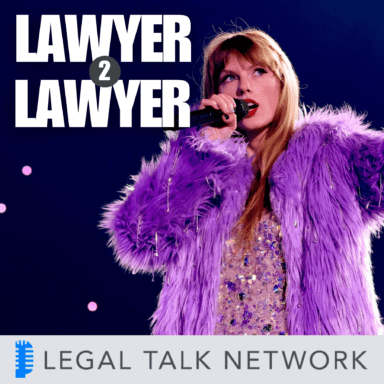
The rise of artificial intelligence has created new legal challenges around identity and consent, especially for public figures like Taylor Swift. In response, Taylor has recently taken matters into her own hands by filing trademark applications to protect her voice and image from AI.
On this Lawyer 2 Lawyer episode, Craig welcomes Attorney Daliah Saper, Principal at Saper Law Offices. Craig & Daliah discuss spotlight trademark law, AI, trademarking voice and image, and how AI has changed the game when it comes to trademark protection for celebrities and non-celebrities.
Mentioned in this Episode:
Legal Issues Surrounding Social Media Featuring Daliah Saper (2010)
Attorney Daliah Saper is Principal at Saper Law Offices. Daliah’s practice focuses on a number of practice areas including trademark, copyright, and entertainment law.
Special thanks to our sponsor 8am.
Daliah Saper:
It’s not just the phrases alone, it’s really the sound recording. So she’s trying to embody this particular sound along with those phrases. So if she had just filed for the words, she might have a harder time. But what she’s claiming really is that the sound recording of those phrases is what’s distinctive and it’s when people hear that sound, not just the phrases by themselves, it would be infringing. So to prevent someone from trying to, again, especially with AI, feeding that sound and trying to replicate it.
Announcer:
Welcome to the award-winning podcast, Lawyer 2 Lawyer with J. Craig Williams, bringing you the latest legal news and observations with the leading experts in the legal profession. You’re listening to Legal Talk Network.
J. Craig Williams:
Welcome to Lawyer Lawyer on the Legal Talk Network. I’m Craig Williams coming to you from Southern California. The rise of artificial intelligence has created new legal challenges around identity and consent, especially for public figures like Taylor Swift. In response, Taylor has recently taken matters into her own hands by filing trademark applications to protect her voice and image from AI. In this episode, we’ll spotlight trademark law and AI. We’ll discuss trademarking voice and image and how AI has changed the game when it comes to trademark protection for celebrities and non-celebrities. Without further ado, we’re joined by our returning guest, Attorney Dalia Saper. She’s principal at Saper Law Offices. Her practice focuses on a number of areas including trademark, copyright, and entertainment law. Welcome back to the show, Dahlia.
Daliah Saper:
I am so happy to be back. Thanks for having me.
J. Craig Williams:
And we’re thrilled to have you back. Well, tell us what’s going on with Taylor Swift and Trademark Law. What is she doing?
Daliah Saper:
Well, Taylor Swift is an iconic pop star. She sells lots of records and due to her celebrity, she obviously has copyrights in her music. She has the rights of publicity as it relates to her persona. And she is now adding trademarks to her arsenal of intellectual property rights and seeking to not protect just her name in the traditional sense, but also her sound, her voice, clips of her voice saying certain things in connection with certain services. And so it’s somewhat novel. Matthew McConaughey is the one who really spearheaded this strategy. I don’t know why he didn’t get as much love as Taylor is, but he’s the one who’s kind of paved the path for Taylor to employ this strategy to not only register traditional trademarks, but also sound marks.
J. Craig Williams:
Is she trademarking the sound of her voice or is she trademarking phrases?
Daliah Saper:
Specific phrases that are necessarily of her voice, so like one for Spotify. So yes, it’s not her voice in the abstract. It’s certain catchphrases and things she’s saying in connection with particular services.
J. Craig Williams:
Do you think it would be possible to actually trademark the sound of your voice?
Daliah Saper:
It’s potentially possible. You’d have to really have a voice that has secondary meaning, that consumers regularly understand it to be this particular person’s voice. And I think that’s where these marks are developing and going, the threat being that AI is able to replicate your voice. We’ve seen cases involving voices in right of publicity. There’s a Barbara Streisand case where they had a sound alike. And so we’re no strangers to this concept of sound alike, but they’ve always been state-based right of publicity cases. What’s novel here is we’re trying to assert a commercial use in connection with a trademarked voice or sound. And I don’t think that’s as available to the regular person as it is someone who can say, “People hear this and know it’s Taylor Swift or they know it’s Matthew McConaughey or pick your celebrity of choice.” Well,
J. Craig Williams:
And the ultimate question is how many people need to know that? I mean, we’ve been doing this show for 20 years. I would like to think I’ve got a distinctive voice. What’s the realm? Can I trademark phrases of my voice like welcome to Lawyer to Lawyer or Legal Talk Network?
Daliah Saper:
Well, we’ll find out. In the all right all, right, all right case, Matthew McConaughey’s mark I think was cited against All Right TV and the office action response spent a lot of time proving through Google searches and evidence to show that when you hear this particular phrase and this particular cadence, it means again, I’ll use Matthew McConaughey as the example. So I don’t think the average person will have the ability to bring these sound mark filings or file them in the way that celebrities can because especially if you’re trying to trademark phrases that are regular phrases, you’re going to have to jump through that extra hurdle to show that your sound is distinctive as trademark law defines that term.
J. Craig Williams:
Right. I would think someone would understand, “All right, all right, all right,” from Matthew McConaughey and I can’t think of anything that Taylor Swift says that is an equivalent.
Daliah Saper:
Right. So Taylor Swift’s marks are new applications. I don’t know how the trademark office will receive them if they’ll push back on the nature of the filing, how they’ve been presented. So it’s kind of a wait and se. The only blueprint we have is the all right all right one and whether or not the way she’s presented those sound recordings are sufficient to survive the scrutiny of the examiner that gets assigned to her file.
J. Craig Williams:
Is Taylor Swift attempting to trademark anything internationally or is this just a United States trademark?
Daliah Saper:
This is a United States trademark. So for those who are not trademark practitioners, trademark law is really a country by country effort. And so there is no way to unilaterally or just singularly protect a brand across the world. You’d have to go to each country to file your registration. Some countries are first to file some are first to use. The United States is a first to use. And so right now she’s filed as far as, to my knowledge, marks before the United States Patent Trademark Office.
J. Craig Williams:
How is this trademark different than a copyright? She copyrights her songs, but how is this trademark different than that?
Daliah Saper:
Well, so let’s discuss IP 101. I don’t know the level of savvy of your listeners, but if you’re not an IP lawyer, it’s important to understand the distinction between the different IP, the intellectual property areas of law. So under that bucket, you’ve got trademarks, copyrights, patents, and a sibling of those which would be trade secrets. But trademark law and copyright law protect very different things. Copyright law protects the actual music. It protects the image, it protects video. All of those are creative works. The trademark singularly protects something that serves as a source identifier as a brand, meaning when I see or hear this particular thing, I know that this particular person or company is selling that good or service. So while she already can rely on her copyrights to enforce any infringement of her music or her pictures and video, she can now also use trademark law to go and enforce her rights throughout the United States versus filing, let’s say, right of publicity cases on a state by state basis, depending on the nuances of who you can sue and where you can sue procedurally when you’re dealing with right of publicity cases.
J. Craig Williams:
So the right of publicity is state by state and not federal?
Daliah Saper:
No, and it’s very interesting. In fact, some states believe that right of publicity is a property right and others believe it’s a personal right. If the state believes it’s a property right, then the heirs to that celebrity can enforce that publicity right for years after the death of the celebrity. I mean, Elvis or Martin Luther King’s estate is very litigious. And I won’t say litigious, but they enforce the rights to MLK’s persona, all of his work. So if you are a celebrity, you have a challenge of determining who you can sue, where you can sue, what that particular state’s scope of right of publicity laws are, whether they extend to just the person’s name and likeness or even literal face and name or broader towards their likeness. Maybe the way they sing or the way they have a catchphrase that’s associated with them. So some states have very little or no law in the books related to right of publicity.
So you have to fashion a claim out of common law or case law. Others have robust statutes, but again, you have to navigate that every time, which state to file and how to file. If you can rely on a trademark, you will just fashion as a traditional trademark suit. It’s an unfair competition on the federal level, the nature of the use is some sort of a false association. It’s counterfeit, it’s infringing, depending on, again, how that voice is used by the bad guy.
J. Craig Williams:
Well, Taylor is, I think, seeking sounds for two marks. Hey, it’s Taylor and hey, it’s Taylor Swift. How is she going to go about establishing the validity and the recognition of those two phrases in her trademark application?
Daliah Saper:
Well, it’s not just the phrases alone, it’s really the sound recording. So she’s trying to embody this particular sound along with those phrases. So if she had just filed for the words, she might have a harder time. But what she’s claiming really is that the sound recording of those phrases is what’s distinctive. And it’s when people hear that sound, not just the phrases by themselves, it would be infringing. So to prevent someone from trying to, again, especially with AI feeding that sound and trying to replicate it.
J. Craig Williams:
Now, has AI just copied the sound or has it actually imitated the sound?
Daliah Saper:
Depends on the use case. A lot of platforms are not preventing … You might say, I think I just did this as a joke. I was like, “Make me whatever, a sound recording that sounds like Donald Trump use this. ” And he says, “Well,” and it literally gave me a pushback, said, “We are not allowed to, or you’re not allowed to use people’s persona.” And that’s because of regulation, industry pressure and laws that are starting to be passed in a variety of states piecemeal that prevent this kind of unauthorized misappropriation of one’s likeness. So the answer to your question is, I don’t know, depending on the platform, even if you use a sound alike, if it’s intended to serve as a source identifier to trade on the goodwill that is Traylor Swift’s persona and voice trademarked sound recording, hopefully in this case, if she gets them registered, then Taylor Swift could bring those claims and the AI companies, depending on, again, whether they were contributory or vicariously liable, could be on the hook for facilitating those kinds of recordings.
Great.
J. Craig Williams:
Well, Dahlia, at this time we’re going to take a quick break to hear a word from our sponsors. We’ll be right back And welcome back to Lawyer to Lawyer. I’m joined by attorney Dahlia Saper, principal at Saper Law Offices. We’ve been discussing Taylor Swift and AI trademark law. What kind of range of intellectual property protections does Taylor Swift seek? What does she have? She has copyright for her music. What does she have for her face and for her celebrity status?
Daliah Saper:
Right. Celebrity status would be probably best protected using what we’ve been talking about, patchwork of various state-based right of publicity laws. By the way, you don’t need to be a celebrity to have a right of publicity, something that I think people don’t realize. If someone were to take my face, I don’t know if they wanted to, but if they did, they would and put it, let’s say, on a orange juice can and try to sell orange juice. And it was just a photo they found of me online drinking their brand of orange juice. If they didn’t ask me, then I would invoke the right of publicity laws. In Illinois, we have a right of publicity statute and say, “Hey, you’ve used my likeness, my face for a commercial purpose without permission and I will bring a claim.” So that’s Taylor Swift’s primary way to prevent others from literally using her name and face to sell something without her permission to endorse or sell a product.
J. Craig Williams:
What kind of ethical responsibilities do these AI platforms have when it comes to this issue?
Daliah Saper:
Well, that’s a harder topic and one that’s obviously very, very debated. If you’re on the team of, we don’t care what the platform’s able to do, it’s the user that should be held accountable and not the platform itself, then maybe there is no ethical because a tool could be used for good or bad. If you’re creating a parody, for example, well, that’s perfectly protected under the First Amendment. If you’re using the tool to create a parody of, let’s again, use a Donald Trump, which we know there’s so many of, then maybe that’s okay. Is it the AI’s ethical responsibility prevent you from using the full scope of tools available to you to make kind of a political point? I don’t know. I think the ethics should be really on, we should have guardrails like all things, but if it can’t be a way that potentially curtails speech in a way that it wasn’t supposed to or intended, because then I think you get bigger problems than just the ills of AI, you might be undermining the good things that AI can enable.
J. Craig Williams:
Is trademark law here in the United States really established to handle the digital self? I mean, mostly it’s brand names and logos that it protects.
Daliah Saper:
Well, it’s yet to be seen. It’s a new frontier and that’s partly why you’re having me on this show. It’s a novel and new way to implement and use something that has been available for years. Sound marks are not new. The Netflix sound, the NBC tones. There are certainly distinctive melodies or sounds that as consumers we know are associated with certain companies. So yes, I think they’re equipped, but I think this nuance of as an individual getting a particular catchphrase in the form of a sound recording, something they’re equipped to do. Well, at a minimum, they gave Matthew McConaughey at least one. I haven’t looked at … I think he has at least eight that are like this, but that’s the one we would look to, to kind of get a sense for how successful Taylor might be with her most recent applications.
J. Craig Williams:
How successful do you think this is going to be if she does get the trademark in terms of her enforcement? I mean, for most of these AI websites and the servers, they’re not here in the United States.
Daliah Saper:
Well, that’s always a challenge, right? If the bad actor’s not within the purview of American courts or the jurisdiction of American courts, you have challenges, but it’s something and it’s not really an expensive undertaking to attempt to file a mark like that she has. And so I would say it’s just one more litigation tool, one more enforcement tool she’ll have under her belt and why not, especially if she’s a celebrity and her sound and voice is distinctive.
J. Craig Williams:
Do you think this is going to be an identity protection for the wealthy that only people that are famous and wealthy can do this?
Daliah Saper:
I don’t think it’s wealth matters. It’s more about, is it famous? The fame and the distinctiveness is what will get you that registration. If you’re really rich but no one knows you exist and your voice is not iconic in any way or recognizable, then the wealth won’t matter.
J. Craig Williams:
What about the 15 minutes of fame on TikTok? If someone goes viral for a day or two or three, is it worth for that person to be filing a trademark if
Daliah Saper:
Taylor wins? Yeah. I think that’s probably the best use case. There’s overnight viral videos that make otherwise not famous people very famous. And that’s probably the best case scenario. If you’re the hottest meme for that month, then get that trademark and prevent anyone from capitalizing on your 15 minutes of fame. You should be the one capitalizing on that 15
J. Craig Williams:
Minutes of fame. Right. But as a partial trademark attorney myself, I often tell people that if you can’t afford to enforce it, what’s the point?
Daliah Saper:
Well, there’s always deterrent. It puts people on notice. I mean, that’s probably a longer conversation about the difficulties with our judicial system in general, but again, considering the cost and what it takes at a minimum, it’s at least a deterrent and establishes your priority and your rights and your voice if that’s what you think you can prove as being a distinctive source identifier.
J. Craig Williams:
What kind of floodgates is this going to open up? Are we going to see now outfits being trademarked and poses and facial expressions? Where does this stop?
Daliah Saper:
I think we’ll find out when we see with the kinds of office actions the examiner’s issue. The core trademark law considerations will remain. Does your outfit look too close to somebody else’s word mark or presentation as they’ve attempted to file? Is it really functioning as a trademark or is it something that’s better as a copyrightable item? Because you can’t copyright short phrases and you can’t trademark something that’s just ornamental, for example. So if I just put something on a t-shirt and try to get a trademark already we know that it’s not going to work because it’s not functioning as a brand. So I don’t think it’s going to cause, it’s just going to be a new way to apply existing trademark law and doing the analysis based on this new context.
J. Craig Williams:
What about voice impersonators? I mean, there are the rich littles of my generation and there’s certainly a whole bunch of new ones on Saturday Night Live. What kind of trouble are they going to get into?
Daliah Saper:
Yeah. And that’s where the distinction of parody or satire and/or clearly it’s a joke or like an artistic work, which is protected under the First Amendment. So I’d say Satura Night Life Skit, that person’s not trying to sell a product or service with that voice. And so it wouldn’t work. They would have First Amendment protections and they’re not using it in commerce in a way that the trademark law expects and would require for you to bring a claim. So I think you’re still safe, but if you are making an entire living trying to trade off, again, pass off yourself as a substitute for the original, that’s going to be more problematic. And with art, it’s like if you’re just an impersonator, that’s really art and can you separate that from a commercial use? And most state statutes do make a distinction between artistic renditions and references as opposed to purely commercial sales of a product or service.
J. Craig Williams:
And how’s Taylor going to go about enforcing her trademark, assuming that she gets it? Let’s take somebody with the average laptop. It’s a Taylor Swift fan, like Swittie, and they put up this homage to Taylor with those phrases that she’s trademarked in it, but it’s not selling anything. It’s there to enhance Taylor, their fans. Can that lack of enforcement that she presumably wouldn’t enforce against a fan hurt her ability to enforce something commercially?
Daliah Saper:
I don’t think so. I think a lot of companies purposely refrain from going after fan creative works, but you also made that distinction. They’re just kind of, it’s a fan page. It’s not selling anything separate and apart from her being a pop star. If they were trying to use that voice to sell T-shirts or products without a proper license, I’m sure her team would be on top of it. If it’s just a fan page talking about how great she is in referencing her music in a way that’s commenting on her, I think that that’s not what they would pursue and it wouldn’t undermine the rest of her litigation and enforcement strategy.
J. Craig Williams:
Well, Dalia, we’re going to take another quick break to hear a word from our sponsors. We will be right back Welcome back to Lawyer to Lawyer. I’m back with attorney Dalia Saper. She’s principal at Saper Law Offices. We’ve been talking about Taylor Swift and trademarks. If you’re going to advise a federal Congress about how to solve this problem other than trademarks, because there’s really nothing in the trademark law that actually says that she can do this, what would you do? What would you say that they actually need to do in trademark law to accommodate this?
Daliah Saper:
I don’t know if it needs to be trademark law. I think it would behoove all of us to have a federal right of publicity statute and something like a Deep Fakes Act could address it. I know Illinois just added a deep fake provision to some of its laws, including its right of publicity statute saying you can’t use AI tools to create deep fakes. I think it’d be nice to not have a patchwork of case law and different state’s rules to navigate in order to bring claims involving your persona. And I think that Congress, if it can succeed in getting an act passed, it would eliminate that confusion and it should be fairly simple. You can’t use my likeness for a commercial purpose without permission, especially using AI tools to circumvent permission you didn’t otherwise obtain.
J. Craig Williams:
We have the opportunity to look here into the future five, 10 years out. What do you think is going to be happening in terms of the kind of changes that we’ve seen in technology and the ability of individuals to be able to instantly do things?
Daliah Saper:
It’s incredible. I mean, our firm is, I would say certainly tries to be tech savvy. And even I’m just trying to learn every day, “Okay, a new thing came out. You better know how to use it. ” We’re going to see more regulation. I think we need more regulation. It’s a tool that if uncontrolled does have negative consequences. I foresee transparency laws so that if AI tools are used, that needs to be disclosed, clear and conspicuous disclosures in the event that advertisements, again, should not be misleading. So I don’t know. I think the law’s going to catch up eventually. It takes them a while, but I think we haven’t really fully grasped the full scope of how AI will be implemented to do all the things that it can do at shocking speed.
J. Craig Williams:
Let’s talk about somebody who’s listening, who is an artist or creator. What proactive steps should they be taking this month to protect their works?
Daliah Saper:
Oh, well, at a minimum, the copyright application is easy. It’s 101. It’s the best insurance policy. It provides you the ability to enforce your rights in federal court without a copyright application. You can put a cute circle C on what you’ve done, but it won’t get you the ability to go to court with your claims. So I would say start with an audit of everything that is copyrightable, whether that’s the text you’ve written, the videos you’ve taken, the photos you’ve taken, music you’ve composed, anything that you’ve combined and with a look towards how much or what AI tools you used to make and create your work, because there’s now all sorts of nuances around what is and isn’t protectable when AI has been utilized. So do an audit, whatever can be copyrighted, you should copyright. And then of course, look at what branding you’re using to sell your services as an artist and that’s what trademark law would protect.
And then finally, contracts to protect that chain of title. So many artists forget that if they invoke or use contractors or friends to help them bring their ideas to life, they might be inviting a co-authorship situation with very unintended consequences where they would have to then share and co-own the copyrights in those creative works.
J. Craig Williams:
What about co-owning a copyright with AI created or semi-created work? I took the picture and now I added flames to it. So who owns that?
Daliah Saper:
Well, that’s an issue that’s literally going through the courts. The copyright office and the courts have already ruled that anything independently created by AI, even if you’ve just generally prompted it like, “Hey, AI, make a photo of a sunrise on a beach.” And if AI creates that, it’s AI, the robots, the computer that made that image and therefore there is no ownership. So that’s very clear. People are like, “But I told it, I prompted it to do that. ” And that’s the Thaler case. Now there’s an Allen v. Promotor case, which is literally pending and he’s saying, but I gave it so many prompts. It was a tool. It wasn’t something that AI created and we’re waiting to see what that ruling is going to look like. But the default answer is if the AI did it, even if you told it to do it, absent you using AI more as a editing tool of something that you independently first created, it’s going to be very hard to assert ownership, even 100% ownership in that coAI generated work.
Now you can get a copyright in the arrangement maybe of the work that you asked AI to create. Maybe if you included in a book with words, you would get a copyright in the whole. But if someone were to copy just the image, it’d be nearly impossible for you to assert copyrights because again, you’re not the one, the computer, the AI robots, the one that made that image.
J. Craig Williams:
Do you think there’s a chance that the case that is arguing that issue that the prompt could be copyrighted but not the image?
Daliah Saper:
Yes. And those are the issues before the courts right now is the degree to which the prompts are not short phrases and they are copyrightable. The number of prompts, the arrangement of the prompts are those … And that’s a lot of businesses software service businesses or just businesses using AI are selling those things. They’ve really played with different prompts and have been able to create artifacts and things within the AI tool built on the bigger available AI models. So again, it’s a rapidly developing area of law. It’s one that we’re trying to keep abreast of. We’re trying to write into contracts what we need to to protect both the creators and the ones who are licensing the work, whether it’s the developers or the agencies. Again, I don’t have a great answer for you right now. We’re watching to see what the rulings are going to be in these cases.
J. Craig Williams:
Let’s assume that the AI company comes out and they win. They say, “This is copyrightable.” Does that mean now that we’re going to have ChatGPT and Claude and all the rest of them flooding the copyright offices with whatever they generate?
Daliah Saper:
I don’t think that’s going to happen. I think we do have definitive rulings on the fact that an AI machine is not a human and only humans can own copyrights. So that is settled.
J. Craig Williams:
Well, what about the human that owns the machine?
Daliah Saper:
It doesn’t
J. Craig Williams:
Matter whether you-
Daliah Saper:
Yep. And that doesn’t matter if you own the machine, it matters who arranged and took
J. Craig Williams:
The
Daliah Saper:
Photo, who created it. Yes.
J. Craig Williams:
Right. Well, thanks for this deep dive. This is close to the end of our show. I’d like to offer you the opportunity to wrap up and give your final thoughts along with your contact information so those of us who are crazy enough to try and enter into this area can reach out to you and get some solid legal advice.
Daliah Saper:
Sure. So yes, as you mentioned, you’ve had me on your show 16 years ago. I started SAPR Law in 2005. We celebrated our 20th anniversary last September and we’ve really started from the beginning focusing on tech, new media, entertainment, and then when social media became a thing a few years into my practice and we’ve tried to be abreast of all these new developing and novel legal issues and the novel legal issue de jour is AI and it’s fun. And I think if there are questions, if anyone has questions about trademarks, copyrights as they are applied in this new medium, this new context, they should absolutely call me. I’d love to chat. You can find all my information at saperlaw.com, my last name, law.com. Yeah. And I’m on all social media, most of them anyway, with the same handle, Saper Law.
J. Craig Williams:
Well, great. Thank you very much for that. And let me give you just a few of my thoughts about today’s topic. I think that Dahlia’s exactly right. This is a ever changing daily changing issue and it’s important to stay on top of it and watch these cases as they come out. The better practice as Dahlia recommended, I think is to make your mark and put it out there with a trademark office in the copyright office and protect yourself. Well, that’s it for my rant. Let me know what you think and if you like what you heard today, please rate us on Apple Podcasts or your favorite podcasting app. You can also visit us at legaltalknetwork.com where you can sign up for our newsletter. I’m Craig Williams. Thank you very much for listening. Please join us next time for another great legal topic. Remember, when you want legal, think lawyer to lawyer.

Notify me when there’s a new episode!
|
Lawyer 2 Lawyer |
Lawyer 2 Lawyer is a legal affairs podcast covering contemporary and relevant issues in the news with a legal perspective.