
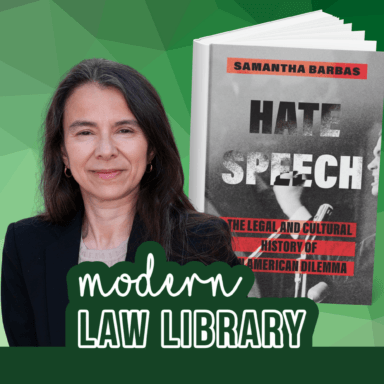

Samantha Barbas is Professor of Law and Aliber Family Chair at the University of Iowa College of...

Lee Rawles joined the ABA Journal in 2010 as a web producer. She has also worked for...
| Published: | September 23, 2026 |
| Podcast: | Modern Law Library |
| Category: | News & Current Events |
“In most other countries, there are laws, criminal laws that prohibit the expression of racial hatred or incitement to racial hatred,” says Samantha Barbas, author of Hate Speech: The Legal and Cultural History of an American Dilemma, in this episode of the Modern Law Library. “There are no hate speech laws in the United States, and that makes the U.S. a true exception, a true outlier in the world. And so my book was trying to get to the question, why did the U.S. take this unique path? How do we explain that historically? Where and when and why did we diverge from the path that was taken by most other countries?”
World War II prompted a barrage of hate speech legislation after it ended, but not in the United States, Barbas tells host Lee Rawles.
“We had just seen how totalitarian governments establish themselves through censorship,” Barbas says. “There are two really important ideals that seem to be clashing in the post-war era. Many hate speech laws are proposed, but they are rejected or struck down on free speech grounds. So at this moment when Europe is adopting hate speech laws, America is going the other way: Proposing them, but then rejecting them, and that consensus in favor of freedom of speech is going to hold for several decades.”
In this episode of the Modern Law Library, Barbas and Rawles discuss how American courts and society have dealt with hate speech issues in the past, and how the growing awareness of psychological harm has impacted public attitudes about hate speech. They also explore Henry Ford and the Dearborn Independent, D. W. Griffith and Birth of a Nation, the Streisand Effect, and a series of cases about Illinois Nazis.
Lee Rawles:
Welcome to the Modern Law Library. I’m your host, Lee Rawls, and today I’m speaking with Samantha Barbas, author of Hate Speech: The Legal and Cultural History of an American Dilemma. Samantha, thank you so much for joining us.
Samantha Barbas:
Thank you for having me on the show.
Lee Rawles:
So as you say in your subhead, this is an American dilemma. I know that I have some international listeners and I would love to give them more of a grounding about laws regarding hate speech in the United States. So as of today, to the best of your knowledge, what is the status of hate speech laws in the United States?
Samantha Barbas:
Yeah, so in the United States under the First Amendment, hate speech is generally free speech. There are no hate speech laws in the United States of the sort that exist just about everywhere else in the world. In most other countries, there are laws, criminal laws that prohibit the expression of racial hatred or incitement to racial hatred. In the United States, speech can only be punished, prohibited by the government unless it falls into one of a few prescribed categories, fighting words, true threats, obscenity, incitement to imminent lawless action. And unless it is in one of those off-limits categories, hate speech is generally protected. So the short answer is there are no hate speech laws in the United States, and that makes the US a true exception, a true outlier in the world. And so my book was trying to get to the question, why did the US take this unique path?
How do we explain that historically? Where and when and why did we diverge from the path that was taken by most other countries? So that’s what the book is about.
Lee Rawles:
Yes, because certainly we experience violence, we experience prejudice, but yes, we have this different legal structure surrounding it. And you kick off the book talking about Birth of a Nation. So I figured makes sense for us to start there too. So Birth of a Nation, can you please share a little bit more about that silent movie and the controversy surrounding it?
Samantha Barbas:
Yeah. So as I write in the first part of the book, the United States really began debating the question of whether hate speech should be regulated in the early 20th century. So I would say around the World War I era, and it’s important to kind of set the context for this. The US was becoming increasingly diverse and urban. Millions of immigrants were coming to the US from Europe, African Americans were moving to northern cities from the south. And in these burgeoning cities, there are increasing number of riots, race riots, clashes between diverse ethnic, racial, and religious groups. And some of that can be attributed to hate speech. And regulators at the time believe that, well, one way to stop these violent breaches of the peace was to make hate speech illegal. So it’s in this context that a filmmaker named D.W. Griffith produced and released a movie called The Birth of a Nation, which is widely recognized to be both a masterpiece of cinematography and also a horrific piece of hate speech.
So Griffith’s film was three hours long. It was technologically sophisticated. Most movies at this time were only 10 minutes, but the subject of Griffith’s film was absolutely noxious. He glorified the Ku Klux Klan. He presented reconstruction as a tragedy in which African Americans had taken over Southern governments and it was horrific, it was false, and it put the NAACP, the nation’s leading civil rights organization in a very difficult position. They had to decide whether they were going to stand back and watch this movie be exhibited with all of its horrible stereotypes, or were they going to take action to try to get this off the screen. And that raised a free speech question that became very difficult for them.
Lee Rawles:
And indeed, I think that it was also shown in the White House at one point. So this was a wildly popular movie and we do see a resurgence of the Ku Klux Klan in its wake. So this wasn’t just imaginary harm. It had very visible effects, but what did the NAACP end up deciding to do?
Samantha Barbas:
Yeah, so the NAACP is a progressive organization of the early 20th century. They were committed to things like eliminating child labor and reducing poverty and eliminating the tenements and of course eradicating racism. They also had commitments to free speech. They were generally opposed to censorship. So again, this put them in a dilemma. Are they going to allow the film to be shown and allow these pernicious effects to take place or are they going to try to stop it? And ultimately they conclude that because of the medium in which this message is presented, the problem is very urgent. So it was widely believed that the cinema movies had more of a sort of pull over the popular imagination than print media. An audience member was more likely to believe something if it was presented on the screen in lifelike form rather than if they read it in a newspaper or book.
So the NAACP embarks on essentially a year long campaign to try to get this movie off of the screen. So they pull every lever of censorship that they possibly can. They go to the legislatures, they go to mayors, they go to police, and in some places they are actually able to stop the film. But they find out that this campaign in the end actually backfires on them because they were drawing all this attention to the movie, trying to get it banned. It made many people curious, what is this thing that’s so horrendous that this organization is trying to halt it? And so I think the movie became more popular as a result of the campaign to ban it. And as you said, it spurred the resurgence of the Ku Klux Klan, which was glorified in the film. So as I describe in the book, the NAACP learned that attempting to censor hate speech may actually work against the cause that they’re trying to promote.
Lee Rawles:
They didn’t yet have the phrase the Streisand effect available to them, but that’s what it was.
Samantha Barbas:
Exactly. Yeah.
Lee Rawles:
You really do go chronologically in your book through so many different key cases, but I’m going to bop around a little bit because what interests me is talking about these organizations that are set up to defend civil rights, to defend minorities and make sure that they’re doing everything they can to protect. And sometimes you’re just faced with a really tough decision. And I’m now going to talk about the case, the National Socialist Party of America versus the Village of Skokie. Now I lived next door to Skokie in Evanston, Illinois during grad school and then as an adult, and people still, of course, bring this up, talk about this. And I have spoken to people who to this day say, “I will never donate to the ACLU because of the stance they took in this case.” So this runs deep, but the ACLU was also faced with this question.
Can you talk a little bit about this particular case and how the ACLU decided to approach it?
Samantha Barbas:
Yeah. So the American Civil Liberties Union was founded in 1919 and its sole purpose was the defense of free speech. So it defended the free speech rights of the Klan and Nazi groups. It defended the most hated speakers in American society going all the way back to the 1920s. So by the time the Skokie case comes around in the 1970s, the ACLU is well established. It has spent decades honing these arguments in favor of a broad vision of free speech. So in some ways it really shouldn’t have been controversial that the ACLU was defending the neo-Nazis in the Skokie case. And yet hate speech was always kind of a dividing line even within the ACLU. There were some members who were just uncomfortable with the idea that the ACLU should be defending these truly noxious hate speakers, and this divide was sort of thrown open in the Skokie case.
Lee Rawles:
To give a little background, Skokie, Illinois is heavily Jewish now, and I believe it was in the 1970s, and that’s one of the reasons, and Illinois Nazi wanted to march through it. So can you tell us about the case and what happened?
Samantha Barbas:
Yeah. So the case goes back to actually the late 1960s when there was a neo-Nazi leader named George Lincoln Rockwell, and he was really the founder of the neo-Nazi movement in America, and I describe him one of the chapters. And after his assassination, the Nazi movement splintered, but one of the leaders of the next chapter of the neo-Nazi movement was a man named Frank Collin. And Frank Collin is a truly colorful character among his many kind of unique. Part of his unique history, I think, is that he’s actually half Jewish, and that wasn’t widely known. And when that came out, that became quite a scandal for him as a neo-Nazi leader. At any rate, Frank Collin has his headquarters in Chicago, and the city of Chicago tries to shut down these weekly demonstrations that he’s holding by requiring him to have an insurance policy in order to speak in the local park.
No insurance company is going to give a policy to a neo-Nazi group, and so he’s not able to have his demonstrations. He decides to relocate his activity, and so he goes to the suburbs and he arrives at Skokie, which as you mentioned, had many Jewish residents, many Holocaust survivors, and he decides to tell Skokie in advance that he is going to go there. And it’s not going to be a huge demonstration. It’s not going to be hundreds of Nazis marching through this community. He’s just going to have a small demonstration with a few Nazis in uniform walking silently in front of the town hall and carrying signs with various messages. Normally, I think the response of the town would’ve been, “Well, just let him come and have a small demonstration and he’ll go away and there won’t be a problem.” And this sort of thing had actually happened a number of times in the past.
But this instance was different because some of the Holocaust survivors protested this. They went to the town and they said, “We can’t allow this to happen. This is how Hitler rose to power.” People just stood back and said, “This isn’t going to be a problem.” And then we ended up with Hitler’s rise. So the Holocaust survivors convinced the leadership of Skokie that Collins March must not be permitted. So Collins is banned. There are various hate speech laws that are passed, and this starts the legal conflagration that becomes one of the most contentious issues in American society in 1977.
Lee Rawles:
And it reached the Supreme Court.
Samantha Barbas:
It reached the Supreme Court twice, but I think the real action in Skokie is more around the public debate that it generated at the time. Again, this is the first time that many Americans are made aware of the fact that hate speech is protected by the First Amendment, and many Americans are confused and dismayed, and I think this is a moment when actually public sentiment increasingly moves towards the regulation of hate speech. Skokie incident is really a turning point, but the courts upheld Colin’s right to march. Of course, he was defended by the ACLU. The Holocaust survivors file a number of lawsuits. They make the novel claim at the time that hate speech should be prevented because it causes severe emotional distress and psychological trauma to its victims. And that’s a relatively new argument that ends up becoming very influential in subsequent debates over hate speech regulation.
So at the end of the day, the law has said unequivocally that hate speech is free speech, but the public is not so satisfied with that legal resolution.
Lee Rawles:
Well, we’re going to take a quick break to hear from our advertisers. When we return, I’ll still be speaking with Samantha Barbas about her book, Hate Speech: The Legal and Cultural History of an American Dilemma. Welcome back to the Modern Law Library. I’m Lee Rawls here with Samantha Barbas talking about her new book, Hate Speech: The Legal and Cultural History of an American Dilemma. So you mentioned back when we were talking about Birth of a Nation, the idea of the medium of the hate speech mattering. And one of the things that you spend a chapter on is another different medium, but it was hugely influential in its time, and this is a newspaper that was owned by Henry Ford and used by him for antisemitic propaganda. So the Dearborn Independent, he owned it from 1919 to 1927. Can you talk about the impact of the newspaper and the efforts to fight against it?
Samantha Barbas:
Yeah, so The Dearborn Independent was published by Henry Ford, of course, the nation’s most prominent industrialist in the 1920s, sort of regarded as an American folk hero. And it was because of Ford’s credibility in American society that his newspaper was so dangerous. Again, people believed the antisemitic statements in the paper to be true because of Ford’s stature. And like the NAACP confronted a free speech dilemma in the previous decade, the American Jewish civil rights organizations of the 1920s were also confronted with the question, are we going to allow this newspaper to be circulated? Are we going to fight back and how are we going to fight back? I think the initial impulse of some of the civil rights organizations, again, was to call for the passage of hate speech laws or other legal means to censor the paper. Lewis Marshall, who is a leader of the American Jewish Committee, very prominent and respected lawyer of the time, ultimately concludes that trying to ban the newspaper will not be productive.
Again, it will backfire, not only because it will draw more attention to the newspaper, but he also recognizes that freedom of speech is absolutely essential for minority groups to be able to make their claims for equality before the public, right? Minority groups need freedom of speech to be able to change public opinion, to call for equality, and that’s the same realization that the NAACP and leaders like Walter White and Thurgood Marshall espoused for much of the 20th century. They understand that while it may be emotionally appealing to ban hate speech, that is not a measure that will help minority groups and dissidents in the long run. Actually, it’s broad protections for freedom of speech that are most valuable.
Lee Rawles:
Henry Ford did eventually stop publishing. Am I right though that it was more related to boycotts and customer sentiment essentially than the force of law?
Samantha Barbas:
Well, sort of an unusual end to the Dearborn independent. So Lewis Marshall essentially affects a settlement with Ford. There’s an individual defamation suit that’s brought against Ford and Ford senses that he’s losing in court and Lewis Marshall says, “Well, we’ll make an agreement, settle the case, but you have to issue a public apology for the antisemitic statements you’ve made, and you also have to agree to stop publishing the Dearborn Independent.” And so Marshall was able to get rid of this newspaper without a hate speech law, essentially through affecting a legal settlement.
Lee Rawles:
And then you take us to a hate speech law, which did backfire. I’m talking about the anti-Nazi law here, which was attempting, and this is not after World War II, this is actually before World War II, and it’s targeted at the German American Bund, which was very risingly powerful in the 1930s. So can you talk about the anti-Nazi law and how it ended up being used?
Samantha Barbas:
Yeah, so in the 1930s, Nazi groups were gaining a foothold in the United States, groups like the silver shirts and the German American Bund, and they were holding rallies in Madison Square Garden attended by thousands. They were conducting demonstrations in New Jersey, and everywhere they went, they seemed to cause a ruckus and cause violence, and some of these state governments and municipalities tried to ban Nazi speech. And so New Jersey passed a sweeping anti-Nazi law, making it illegal to say anything, publish anything that would incite racial hatred or that would vilify a group because of its race, religion, or ethnicity. And this law was so broad that a truck driver who was carrying publications that contain hate speech could be liable. I mean, it was sweeping. It certainly would be unconstitutional today, and indeed the New Jersey Supreme Court in 1939 struck down the law using the newly enunciated clear and present danger test that had been developed by the Supreme Court in the 1930s.
But the Jewish civil rights organizations opposed the anti-Nazi law for the reasons I previously described, again, fearing that a law that was so vague and so broad would be turned against minority groups. Again, these laws were all dependent on who’s defining them, who’s enforcing them, and that doesn’t always mean that they’ll be enforced as they were intended. Interestingly, the first group to be prosecuted under the anti-Nazi law was Jehovah’s Witnesses, a highly unpopular religious minority that was both anti-Catholic and anti-Nazi. So the anti-Nazi law was imitated by many states, and its constitutional status was thrown into question with the 1939 ruling, but that didn’t stop the continued passage of hate speech laws into the 1940s and the World War II era, I think when the United States actually had a regime of hate speech laws, and we might have continued to pass those laws had the cultural and legal climate not changed after the Second World War.
Lee Rawles:
And let’s talk about that shift. What do you think really marked the beginning of that change away from hate speech laws at a time when other countries were actually starting to think, “Yeah, let’s go deeper in. Let’s pass more hate speech regulations.”
Samantha Barbas:
Yeah, so the US, again, passed hate speech laws during the Second World War as almost sort of national security measures. It was widely believed that hate speech that was propagated by these American Nazi groups was creating race riots leading to unrest in munitions, plants, and other places that were critical to the national defense. And so when the war ended in 1945, some of the urgency, some of the pressing need for these hate speech laws disappeared. After the war is very interesting. I think America in some ways became more committed to civil rights than ever, having fought a war that was waged or started on the basis of racial and religious hatred. Many Americans believe that it’s more important than ever for America to live up to the democratic ideals that it had just fought for, but the war also increases American’s consciousness of the importance of freedom of speech.
We had just seen how totalitarian governments establish themselves through censorship. There are two really important ideals that seem to be clashing in the post-war era. Many hate speech laws are proposed, but they are rejected or struck down on free speech grounds. So at this moment when Europe is adopting hate speech laws, America is going the other way, proposing them, but then rejecting them, and that consensus in favor of freedom of speech is going to hold for several decades.
Lee Rawles:
There is a case that I had never heard of before, and I would say I’m still a little unclear on if we would consider this still good law, but I hope I’m saying this right, Bo Harneys versus Illinois, I had never heard of before reading your book. This is a 1952 case, I believe. Can you tell us about this case?
Samantha Barbas:
Yeah, so Bo Harneys versus Illinois from 1952 was the first time the Supreme Court ever considered a hate speech law, and this involved an Illinois hate speech law passed in 1917 that criminalized, again, the expression of racial hatred. Sometimes this is referred to as a group liable or group defamation law. The case involved a white supremacist leader named Joseph Boharnes, who was protesting the integration of Chicago neighborhoods after the Supreme Court struck down restrictive covenants, and he wanted to essentially petition the government to do something about this integration, which he perceived to be a terrible problem, and he also wanted to find members for his group, the White Circle League. So he stood on the streets of Chicago and passed out leaflets, again, trying to generate support for this, and he was convicted under this group defamation or hate speech law because his leaflets contained hate speech.
The ACLU represents Bo Harneys. This goes up to the Supreme Court, and in five to four ruling, the court upholds the Illinois hate speech law. The opinion was written by Felix Frankfurter, and he said, “Well, at the time, defamation was not considered to be a form of First Amendment protected speech. This law is a group defamation law, therefore there should be no constitutional issue with it.” Technically, Bo Harneys is still good law in the sense that it hasn’t formally been overruled, but subsequent cases like New York Times versus Sullivan, Brandenburg versus Ohio, RAV versus City of St. Paul have effectively nullified Bo Harnays. It would be very hard to use that case as a basis for a hate speech law today.
Lee Rawles:
Samantha, you wrote an entire book on New York Times versus Sullivan that I do encourage people to pick up. I’ve read it, Actual Malice, Civil Rights, and the Freedom of the Press in New York Times versus Sullivan. We’re not talking about Label today, but I do want to talk about New York Times versus Sullivan because it was an instance where this was a case being used to target civil rights groups, essentially. They wanted to shut down civil rights groups, and they were attempting to use a speech related law to do it. Did this make it sort of a natural parallel for you to work on hate speech, legal and cultural history of an American dilemma next?
Samantha Barbas:
Yeah. So essentially, what is happening in the South in the civil rights era is that segregationists are trying to quash the civil rights movement by suppressing its free speech. So they use seemingly neutral laws like liable laws, breach of the peace laws, nuisance laws in a targeted way to shut down civil rights speakers. New York Times versus Sullivan is an example of that, essentially frivolous libel suits being filed against civil rights speakers. And that is really kind of an example, I think, of the ways that seemingly neutral and benign laws can be used against dissenters. It all depends on who’s enforcing them and who’s defining the terms. So that did lead me to become interested in this new project on hate speech. But I will say the most direct link between Sullivan and this book was really kind of in the concept of defamation. So New York Times versus Sullivan involved individual defamation, a libel suit that’s brought when someone claims that a speaker has injured their personal reputation.
I noticed that in the early 20th century, there was a lot of discussion about group defamation. That term was widely discussed, really going up to the 40s or 50s, and we don’t have that in our kind of legal language anymore, the concept of group defamation, essentially hate speech. So I became interested, why did libel end up only in individual action? Why don’t we have group defamation actions like most other countries do? So that was the connection to hate speech.
Lee Rawles:
Well, we’re going to take a break to hear from our advertisers. When we return, we’ll still be speaking about hate speech, the legal and cultural history of an American dilemma. Welcome back to the Modern Law Library. I’m your host, Lee Rawls, here with Samantha Barbas. So Samantha, one of the trends that you note about the changing legal and cultural history of hate speech is what regulators are trying to prevent, the effects that they’re trying to prevent. Can you talk a little bit for our listeners about that?
Samantha Barbas:
Yeah. So in the early 20th century, regulators were really concerned with stopping violent breaches of the peace that were caused by hate speech. So in other words, preventing race riots in particular. But over time, the protected interests migrated. And in the postwar era, really starting in the 1960s, we see a robust dialogue that is in fact informed by psychology and social science about the harms that are inflicted upon the victims of hate speech, psychological and emotional distress, victims of hate speech dropping out of school and losing their jobs. And is this discussion again about the sort of intangible harms caused by hate speech that really informs the national debate in the Skokie case and also animates the critical race theorists in the 1980s who are writing about the harms of hate speech and that ultimately inspire many of the campus speech codes. About 350 universities in the 80s and 90s passed speech regulations because they wanted to protect students again from these sort of intangible, emotional, psychological harms are said to be caused by hate speech and that interfered with people’s educations was the theory.
And so today I think when we debate hate speech laws, we may be thinking about violence, but even more, I think we’re thinking about, again, the effect on the person, on the person’s dignity, their emotional wellbeing. And that’s, I think, a very important shift that took place over the 20th century and something that critics of the current legal regime really take issue with because our law is focused on imminent lawless action, clear and present danger, true threats, but it’s really not sort of calibrated to look at the more subtle and insidious harms that hate speech can cause. Those don’t sort of map onto our legal categories.
Lee Rawles:
And it is true. We know so much more about trauma than we did in the World War I era when we were seeing shell shock and we now understand much more about what we now call PTSD and the physical damage, et cetera. When you talk to people who are pointing this out and advocating and saying this too is harm and our legal system isn’t addressing it, What’s your response to that?
Samantha Barbas:
Yeah, I think that this line of thinking and the work of the critical race theorist is incredibly important in documenting, again, the severe and intangible harm that can occur. And I would say despite that, I mean, even with that, I still think hate speech laws are the wrong step to take. I think there are better ways to try to ameliorate those harms in more effective ways. Again, public education, counter speech, modeling civility in our daily lives. So I think it’s possible to recognize the harm, but also not agree with hate speech law as the best way to prevent that harm.
Lee Rawles:
Samantha, I was born in 1980. I am an elder millennial, zennial, whatever you would want to say. And I do feel like I have witnessed in younger generations maybe a shifting attitude towards the necessity for regulating speech as they see it. You teach at a law school, you come into contact with a lot of students. Are you approached by them? Do they talk about the necessity for passing hate speech laws or do you see a difference in attitude in younger generations towards things like hate speech?
Samantha Barbas:
Yeah, I do. And I think just speculating that one reason is the proliferation of hate speech on social media. I think it’s very tempting to say that everything is worse today than it was in the 1950s and ’60s because hate speech has become so visible. And I also think that perhaps the younger generation takes freedom of speech for granted in a sense, not understanding the struggles that people I describe in my book had to wage in order to get the basic right to express dissent, to criticize the government, to put forward a controversial message. We now think, of course, we’re in America, we can say something that’s unpopular, but that wasn’t always the case. And so I do think that older generations tend to be a little more protective of free speech than maybe some of the younger generations are.
Lee Rawles:
And that leads us really well into your final chapter, hate speech in the age of the internet. I agree with you. I think that there’s always, as I heard myself saying the younger generation, I thought there is graffiti scribbled on Roman walls about how the youth today are different, things are the worst they’ve ever been. And so that seems like a perennial worry, but the age of the internet does feel different. The marketplace does look different than the agora of the Roman Empire. So what did you decide you needed to address in that final chapter about hate speech and the age of the internet?
Samantha Barbas:
I think that I just wanted to leave the book kind of open-ended. I felt an obligation to bring it up to the present day and to say after a hundred years of debating hate speech, this is where we are. We have a legal regime that is totally protective of hate speech. And we also have a populace that is more eager to pass hate speech laws than at any point in history, in part because of witnessing hate speech online. And so what do we do with this, this sort of divergence between law and cultural sentiment? And so ultimately in the end of the book, I think I make the argument that it may be very tempting to proffer the passage of hate speech laws, especially in light of these tragedies like Charlottesville and some of the atrocities that are being carried out online. But again, as civil rights leaders of the 20th century recognize these laws may cause more harm to dissenters and minority groups, they may impede social change and we should be very wary.
I also wanted to suggest that social media, although it is responsible for the proliferation of hate, is also a tool that we can use to engage in counter speech. And that was a historic remedy that civil rights leaders promoted. The best way to get rid of hate speech is not to ban it, but to talk back against it, to engage in campaigns of public education, to try to change public opinion, to engage in dialogue with those promoting noxious messages. And so 50, 100 years ago, the only way you could speak to the public was if you owned a newspaper or you had a broadcast station and now everybody has that opportunity. And I think we should be using that to engage in the kind of dialogue that can ultimately eradicate hate speech or at least reduce it more effectively than a legal ban. I
Lee Rawles:
Think people also sometimes conflate laws that the government enforces versus societal center that we as people in a community can “enforce.” And I think that you very persuasively show in the book how dangerous the government enforcement of some of these laws can be. You may start out with great intentions, but can you craft a law that can never be used to harm a vulnerable population? I don’t know. I don’t know that we’ve seen it successfully in American legal history. So what are your thoughts there?
Samantha Barbas:
Yeah, I think that’s exactly right. I mean, again, these hate speech laws are inevitably vague, terms like insult, offend, stigmatize, vilify. It was Thurgood Marshall who said in the 1940s that under some of those hate speech laws, civil rights groups criticizing the poll tax or criticizing segregation or white supremacy could be accused of engaging in racial hatred, right? I mean, their protests could be seen as a form of hate speech, again, depending on who’s interpreting the law. So I think there is no way to draft a law that would not be open to that type of manipulation and abuse. So we don’t have any evidence that hate speech laws would be successful in an American setting when hate speech laws existed in the US. I don’t think there were any tangible effects. And hate speech laws have also been turned against minority groups in other countries in France and Britain and Germany.
And I have yet to see any convincing empirical evidence that these laws are working as intended.
Lee Rawles:
Well, Samantha, I really want to thank you for coming on to talk to us today about your new book. If people wanted to reach out, learn more, contact you or read anything else that you’ve written, is there a website that they could go to to do that?
Samantha Barbas:
Yes. I have a website, samanthabarbas.com, and I have some descriptions of my writings. And of course anyone can feel free to contact me directly.
Lee Rawles:
And you get into a lot more than what we’ve spoken about today, but I hope this gives people a good feel for the kinds of debates that you talk about us having when it comes to hate speech. So thank you to Samantha Barbas and thank you listeners for joining us for this episode of The Modern Law Library. If you enjoyed this episode, please rate, review, and subscribe in your favorite podcast listening service. And if you have a book you’d like me to check out, you can always reach me at [email protected].
Notify me when there’s a new episode!
|
Modern Law Library |
Modern Law Library features top legal authors and their works.