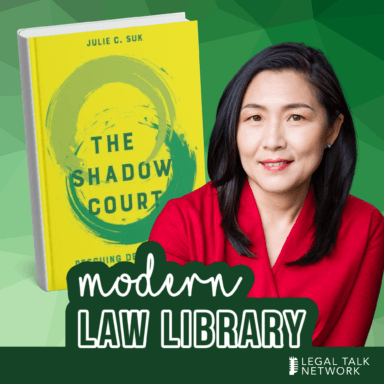
Julie Suk is worried about American democracy.
“Over time, the control of our constitutional future has really been in the domain of the judiciary and the executive branch, with the judiciary increasingly green-lighting actions by the executive branch,” Suk tells host Lee Rawles. “And at the same time, our institutions, our lawmaking institutions that are supposed to represent the people have become less and less representative because of gerrymandering, and also less and less capable of making laws that push back against judicial and executive power.”
In her new book, The Shadow Court: Rescuing Democracy from the Supreme Court, Suk proposes one potential tool to fight back.
The “shadow docket” may be a familiar term to people who have been paying attention to growing controversies over the U.S. Supreme Court’s emergency decisions. But a shadow court is a different–and older–concept, Suk says. Just as a shadow parliament is intended to be a check on the power of a parliament, a shadow court could issue legal opinions independent of h a supreme court’s actions. Many other countries have constitutional courts in addition to courts of litigation, that issue advisory opinions on constitutional issues.
Suk proposes that Congress could create “a watchdog institution that provided an alternative jurisprudence or an alternative set of rulings so that the people could know what would we have in America if we actually had institutions that were designed better for the purposes of constitutional lawmaking and constitutional change.”
One benefit of an Article I shadow court would be the ability for its judges to weigh in on constitutional questions without the necessity of a plaintiff with standing bringing a case through the entire Article III court system to reach the U.S. Supreme Court, Suk says. They could evaluate pending legislation or executive actions with much greater speed.
“And that opinion is advisory,” says Suk. “It’s not binding on Congress. It doesn’t invalidate the state statute. It doesn’t suspend the operation of the executive order in the same way that a court can issue a preliminary or permanent injunction. The shadow court’s opinion being advisory, I would say could still, if it’s designed properly, could still have a tremendous effect on our politics and also on our law.”
In this episode, Suk and Rawles discuss how other countries have used shadow parliaments and constitutional courts to safeguard democracy. They also discuss ways to make a shadow court more reflective of changing public attitudes, and Suk’s Lego-piece theory for improving the United States government.