|
|

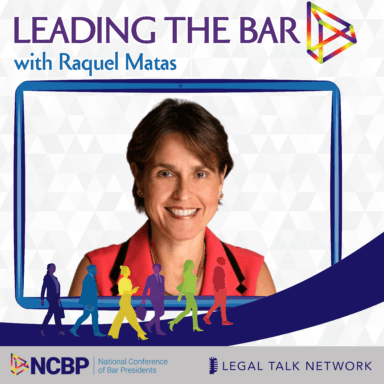
Raquel M. Matas, 2026–27 President of the Hispanic National Bar Association, is an accomplished lawyer, senior executive,...

Amanda Arriaga is Chair of the National Conference of Bar President’s 21st Century Lawyer Committee. She was the...

Juan R. Thomas is Of Counsel to Clifford Law Offices and is the founder and principal of...
| Published: | October 19, 2026 |
| Podcast: | Leading the Bar |
| Category: | Career , News & Current Events |
One of NCBP’s goals is to elevate the voices of affinity bar associations, creating opportunities for leaders from diverse backgrounds to learn from one another and deepen their understanding of leadership within the legal profession. Amanda Arriaga and Juan Thomas welcome Raquel Matas, President of the Hispanic National Bar Association (HNBA), to explore the organization’s origins and progress as it approaches its 55th anniversary.
Raquel reflects on her own path to leadership and shares her vision for the HNBA’s future, including key initiatives planned during her presidency. She highlights the continued development of the HNBA Legal Academy and the organization’s ongoing efforts to support and empower the next generation of Hispanic legal professionals.
Resources:
To learn more about NCBP or to become a member, visit ncbp.org
Raquel Matas:
Hispanics do face unique hurdles. And so here at the HMBA, you have a community, first of all, of experts, but secondly of familia members who are going to take your hand and hold it and tell you how to do it and be with you along the way. So it’s a way of traveling through a complex journey that provides us a lot, gives us a chance to give a lot, but not to do it alone and do it with the support of many members around us.
Amanda Arriaga:
Welcome to the next episode of Leading the Bar. I’m your host, Amanda Arriaga. Today, NCBP President Juan Thomas and I are joined by Raquel Matas, President of the Hispanic National Bar Association. Raquel received the Primera Abogada Award in 2023, which honors a Latina lawyer who has been a trailblazer, has achieved great professional distinction, and has opened opportunities historically closed to Latina lawyers. She’s been a lifelong advocate on social justice issues, and we’re so lucky to talk to her today. Raquel, welcome.
Raquel Matas:
Thank you. Thank you so much.
Amanda Arriaga:
We’d like to start at the beginning and ask why you wanted to be a lawyer.
Raquel Matas:
That’s in a way an easy question to answer. I knew I wanted to be a lawyer since I was a very young person. I just had this sense that there was injustice in the world and I wanted to make it right and I wanted to fight for the underdog. And it was just something that I knew. So I didn’t have to struggle with my professional career choices the way that I see a lot of people struggle. I was in the academic world for over two decades and I talked to so many law students who weren’t quite sure why they were in law school. And I feel very fortunate that I always knew why I wanted to be a lawyer and why I wanted to be in law school.
Juan Thomas:
Raquel, so good to have you with us today and we are excited to be partnering with HNBA. Can you tell us and tell our audience about the Hispanic National Bar Association, when they were founded, the purpose, the mission of HNBA?
Raquel Matas:
Sure. I’m very proud of the fact that I am going to be president of the HNBA the year that our organization is going to be turning 55. So next year when we are in Puerto Rico in 2027, we’re going to be celebrating the 55th anniversary of its creation. The HNBA was established in 1972 really by a group of largely Mexican American lawyers in California who were confronting all of the overt discrimination that existed at that time across all of our spheres of civic society in the workplace, in education, in the courthouse. And a group of Hispanic lawyers, Mexican American lawyers said enough is enough and we’re going to get organized and fight back. And that was the beginning of the HNBA. And today, that organization that was started as basically a civil rights organization in the early ’70s has become a broader, much more comprehensive organization of Hispanic legal professionals that not only advocates on behalf of Hispanic lawyers and Hispanics in the United States, but that really worked very hard to make sure that all Hispanics have opportunities to advance within the legal profession.
So we’ve grown quite a bit in these 55 years and will continue to grow, I am sure, in the years ahead.
Juan Thomas:
So Raquel, one of my initiatives this year as president of the National Council Bar Presidents is to reach out and elevate the voices of what we call our affinity bar associations. What we mean by affinity bars are those bar associations that are organized around different affinities of a particular lawyer. So it could be cultural, it could be racial, it could be gender, it could be sexual orientation. And so HNBA in our network is considered one of our affinity bars associations, similar to the National Bar Association. As you know, I was a past president of the NBA. And so I have the honor of serving as the first Affinity Bar national president to serve as NCBP president. And so I mentioned that background because I’d like for you to share with us what is the structure of your affiliate chapters across the country in HNBA? Are you organized by region, by state, by local chapters, in particular cities?
Could you share that with us so people understand how not only your mission, but also how you’re structured and organized?
Raquel Matas:
Absolutely. Absolutely. So we are a national organization and our mission is, as I said earlier, is to represent the interest of the close to 80,000 Hispanic law students, lawyers, judges, academics, and more broadly advocate on behalf of issues of importance for the Hispanic community in the United States. When we say that we are a national organization is that we are divided or organized structurally across 19 regions that covers all of the United States, including Hawaii and also Puerto Rico. And so the organization has a national president, president-elect and president-elect will take office as president in a few days. We have then an executive committee that are the vice president, the officers of the organizations. And then we have, importantly, I would say the most important segment is our regional governors. They are the representatives and leaders in each of the regions. And as you know, from having led a national organization yourself, we have a lot of work to do individually as an organization, collectively as a coalition of bar organizations.
And we are also an organization of volunteers primarily. We have a paid staff that is relatively small. So our work gets done by volunteers who are themselves very busy lawyers and very committed to the mission of the organization. But it’s very important too that the work gets done at the local level. Also because we understand the United States is so different regionally, the person at the ground understands the dynamics of that region much better. So that governor will work with the members of the organization, HMBA organizations who live in that region, but also with the affiliate organizations, Hispanic Law Associations. For example, I am based in Miami and Miami has a very strong local bar association, the Cuban American Bar Association. It has all this, Puerto Rican American Bar Association, Venezuela. We have all the ethnicities. And so many of those organizations are affiliates so that we collaborate quite a bit on the common goals that they share with the HMBA as a national organization.
And we in turn offer a platform, a national platform that a local organization cannot offer. So I see it as win-win for everyone.
Amanda Arriaga:
Raquel, why did you decide that this was an organization that you wanted to lead?
Raquel Matas:
It’s almost personal in a way. I was born in Cuba. I grew up in Puerto Rico. I always like to say that I’m Cubarican. I have had the privilege of spending over four decades in the legal profession as a private practitioner, as an academic, and in government. And throughout that professional journey, I have seen firsthand the importance of having people and institutions like the HMBA open doors, create opportunities, and make sure that talent is seen and heard and that our collective voices can be expressed in a louder forum. And that’s what the HMBA has done for me and for so many others. And what I think is that the HMBA, it’s so special because it is bigger than just one person. It is a community of people that believe that our profession is stronger when Hispanic lawyers are at the table in positions of leadership and using their talents, as I said, to make sure to make a difference.
And so I want to lead this organization that has done so much for me and so much for so many other Hispanic lawyers because we are at a very important moment in our country. Certainly our numbers are growing and our influence is growing and there’s tremendous talent within our community, but we also have enormous work to do, enormous challenges in representation, in leadership, in access to justice, and very, very importantly in making sure that we are protecting the rule of law, the central mission of our oath as attorneys. So that’s why it’s a very important moment in our history, and I am honored to be in a position to lead this great organization.
Juan Thomas:
So by the time this podcast airs, you will have been sworn in as president of HNBA. And I’m wondering if you could share with us some of your initiatives and events you have scheduled for this year as president as you celebrate the 55th anniversary of the founding of HNBA, and how can lawyers across the country participate in these activities and be part of your celebration in your work?
Raquel Matas:
Wow, that’s a handful. Yes. So by the time that this podcast airs, I will be formally installed as the president. I think that importantly, we will have celebrated at the annual convention a very significant milestone for the country, which is obviously the anniversary of the 250th anniversary of the birth of our country. So our theme for the convention is the America at 250, strengthening the rule of law, elevating leadership and shaping what comes next. And so during the conference, we had tremendous programming that addressed essentially what we were talking about in the theme in terms of what can we do to make sure that we are protecting the rule of law, what can we do in terms of shaping the future of our profession? And in that regard, one of our most exciting initiatives, at least for me having spent so many years in the academic world, is that we just formalized the establishment of a section of the HMBA, the legal academy section.
And that section that is going to be made up largely of law professors and academics is going to work very closely with the HMBA on two realms. One is to make sure that Hispanic legal professionals have opportunities to enter the legal academy, which is sort of a secret society. They’re special rules that you have to follow in order to enter the academy. And if you don’t know, you don’t know. So we want to open that curtain and make sure that Hispanic legal professionals who want to maybe join the academy know how to do it. But also importantly, to make sure that as the practice of law is evolving, especially with respect to AI, that both we inform law schools and law professors what it is that as practitioners, we need law students to learn about how to practice law in this new world of AI as they are graduating law schools.
And at the same time that the legal academy is informing the established bar, what is it that they are doing to train lawyers so that they are practice ready in this new world of evolved technology and AI. So that’s an important initiative, one, and it’s easier said than done because our segments exist in silos. And so bridging those silos really requires a lot of intention and effort. And this establishment of this section is actually the product of the study of a task force that was created two years ago, and I was honored to co-chair with Seattle University School of Law, Dean Tony Varona. And so we both co-chaired the section, the task force, understanding this need. And two years later, now we have this section. We’re going to have our first plenary on this subject of AI and the future of legal education in the phase of AI.
And then that programming is going to continue to evolve throughout the year. So that’s a very important initiative, Juan. I can go on and on if you’d like.
Juan Thomas:
Oh, sure. Yeah. I can tell you that law firms and bar associations and law schools, you mentioned academia, I’m an adjunct professor at my law school at the University of Illinois in Champagne Urbana, and I see the ongoing conversation around AI and adapting to new technologies, new ways that we research ethical issues involved with AI. And so I hope that your leadership in this space will also be a bridge to maybe helping other bar associations around the country think about ways they can bring this conversation to their associations. And that leads me to my next question around the collaboration that HNBA does with the other national affinity bars like NAPABA, NBA, and other organizations. Do you see yourself continuing that collaboration? Have you been able to reach out and connect to your other national leaders who serve with you during your year as president to have these kind of conversations and programming?
Raquel Matas:
Yeah, absolutely. I believe so strongly in collaboration and I believe that United, we can accomplish so much more than not united. I also believe that there are many segments of society out there who would rather see us be fighting against each other. And by the way, Juan, I have to tell you that one of my… I mean, I have wanted to create this section on the legal academy and the HMBA for years because I’ve been involved in the HNBA for years and I’ve seen this as a gap, but I have also observed how the National Bar Association and the legal faculty, the African American faculty and Black faculty have done a much, much better job in terms of creating that cross-pollination and that pipeline. I mean, if you look statistically, there are more African American law school deans and senior leaders in law schools and in universities than there are Hispanics, and that is simply a function of pipeline and connection and networking.
And so I have looked at the MBA as a model, and so this is one reason why organizations have to collaborate and work together. This last May when we were in Washington DC doing our advocacy day work, we were working in partnership with the other bar organizations of color. We were in Chicago in July for the Coalition of Bar Organizations of Colors and Leadership Academy. And we are going to continue to do that work throughout the year because United, we’re certainly stronger and we have many, many issues of common where we can partner, leverage, and advance together.
Juan Thomas:
I wanted to follow up with you, and I’m glad you said that about the collaboration. I’m glad that’s going to be continuing during your year. I know I had the wonderful opportunity to work with many great leaders of HNBA when I was NBA president, people like Pedro Torres Diaz, Erika Mason, and now at the ABA, I work with Peter Reyes and Victor Marquez pretty closely and other leaders throughout the Latino legal community. But I wanted to ask you specifically, what activities or what events do you have scheduled that we should know about during your year as president that maybe people can attend or participate in throughout your year as president? Okay. Well,
Raquel Matas:
The ones that I certainly want to make sure that people put in their calendars is in March of 2027, we’re going to be in Houston celebrating our corporate council conference, and that is the next big national gathering. HMBA has never been in Houston before, and Houston has a very, very strong network of Hispanic lawyers and actually lawyers of color. And so we want to work together with that segment to leverage, again, talking about AI, the future of technology. Houston is an emerging city in that realm, in everything that has to do with energy, with tech, in healthcare. And so we want to be there advancing all of those themes. So that’s one. And then as I said earlier, in the podcast in September of 2027, we are going to be in Puerto Rico, in San Juan, Puerto Rico for the first time in 20 years.
We were last there 20 years ago celebrating our annual convention and our 55th anniversary. And then in between, we’re going to be all around the country. Two weeks, maybe by the time actually this podcast is being aired, I will be in Denver at the annual gathering of the Denver affiliate organization. Then in October, I am going to be in San Francisco participating in HNBA and affiliate events. Then I’m going to be in LA where LA is going to have the celebration that the Latina Lawyers Association, the National Latina Lawyers Association is celebrating its gala, and HNBA is going to be there with them. And of course, then we’re going to be planning our advocacy work. This is going to be both in person and virtually, but we’re going to be partnering with NALEO to make sure that as the midterm elections come upon us, that our Hispanic community have opportunities to be very well-informed about their rights, about voter protection and voter rights.
And so this is a partnership that the HMBA and NALEO will begin executing in early October. So we have lots and lots coming up. Just look at our calendar and come join us.
Amanda Arriaga:
We will put a link in our podcast notes to the HNBA website and some of these big dates so that folks can make sure that they know where you are and they can participate as well.
Raquel Matas:
Wonderful. Thank
Amanda Arriaga:
You. Of course. I’m lucky enough to be one of your members, and one thing that I am very impressed by is you have programming that is different than other bar associations that I’m a part of that really deal with the life of the lawyer as a whole. You focus on the career path with programs like Bode and the Puente Institute, and you also want to make sure that people are doing a good job with their money with. So why is it important to provide this entire package to lawyers and not just traditional bar programming?
Raquel Matas:
I would say because our members are whole people. We’re not just lawyers. We want to build a strong and successful Hispanic legal profession, but I would say that about any of the minority segments of the profession, we have to think about success holistically. I think we do a lot with our law students, but it’s really not enough to help them get through the bar exam by offering them scholarships or study opportunities or even help them get their first job. We also have to help them understand how to navigate their career, develop leadership skills, build relationships, achieve financial stability, and ultimately be in a position where they can give back and create opportunities for the people coming behind them. I say it all as an ecosystem that really begins in law school and ends very, very, very late in life. And anywhere across the spectrum, there’s a place for HMBA lawyers and members to participate, contribute, and give back.
Amanda Arriaga:
Thank you for providing that for your members.
Raquel Matas:
Thank you. Of course, you’re welcome. Thank you for mentioning it. We work really hard to make sure that it’s a holistic endeavor that really begins in law school and ends at the retirement home and beyond.
Juan Thomas:
Madam President, you have been a wonderful guest today, and we want to thank you for your time. I’d like to ask you one last question. You’ve answered this throughout the conversation today, but I want you to imagine you were talking to a group of young Hispanic law students, and they’re trying to figure out what should they do in their career and why should they join one group versus another? Why should they join the Hispanic National Bar Association and how will it benefit them and why are you relevant to them in their career and their practice and their life?
Raquel Matas:
Yeah, that’s an excellent question, Juan. I hope that I have answered it throughout this conversation, but basically I would say that if you are a law student or an early career lawyer especially, I would encourage you to get involved early, not to wait until you’re senior enough because by the time you… First of all, what does that even mean? But some of the most meaningful relationships people develop throughout the HMBA really begin when they are students or young lawyers. So it’s that… We like to say that we are familiar and we really mean it. We are a familia of legal professionals and we take care of each other. And so the reason why you should join this organization and why this organization is relevant is because of what I just shared with Amanda in terms of all of the programming that we offer from the moment you enter law school to when you are a very senior corporate lawyer and you’re in the GC’s office and you want to become the chief legal officer, and how do I do that?
Well, we have a program for that. If you are 10, eight, 10 years out of law school, you’re settled as a junior partner and you want to move on to the next level, well, how do I navigate that? These are very complex career steps, and Hispanics do face unique hurdles. And so here at the HMBA, you have a community, first of all, of experts, but secondly of familia members who are going to take your hand and hold it and tell you how to do it and be with you along the way. So it’s a way of traveling through a complex journey that provides us a lot, gives us a chance to give a lot, but not to do it alone and do it with the support of many members around us.
Juan Thomas:
Wonderful. Thank you for your leadership and your service, and we look forward to working with you throughout this year, and I plan to make sure I attend as many HMBA events this year as I possibly can, and we’ll encourage others to do so.
Raquel Matas:
Thank you so much, Juan. It’s really been a pleasure and a privilege to be able to chat with both of you.
Amanda Arriaga:
On behalf of the National Conference of Bar Presidents, thank you for tuning into this episode of Leading the Bar. For more information about membership or getting involved, visit ncb.org. To catch up on episodes you may have missed, you can find us wherever you get your podcasts or watch us on YouTube at Bar Presidents.
Notify me when there’s a new episode!

|
Leading the Bar |
Bar presidents share strategies, tools and insights for attorneys growing into leadership roles. Learn from real stories of growth, crisis management, and innovation in NCBP's Leading the Bar podcast. Listen monthly for compelling stories the next generation of lawyer-leaders can use to develop skills, confidence, and vision to lead with purpose and integrity.