

|
|

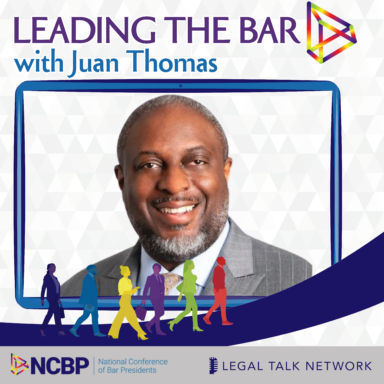
Juan R. Thomas is Of Counsel to Clifford Law Offices and is the founder and principal of...

Amanda Arriaga is Chair of the National Conference of Bar President’s 21st Century Lawyer Committee. She was the...
| Published: | August 17, 2026 |
| Podcast: | Leading the Bar |
| Category: | Career |
Good leaders encourage others to a high level of integrity, creating cultures of respect and examples of servant-hearted civic leadership. At a challenging moment for both the country and the legal profession, lawyers have an important role to play in upholding the rule of law and persevering in civility and professionalism.
As Juan Thomas begins his term as President of the National Conference of Bar Presidents, Amanda Arriaga welcomes him to discuss his vision for the year ahead, the responsibilities of bar leadership, and how lawyers can lead with purpose while contributing to the health of the profession and their communities.
To learn more about NCBP or to become a member, visit ncbp.org
Juan Thomas:
I think the work of leadership is to hold not just process and procedure in place when it’s fair and just, but also hold the membership to a level of integrity.
Amanda Arriaga:
Welcome to the next episode of Leading the Bar. I’m your host, Amanda Arriaga. Today we’re talking to the new NCBP President, Juan Thomas. Juan, this is sort of a part two for you and I. We had the pleasure of first doing an interview in 2024 at our mid-year meeting in Louisville where we got to know you and your life as bar president of the National Bar Association, and we re-aired it earlier this year in season one of Leading the Bar. Since our listeners learned about your past accomplishments to get to this point in a previous episode, today we’ll focus on the future. Juan, this is sort of a part two for you and I because we had the chance to talk to each other at the mid-year meeting in Louisville in 2024, and then we re-aired it on Leading the Bar last season. What do you hope to accomplish as NCBP president?
Juan Thomas:
Well, first Amen, I want to thank you for your continued leadership in hosting our podcast. You are a great council member over the last three years, and I’m so honored that you have agreed to continue to serve us in this role. You do a great job for the podcast for getting out our message across the globe, frankly, and you have just been a tremendous asset to NCBP. I look forward to your continued leadership in our organization. And it’s good to be with you again. It’s good to see you. It was good to be with you. I’m in Chicago at our annual meeting, and I’m very honored to be in this role. And I just first want to say one of the reasons why I’m honored to be in this role is because I have the honor of being the first NCBB president from an affinity bar.
As you noted, I was the past president of the National Bar Association and served there from 2017 to 2018 as its 75th president. And so one thing that I really want to do in this role is to elevate the importance and the work of our affinity bars across the country. We have so many different bar associations beyond state and metro bars that do wonderful work in and around the country. And so one thing I’m going to do as president is elevate the role and the voice and the importance of our affinity bars. So not just our bars around different cultural groups, but also gender, sexual orientation, religion, and other affinities that group lawyers together, because I think that’s important, particularly in these times. So that’s one of my objectives this year is to elevate the affinity bars and to continue to get them involved in NCBP, but also focus on wellness issues.
We’re in very challenging times in our profession and in our country. And while lawyers are called to do very important work, not just in the aspect of supporting and working with their clients, but also as civic leaders, as leaders in the profession, as community leaders, leaders in a variety of different organizations, I really want to help lawyers when it’s time to unplug, when it’s time to decompress, create space where they can receive the mental health and physical relaxation that they need in order to continue to do the work that we are all so honored to do as lawyers and bar leaders.
Amanda Arriaga:
Well, and both of those goals are so important. One, with the affinity bars, that’s also where the growth is. With NCBP, there are a finite number of state bars because there are a finite number of states. And so we should be reaching out to these other bars who might be less well resourced, less well organized, have fewer staff that they can afford. And that’s what this organization does best. We provide resources, we provide information, ideas to them. And then with wellness, we were joking about this earlier, it seems like what people think of our lawyers is you’re going to see us at happy hour, but we could also go to coffee. We could also go to the gym. We could stretch. We could have a book club. There are lots of different ways that people like to decompress and there are things to do other than just meet for drinks.
So I’m glad that you’re doing both of those things have a constant need for all of our organizations.
Juan Thomas:
We should remember that lawyers are people too, and we need to take a break. We need to reconnect to our family, our friends, find other things besides the practice and the work of law to do. And so we will be definitely emphasizing that this year as well.
Amanda Arriaga:
I love that. Lawyers are people too. This is why people are obsessed with lawyer movies and TV shows even when they’re not that real, because they like to see what happens after the brilliant courtroom speech when the person goes home and thinks about what they did and talks to their friends and family about how it turned out.
Juan Thomas:
That’s right.
Amanda Arriaga:
What do you think the biggest issue is facing a bar leader today?
Juan Thomas:
For most bar leaders, they would probably say membership is always a very significant issue if you’re not a mandatory bar. Most of our affinity bars are not mandatory, obviously. And so always trying to grow membership is a very ongoing issue throughout the bar community. But I think a much more challenging issue, candidly, particularly this year, is what is the role of bar associations and bar leaders in these challenging times? We are facing some very monumental questions with respect to what we call the rule of law, democracy, fairness, the independence of our judiciary. The way I kind of put it is like this. We became lawyers, I became a lawyer literally 30 years ago in 1996, and there’s a set of rules that we agreed to. There was an oath that I took to become a lawyer. And candidly, those rules and that oath are being undermined.
And I’m not making a political statement, even though some would suggest that I am, but I don’t think rules are political. I don’t think the process that we agreed to when we became lawyers is a political question. But when you challenge those, when you undermine those, when you no longer follow those rules, it really goes to the heart of our profession.
I am a litigator, a trial lawyer, and sometimes judges rule against me. When I lose a motion or have a case that does not go my way, I don’t have the luxury of questioning the competency of the judge. That’s just not how we do this in our profession. And so I don’t tell my clients not to follow court orders that I don’t particularly agree with. If a judge issues an order, we follow it. If we don’t like it, we file a motion to reconsider. Or if you lose a case, you can file an appeal. But what you don’t do is file a complaint with the Judicial Code of Conduct Commission in your state and question the integrity of the judge. That’s not how we operate in our profession. And so when I see that happening, I think we have a real responsibility regardless of your political perspective to uphold the rules that we all agreed to.
Here’s how I put this. You’re from Texas, I’m from Illinois.
Unfortunately, one of your local teams lost the NBA championship this year, right? The Spurs didn’t win. What would happen if all of a sudden they pretended that they did and they had a parade in downtown San Antonio and they took the trophy from the Knicks and said, “No, we actually won, you lost.” And then the premier of San Antonio allowed them to have a parade even though they knew they lost the series. That’s a level of chaos that we would never allow in the NBA. And so I’m being a bit facetious, but I think the idea of that is just so out of the ordinary that it really goes to the point that I’m trying to make that we follow rules in our society and we have rules for everything from how we play basketball to how we drive a car to how we practice law.
And I think those rules need to be followed. And just because your team loses, you don’t get to pretend that they actually won. And so you don’t see San Antonio Spurs fans going around the country saying, “Hey, we won the championship this year.” That’s just not true.
And to me, that’s pretty simple.
Amanda Arriaga:
So this emphasis on rules goes straight into the next question. There are some bar associations where the president wants to talk about rules and not all the members agree with what the president is saying. And depending on the type of bar you are, whether it’s mandatory or not, might influence what the members want. When is it worth the risk as the president to do what’s right even if it’s not popular?
Juan Thomas:
I believe that as a leader, you are called upon to do what’s right and just for your organization. If there are people that disagree with your process or your procedure, usually there’s an internal process to change that or to challenge that. I don’t believe that our disagreements should cause us to become dysfunctional, but I also question or wonder what’s at the heart of the disagreement? What are we disagreeing about? Is it a rule and a process or is it following the process and the rules in the first place? And that’s the question. I go back to my analogy. We can debate all day who’s a better basketball team. We can have that disagreement, right? I can say in my context as a Chicago Bulls fan, I think Michael Jordan is the GOAT. LeBron James is the second best basketball player in my lifetime. That’s a legitimate debate, but we can’t debate if Michael Jordan scores a basket, he gets two points, but if LeBron James gets a basket, we’re going to give him four points because we like him more.
No, we’re not debating that. Now you’re changing the rules. And if you want to make the argument that you no longer agree with me because as I am holding up the NBA commissioner role and I’m enforcing the rules, well, your disagreement is not legitimate because you want to change the rules, you want to change the process. We’re not debating whether or not Jordan or LeBron are the better player anymore. And I think we need to be honest about what we’re disagreeing about. And I think bar leaders have to push its members to have integrity in their disagreement, to have a sense of understanding, here’s what we’ve all agreed to as a process. Because you don’t like the decision, does it now mean you get to question the merits of the process? So again, if LeBron James beats Michael Jordan, I have to accept the results of that game even though I’m a fan of Michael Jordan.
I know I’m dating myself. There are people on this podcast who may be thinking, didn’t he retire 20 plus years ago? Yes, he did. I’m sorry. But that’s my era as a fan of the Chicago Bulls. But I’m pushing this point because I’m really trying to make what people want to make political and complicated. It’s very simple. I don’t get to run a red light just because I’m rushing to the office, I’m late to court or something. I have to stop at the light. I don’t get to say that light shouldn’t be red because I need to go through it. No, we’ve agreed that at red lights you stop and you wait.
And when it turns green, then I can go. And I don’t get to go to my mayor and say, I now disagree that a red light should mean stop. That’s not how this works. And that’s not a legitimate disagreement. And so to make a long answer for a point poignant, I think the work of leadership is to hold not just process and procedure in place when it’s fair and just, but also hold the membership to a level of integrity and understanding what are we really discussing here and what’s the real disagreement that we’re actually having.
Amanda Arriaga:
And one thing that I think has been great about being on the NCBP Council is not every discussion is easy, not every vote is unanimous, but this group of leaders can disagree without being disagreeable. And ideally, so can all of our leaders because you and I can have different perspectives. I do agree that the Spurs lost. I can want them to have won, as all of my friends in town did.
But because I like the Spurs doesn’t make me a bad person and because I wanted them to win doesn’t make that bad. And so I do think part of the leadership lesson that hopefully bar associations are having are there are people that disagree with some of the things that are being debated at every bar association and that people can disagree about every topic in the world. That’s part of, for some, the fun of being a lawyer, I think, is just to have a fight and people can speak their peace and their response can be equally as peaceful. You’re not a bad person because you had the dissenting voice and the losing vote. And I think that’s one of the things that the integrity on all the sides of if I spoke up against the thing you really wanted, we’re not going to end the meeting and then have you go around and say, she’s crazy and she’s terrible.
We had different opinions for whatever reason on some issue and we’ll still work together. And I mean, you and I haven’t had any disagreements, but I do feel sure that if we did, we would sit down and have a cup of coffee or a yoga session together or maybe hang out at the bar.
Juan Thomas:
Well, I mean, I agree with you and we’re keeping this lighthearted around sports and driving, but obviously at the heart of this conversation, we’re alluding to much deeper issues that we are debating in our society. And I think good people can disagree and have a reasonable disagreement, but I am remembering a quote that I once heard, once read rather, I didn’t hear it from, but I read it from James Baldwin, the famous African American intellectual and thinker and poet and writer. He said, and I’m summarizing this, “We can disagree, but we can’t disagree about the conditions of my humanity.” In other words, and I’m paraphrasing it, “We can disagree and still love each other unless your disagreement is rooted in my oppression and denial of my humanity and right to exist.” That’s James Baldwin. And I think that’s where we have to, as leaders, really ask ourselves, what is at the core of our disagreement?
And so let’s just keep it simple. If you believe you should have the right to vote, but I should not, that’s a fundamental disagreement that goes to the heart of my right to express my values and what I care about. So if you can express your values and what you care about, why can’t I express mine? And if you want to make it harder for me to vote than you, that’s a disagreement that I think goes to my right to exist. And so for me, that is not a legitimate that keeps you in this context of, well, good people can just see things differently. No, you’re impacting my right to exist now, and I’ll keep it back to sports. We can debate all day who’s a better basketball team, the Spurs or the Bulls. But if you don’t think the Bulls should be allowed to play the game, only the Spurs can play.
Now we’re having a very different conversation. And so you want to make it harder for my team to score than your team to score. When your team scores, you get five points. When my team scores, we only get two points. No, that’s a different kind of disagreement. And I think we need to be honest about what we’re actually talking about when we have these disagreements, because I agree with Baldwin that our disagreement can’t be rooted in my oppression or my right to exist.
Amanda Arriaga:
And I referenced how this podcast is really a part two for us. And so I would encourage the listeners, if they would like to know more about you and your philosophy and what we talked about in terms of the importance of DEI, go listen to part one because that was a great discussion we had when it started with the Austin Bar Podcast, Counselor First, about the importance of diversity in legal leadership positions.
Juan Thomas:
Absolutely. It was a great conversation.
Amanda Arriaga:
My hope is that the debates that are happening at bar associations, especially mandatory ones, are less in terms of who should exist and more in terms of what do we have money for? Or even a tiny bar association might not be equipped for the heavy issues because they’re really just trying to figure out how do we incorporate? How do we have a member? So that’s my hope is that lawyers, if we all became lawyers for truth and justice, and then we wanted to lead legal associations to help further that, my hope is the debate is of that spirit and not what Mr. Baldwin was talking about.
Juan Thomas:
Well, I would ideally like to have that broader discussion as well. It’s true.
Amanda Arriaga:
For those organizations that aren’t formally members of NCBP, but hear what we’re doing because of this great podcast, how would you describe the value of NCBP?
Juan Thomas:
The value of NCBP is the opportunity to grow and develop your leadership skills, not just as a bar leader, but also as a lawyer and as a citizen in the broader community. There’s a concept in scripture that talks about ironing, sharpening iron. And I think this is an example of that where you come together with smart, talented people and they make you better. They strengthen your skillset. They help you close the gap where you may need to grow. They open up opportunities of thought around ideas and programs that you may not have thought about that you can take back to your community, take back to your bar association. I think it’s a wonderful opportunity to debate with people that you disagree with or you may see the world differently because it allows you to have perspective and to hear other voices to understand. I think one thing that we don’t do enough of as people is try to at least understand the other perspective, right?
We may disagree with it, but understand how someone got to that way of thinking or that thought. I can think of people on our council that you and I have worked with over the last three years who I’ve come to understand grew up differently than me, that grew up with a different perspective than me, had different experiences and opportunities. And we’ve come to this table from different roads, but we’ve come to some common ground on some topics and around some issues. And I appreciate that. And I want to just encourage people to get involved. It’s a place where you can grow, where you’re stretched, where you’re challenged, but also where you’re supported and embraced as colleagues and as friends.
Amanda Arriaga:
And because wellness is one of your major initiatives, how do you decompress?
Juan Thomas:
Well, I believe in traveling with family and good friends. I think that’s important. I think it’s important to find other hobbies and habits that you may have had in younger days of life that you want to get back to. I love a good movie. I also am enjoying music more. I’ve always loved music. I played the trumpet when I was in high school and early college, but I collect vinyl records now. And so I’m enjoying playing old dusties that my mom and dad used to play on a Saturday morning or a Sunday afternoon at our house. And so I think listening to good music is one way that I decompress. And then spending time with family and friends where we’re not always talking about the law and work and the state of our society is also very important.
Amanda Arriaga:
We need an NCBP band because I’ve heard a couple of y’all can play instruments, a couple of us can sing. So the same way the ABA fellows do a singalong, we need a band and we should add that into our program.
Juan Thomas:
That’s a great idea. I like that.
Amanda Arriaga:
So for our last question, if you weren’t a lawyer, what would you be doing?
Juan Thomas:
It goes right back to your point about music. I’d be a jazz trumpet player. I would travel the world playing the trumpet and being part of jazz groups and jazz clubs. I had a chance to spend some time in New Orleans when I was a little younger in my career, and on a regular basis I would hit not just the tourist attractions around Bourbon Street, but I found local spots around the city where the locals go, where the natives go to hear good music. And so I love a nice jazz set late at night, early into the morning, and I would do that for a living if I could, but I didn’t keep the trumpet up, so I let it go my sophomore year in college.
Amanda Arriaga:
I think there are still places that rent them for your high school band, so we’ll get you one and we’re going to get this jazz group together.
Juan Thomas:
All right.
Amanda Arriaga:
Well, Juan, thank you so much for being here. Thank you for leading us through this bar year. I’m very excited to see everything that you’re going to accomplish as president, and I can’t wait.
Juan Thomas:
Aman, thank you again. It was an honor to be with you and always good to be in your presence. And thank you for all that you’re doing for NCBP in this podcast.
Amanda Arriaga:
On behalf of the National Conference for Bar Presidents, thank you for tuning into this episode of Leading the Bar. For more information about membership or getting involved, visit ncb.org. To catch up on episodes you may have missed, find us wherever you get your podcasts or YouTube at Bar Presidents.
Notify me when there’s a new episode!

|
Leading the Bar |
Bar presidents share strategies, tools and insights for attorneys growing into leadership roles. Learn from real stories of growth, crisis management, and innovation in NCBP's Leading the Bar podcast. Listen monthly for compelling stories the next generation of lawyer-leaders can use to develop skills, confidence, and vision to lead with purpose and integrity.


