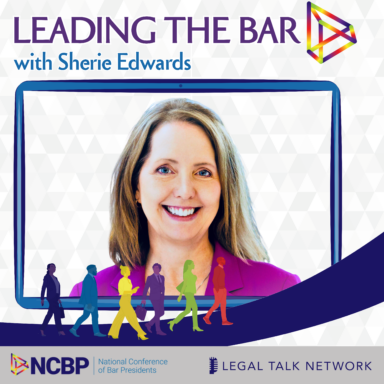

Sherie Edwards is the current President of the Nashville Bar Association, a past president of the Tennessee...

Amanda Arriaga is Chair of the National Conference of Bar President’s 21st Century Lawyer Committee. She was the...
| Published: | September 21, 2026 |
| Podcast: | Leading the Bar |
| Category: | Career |
“To whom much is given, much will be expected.” For leaders, that means embracing the opportunity to identify challenges in our communities and find meaningful ways to meet those needs. Amanda Arriaga welcomes Sherie Edwards for a conversation about the power of servant leadership and how bar leaders can inspire their members to engage, give back, and make a difference in their communities.
To learn more about NCBP or to become a member, visit ncbp.org
Sherie Edwards:
You need to have a reason why you want to do it other than it will look good on your resume or it will give you visibility in your community. It really comes down to service. It comes down to giving back. And there’s all different ways we can give back as leaders, but if you don’t have that burning desire, that passion, that mission, and the values of giving back to your community, you’re not going to have fun and you’re not going to be an effective leader.
Amanda Arriaga:
Welcome to the next episode of Leading the Bar. I’m your host, Amanda Arriaga. Today, I’m so excited to talk to my friend Sherie Edwards, President of the Nashville Bar Association. Sherri is a past president of the Tennessee Bar Association, board member at the Tennessee Justice Center, delegate to the ABA House of Delegates, and serves on the executive council of NCBP. She retired as vice president of corporate and legal at SVMIC, where she managed corporate legal matters, government relations, data privacy, and corporate services. She’s opening up a mediation practice soon, so if you need her help, let us know. Her proudest accomplishment is being a mother of three, grandmother of three, and dog mom of two. Welcome, Sherie.
Sherie Edwards:
Thank you, Amanda. So good to be with you today.
Amanda Arriaga:
I have a question I’ve actually never asked you before to start off. Why did you want to be a lawyer?
Sherie Edwards:
That’s an interesting question. I didn’t always want to be a lawyer. When I first started out through high school and… Well, let me go back to when I was in junior high in Philadelphia, there was a television reporter named Jessica Savage on, I think it was KYW in Philly. And I admired her so much that I wanted to be a television journalist and a reporter. So when I went for my first two years of college, I actually got my degree in journalism with a minor in English and got married right after graduation from junior college. I was going to go off to college, but fell in love as most good transplanted Southern girls do. I got married when I was 19. And when I was in my mid to late 20s, there was a leadership program in the county where I lived, and we spent one day with the DA’s office and in the courts, and I just fell in love with what they did and had all of a sudden a burning desire to be a prosecutor.
And so I went back, finished my two years of undergrad, and then I started law school. And when I was in law school, I had my first year, as most people do, I had a class in criminal law and a class in contracts. And I though criminal law was interesting, but I was fascinated by contracts and what you could do through contracts. And that just sort of changed the trajectory. Soon after I started law school, I got divorced and I got a job as a risk manager at the local hospital, and that’s where I learned healthcare law and tort law, and that just pretty much sealed the deal. So here I am 30 something years later, and I do not regret the path that I took.
Amanda Arriaga:
Sherie, I think this is why we’re such good friends because I also love contracts and people don’t read them. People are signing things. They don’t know why. And so when you have a contract expertise, whether it’s in the private sector or the government, it’s really valuable because folks are just signing all of their life away and they don’t even know.
Sherie Edwards:
My favorite was at work when somebody would bring me something to review and say, “Would you please review this contract?” And they had already signed it and I’m like, “Well, I can tell you what you might run into, but I can’t do anything about it now.” So getting everybody on board to let the lady down at the end of the hall read the contract first was really helpful. But yes, I love contract law. I love regulatory law, which served me well for 25 years with an insurance company. Nobody goes to law school wanting to be an insurance regulation, but that’s how it worked out for me.
Amanda Arriaga:
Well, I also think maybe our future career is, this is our audition for a legal version of The View because we’re technically on TV right now. We can break down things. We can make legal analysis interesting and easily digestible. Exactly. So when you’re ready to retire after mediation, let’s go do that.
Sherie Edwards:
Let’s do that. That sounds like fun.
Amanda Arriaga:
So I want to go back to when you were president of the Tennessee bar, and that happened from 2021 to 22. Remind us what the big issues were at that time.
Sherie Edwards:
Well, this little thing called COVID was a big issue at the time. So everything shut down as we all remember in March of 2020. And I was getting ready to start my year as president elect in June of 2020. And so everything had to pivot. All of our in-person CLEs, all of our in-person networking, that all changed on a dime. And the big thing was how do you keep everybody engaged during this? So when we got to June of 2021, when I took office, we were just starting to come out of COVID and people were very reluctant to do anything in person. And to a certain extent, they still are, although they’re getting better. And so my big thing in my year was half of my year was still COVID and still in place. And the second part of the year was to try to get people back out and going to in-person CLEs.
It did not help that our Supreme Court, like many others, and I have a great deal of respect and admiration for our Supreme Court, so don’t get me wrong, but they went ahead and changed the CLE rules from you could only get six hours out of 15 online to you could get all 15 hours. And people are going to say, “If I can get them at home, sitting in my running shorts in my pajamas, rather than have to get up and dressed and go somewhere, I’m going to do that.” And so the challenge that part of the year, the last part of the year was getting people back out.
Amanda Arriaga:
Yeah. And it’s interesting because since that time, once we learned everything could be hybrid, now folks still want it to be hybrid. And there remains a challenge really in any industry because half of us need to be in person because we need to see people. And then half of us are desperate to be in our soft pants and to be able to multitask from home.
Sherie Edwards:
Exactly. So
Amanda Arriaga:
It’s a real challenge that still exists. It’s a
Sherie Edwards:
Challenge and it’s a problem for two reasons. The first reason is mental health. When people are isolated as they were during COVID and as some still are because either they are fearful of getting out and getting sick or they’ve just gotten used to being on the couch in their comfy pants, isolation is not good for any of us. So getting people back out, getting them networking, seeing each other, that’s one issue. The other issue to be very blunt is revenue. When your revenue is dependent on membership and CLE and all of a sudden your folks can get their CLE anywhere online, the challenge then is making CLE so compelling that they can’t get anywhere else that they’re willing to come out. And I’m seeing that more and more this year. We have more and more members coming to our CLEs. We’re having bigger attendance. So I think we may be getting past the point where people just want to sit on the couch in their comfy pants, I hope anyway.
Amanda Arriaga:
Well, and your path is interesting because arguably you had the bigger bar association you’ve already led with your state bar, and now you’ve come home and you are head of your local bar. So how did that happen? And tell us what you’re doing with the Nashville Bar.
Sherie Edwards:
They are very different. Let me just say that. And it’s funny, I was just having this conversation with a rising 3L who asked me the difference between the two. So Tennessee, if people aren’t familiar with it, is a very long, narrow state. And it takes three hours to get from Nashville to Memphis and it takes almost three hours to get from Nashville to Knoxville and then another hour to get up to the Upper East Tennessee area of Kingsport and Johnson City. So when you’re president of the Tennessee bar, you can’t go to everything. You have to pick and choose. Are you going to do something in Nashville? Are you going to do something in West Tennessee? Are you going to do something East Tennessee? So even if COVID hadn’t been an issue, I still wouldn’t have been able to get out amongst our members like I can as Nashville Bar president.
Being here in Nashville, it is pretty contained. So last week I was able to go to four different functions. I tried to get to as many as possible because I’m here and I know more of our members, which is great. I hear more of our issues, which is also great. And out of some of those issues come some of our programs. So this year before COVID, we had what we called our collegiality coffee where we would meet at the courthouse on a Friday every quarter and the judges would come down when they had a break in trial and the attorneys would come in and out and they got to know each other and they got to talk to each other. That went away a few years ago with COVID and somebody asked me about it and I said, “Well, why don’t we do it?” And so we have brought it back.
We’ve just had our second collegiality coffee and we had a fantastic turnout both of judges and of attorneys. And our membership surveys that we do every couple of years have consistently shown that what our members really value in our Nashville community is the relationship we have with our judges. Our judges, besides the fact that I’m friends with most of them because I’ve known them forever, they are just so warm and inviting. They’re great judges and they’re tough when they have to be, but they put people at ease and they do not hesitate to come to our functions and get to know the attorneys that are in front of them and also the corporate attorneys. So that’s one of the things we’re doing. Another thing that we’re going to institute in just a little while, maybe next month, is a community legal resources and pro bono committee.
So the Nashville Bar has several legal resources for our community that are kind of scattered. We have our attorney directory that attorneys can pay to be listed under a category and that gets, I’m going to say 50 to 75,000 hits a year. Then we have our LRIS, our legal referral and information system where people can be matched with an attorney in the area they’re looking for. The attorneys pay a fee to be listed, the person pays a fee to be matched, and they find an attorney that way. We also have Diala Lawyer every month where we have a great group of very dedicated attorneys that come in the first Tuesday of every month for a couple of hours. We give them pizza and in return they sit there and they take general information calls from the public. So those are very well known. One thing that some of our newer attorneys do not know is that our legal aid of Tennessee and the Cumberlands actually was born from the Nashville Bar years ago that we had a group of gentlemen who saw the need and started Legal Aid.
And so one of the things that this committee is going to do is bring that attention back to Legal Aid and encourage people to give their time, their treasure, their talent, to help the many, many people in our community that really could truly benefit from having legal aid. We’re also starting, and I’m going to a meeting this afternoon of a new committee called Grand Older Lawyers Division. So we all know about YLD. We all know about young lawyers. John Tarpley, who was president of the Tennessee Bar years ago, Gail Ashworth, who was also president in the Tennessee Bar, and Jackie Dixon, who was president. We all got together a few years ago at an annual meeting of the ABA before House of Delegates, and John had this idea for the Grand Older Lawyers Division, and he is now on my Nashville Bar board and he didn’t even ask if he could do it.
He just came to me and said, Gail and I have met, this is what we’re doing and we’re running with it. And what that will do in addition to having fun, mentorship of younger attorneys, especially those that are coming out of law school and can’t find a job, so they’re putting out their own shingle, but we have a need in our community for more guardian ad litem. And so we’re going to be doing some training for older, maybe retired attorneys to get into the trenches doing the guardian ad litem work. So I am very, very excited about all of those programs. I have loved being president of the Nashville Bar. I think, I hate to say it, almost more than I loved being president of the Tennessee Bar, just because I can see everybody and be very involved.
Amanda Arriaga:
Well, you’ve got to be a great role model to your members because you went from leading statewide to leading locally, and now all these new programs are to encourage lawyers to give back locally, right? Because you can get very myopic and very focused on, I have to make money, I have to do the work, I have to bill the hours, but you also have to give back. It’s not really worth it.
Sherie Edwards:
What is the saying, and I always get it wrong, but to whom much is given, much is expected. And it’s how I was raised. I don’t come from means. I was very surprised one time when my mother told me that I grew up in a lower middle working class neighborhood. I didn’t know that. I just had a great childhood. But we were always told to give back and I watched my mother do that. My mother was a nursery school teacher and she was a girl scout leader and my grandmother was a scout leader, both boys and girls. And so just that ethos of being involved and giving back to your community, I feel is very ingrained in me. And that is what I want our bar to understand that there are so many issues out there that we can help with because we have that training and we’ve been blessed with the intellect and with the ability to take what we’ve learned as attorneys and apply it to solve problems.
So hopefully I’m a good example. I try. I try.
Amanda Arriaga:
Important question. What is the age range for the grand older lawyers?
Sherie Edwards:
Technically 50 and above, but we’ve already had several attorneys in their late 30s and their 40s ask if they can join too. So all are welcome. All are welcome. Plus we need somebody to help us get out of our chairs.
Amanda Arriaga:
Well, it’s interesting because there’s young lawyers and that’s defined. And at least in Texas, it was 36 until we all turned 36, then we increased it to 40. And so now you can be a young lawyer or you can be a grand older lawyer, but I don’t know what to call us in the middle because we’re millennials. We need love too, but also it would be weird to be, we’re youngish lawyers, but 50 seems very young to be a grand older lawyer.
Sherie Edwards:
I think 50 is awfully young because I haven’t been 50 in years, but I think having more people there at the table just makes it better for everybody, especially when it comes to mentorship and to giving back to the community.
Amanda Arriaga:
Yeah. If there is a brand, a group that people want to be a part of so they can give back, we’ll put a name on it so that you want to be part of that group.
Sherie Edwards:
Absolutely. Absolutely. That’s one of the challenges I think that all bars are facing right now is when people age out of young lawyers, but they’re not yet seasoned veterans, we lose them there. And so the trick is to keep them involved, keep them engaged in leadership, in volunteer activities, in teaching CLEs. And so I’ve been pretty deliberate this year in making sure that my committee chairs are in that age group.
Amanda Arriaga:
So Cheri, can you tell the group, when did you find NCBP and was it a resource that you knew about when you were Tennessee bar president?
Sherie Edwards:
It absolutely was. So the Tennessee Bar Association has a really good longstanding tradition of getting the president elect involved. The vice president is involved to a certain point, but they pay for the president elect to go to all the NCPB meetings. And as a matter of fact, Jonathan Cole, who is now the ABA Speaker of the House, is a former NCB president. We have several former TBA presidents that have been NCBP presidents. So I knew about the resources that were there, but I didn’t know how great it was until I actually got involved. And I cannot imagine not being involved. It’s such an incredible organization. It has so much to offer for future leaders, present leaders, and even past leaders like myself who are crazy enough to jump back into it. But there’s something there for everybody and the friendships that you make, as you know, are just second to none.
Having friends and a network all over the country is just so precious and special.
Amanda Arriaga:
I think you’re the first guest that we’ve had that knew about NCBP coming into your presidential term, and then certainly now you get to be on council as you are president of Nashville. But I think it’s typically a very well kept secret and we need more people to know about the secret because as you know, most bars, depending on where we are, we might have slightly different challenges, but we have basically the same problems, governance, how to increase members, how to make more money, how to keep members engaged. And with all of us that are involved, we have answers to those questions.
Sherie Edwards:
That’s the truth. And I don’t know how other bars handle it, and maybe it’s getting to the executive directors and letting them know the value of being an NCPB member. My executive director for a while didn’t realize that you could have five leadership members on our membership, and now we do have people that are looking at the resources and being involved, which is so very important. But we have some bars, as you know, Amanda, that don’t even have staff. And those are the bar associations that could so benefit from everything that NCBP has to offer. So as membership chair this year, that’s been my challenge is how do we get to those members that don’t have bar executives?
Amanda Arriaga:
The other thing about NCBP that I think most people don’t know is with a group that is all former bar presidents, it’s the leaders of leaders, you would think there might be some competition of, look over here, listen to me, I have the best idea. And I don’t find that our council works like that at all. We have great relationships. As committee chairs, we’re very collaborative even when no one asks us to be. And I wish that people would know that so that they would want to come talk to us.
Sherie Edwards:
You are so right about that. And one of the things I was interviewing board members recently for another board that I sit on, and one of the questions we asked is, what are some of the challenges that you have seen sitting on other boards? And to a person, they all said, you always have that personality that has to be out there, that has to be heard, who has to talk over everybody else. And I thought to myself, I’m so fortunate. I don’t have anybody like that on my Nashville Bar board, and there’s nobody like that on our NCPB executive council. I mean, I think we’re all friends. Some of us are closer friends than others because we have our little group too, but everybody does a really great job of letting each other talk, of really having great debate over issues because we’re not always of one accord, but with any good board, you can have that debate as long as it is respectful.
But when you all walk out of that room, you have to be of one front and one accord where things start to fall apart. And I don’t think people realize that because you would think everyone around that table has an ego. I mean, even if you don’t think you do, you have to have an ego to decide to run for president of a bar association. And so I think we work very well together. You’re really right about that.
Amanda Arriaga:
Well, and it’s interesting. I think the reason that people form real friendships is because I like people that are fun and interesting, but if we have to work on a project, I like people that get things done. Exactly. We can’t be friends if you commit to doing something and then you don’t do it. So it’s nice that our group actually has that. And when it’s appropriate to speak up, we do. The group that you mentioned that we formed, maybe not everyone’s going to like this name. We can cut this out if we need to, but I deemed us the Maali Broads because we are not afraid. A group of strong women came in not afraid to speak up when things seem wonky, when they could go in a different direction. No one speaks just to speak, but everyone that is raising their hand has a real message that drives the initiative forward.
So I am proud to be a Maldive rod. Me too. I made merch for us to do that. And we have some of the men have asked to be in the Maldive Broads as well. We welcome the Maldive Bros. We welcome those Maldive Bros.
Sherie Edwards:
I don’t think there’s anybody around our table at the executive council meeting just as I don’t believe there’s anybody around my board table at MBA that is there simply to pat a resume. They are there because they love the legal profession, they want to give back and they want to lead. And what is our saying, president for a year, leader for life? And it is the truth. You get that, it’s ingrained in you and it carries over to everything else that you do.
Amanda Arriaga:
So million dollar question, something we talk about all the time. In your opinion, what is the biggest issue facing a bar leader today?
Sherie Edwards:
Well, there are two. One is pragmatic, which is how do we get members? How do we keep members? Members are the lifeblood of our organizations. We can’t exist with no money in the coffers. And you bring in revenue through memberships and you bring in revenue through CLE and you bring in revenue through non-dues revenue. So getting people in the door… I’m a different generation than you. I think I’m Generation Jones or something like that is what they call it now. I’m evidently not considered a baby boomer anymore, but my generation was raised to be involved in the Bar Association, to go to the conventions, to be on committees. And I think as we get into each generation, thankfully it’s more of a work-life balance thing, but people are saying like, “No, I’m going to put the brakes on that right now because I don’t want to go to another bar function.
I want to be home with my kids or I want to be coaching softball or going to scouts and all.” So I think that is one issue. The other issue is rule of law issues, to be very honest, and making sure that people understand this is not a political issue. Rule of Law is not political. Rule of Law is fundamental to our democratic way of life and goes all the way back to the Magna Carta. And so when we’re talking about these issues, we do have to balance because again, we need our members and we don’t need people dropping away because they don’t like what we said. But one of the big differences between being Tennessee bar president and being Nashville bar president is quite honestly the political landscape. Tennessee is considered a red state. I don’t know if it’s a red state or a low voter turnout state, but it is a red state.
And so if you’re state bar president, you have to be very careful not to even get into those issues because if you do, it’s going to be political. Whereas in Nashville, we are blue for the most part, but we have members that are Republicans and we’ve got to be careful with how we say things, but they still need to be said. I think that’s the balancing act for the president and by extension for the governance committee and the board is making statements that resonate with everybody that are not political. And sometimes you just have to come right out and say, “This is not a political issue, this is a democracy issue.” But still bring them up because if we can’t ignore it, we are the ones, the attorneys are the ones on the front line, the bastions of democracy who can help to make sure that we can keep rule of law in place, that we can keep constitutional rights in place.
So we can’t be afraid to talk about it, but we just have to temper it.
Amanda Arriaga:
Well, you have been a leader for so long. I know that you have mentored so many people. I am one of those people that you mentor, but I wonder who is still mentoring you?
Sherie Edwards:
Jonathan Cole. Without a doubt, Jonathan Cole. I know I can pick up the phone and call him if I have a question about something going on at the Bar Association or with the House of Delegates and we’ll sit and talk. The people I said earlier, Gail Ashworth, Jackie Dixon, John Tarpley, who Gail was also a Nashville Bar president and TBA president. There’s five of us doubles who were both metro and state. John Tarpley, I can pick up the phone and call him anytime. Since I’m not practicing law anymore, I don’t really have any legal mentors, but there are a few people that I look to for mediation guidance and questions. So just different mediators around the city, Anne Hunter being one of them, she’s great.
But those are my mentors. The person I look up to the most though is my mother. She always had faith in me, has always been behind me and encourages me to do anything. And so maybe I talk a little bit too much with her sometimes in terms of I just talk and talk and talk, but she is the person I look up to. She put aside her own wants to follow my dad to Nashville so that he could actualize his dream as a musician. So I really look up to her a lot, but I do have some great mentors. Joseph Hubbard, I look to him because he was our immediate past president. So I’ve got a wealth of people that I can look to and call and it’s a wonderful position to be in.
Amanda Arriaga:
Well, you know what I love is that you keep saying you’ll pick up the phone. And I know that that’s true because you and I will text and then eventually we’ll just say, “Can I call you?” Because there is something different. We could send text messages for an hour about an issue or we could just talk about it. And so when you say, “I’m going to pick up the phone,” I know you do because we do that.
Sherie Edwards:
Well, I believe we have, I think as a society, and again, I blame this on COVID and I blame it on social media, we have lost that ability to connect face-to-face. And when you’re looking somebody in the eye or you’re talking to them on the phone and you can hear the inflection, there’s a big difference between texting, “Hey, I’m doing fine,” and talking to somebody and hearing, “Hey, I’m doing fine,” or, “Yeah, I’m doing okay.” Then you know to follow up with it. You can mentor by Zoom, but mentoring face-to-face is so much better. You can get answers to your questions by picking up the phone and talking because when you have more questions that come from that conversation, you can just naturally flow into it. So I am a big believer in person-to-person communication. I think we have lost that. I think this is another one of my soapbox issues.
I think that’s why we as a society have lost the ability to disagree agreeably, if that makes sense. We don’t know how to discuss politics. We don’t know how to discuss issues of the day without going like this with each other when we don’t agree. And we need to understand, as I just wrote in my recent column for the Bar Journal, our founding fathers were not of one accord of going away from Great Britain. They fought. They had some knockdown, drag out arguments about it. Some people wanted to stay, some people wanted to leave, but in the end, again, they were of one accord going out that door. They had to be. They were either all going to make a new country together or they were going to die together. And so I just truly believe that that face-to-face or voice-to-voice Communication is so, so vitally important, especially in this day and time.
Amanda Arriaga:
Well, and I hear that it’s controversial for some reason, but if you are not available for a phone call, I love to leave a voice note because I think it’s important not just to tell you, “Oh, something fun happened,” but I want you to hear the story in the way that I am telling it. And I’ve heard that the kids these days find it very aggressive to leave a voice note. That’s too bad. If I’m leaving you a voice note, I want you to know what I am feeling when I’m telling you that story.
Sherie Edwards:
Exactly. And I need you to teach me how to do that because I still haven’t been able to figure it out.
Amanda Arriaga:
When I see you next, I will teach you because it’s amazing.
Sherie Edwards:
Wonderful.
Amanda Arriaga:
So speaking of when I will see you next, you have a lot of non-legal passions and I am lucky enough that you have shared your love of food and wine with me and some of our friends. So tell us about those passions and why those are important to you.
Sherie Edwards:
Okay. Well, food. I like to eat. I wish I’d like to exercise more than I do, but I do like to eat. And we have some fantastic restaurants here in town. One of them I happen to be a teeny tiny baby investor in, but I love going to restaurants in any city I go to, whether they be a Michelin Star Restaurant or the Best Taco Joint in San Antonio. The wine came along… I started out as a bourbon girl, to be really honest. And I still do like bourbon, but I have several friends who have their level one, level two, and I think one may even have his level three sommelier. And I just got so interested and caught up in that world that now I am studying and will be taking my level one probably within the next month or so. So those are two big interests, but also travel.
I love to travel and I sit on the board. I’m the vice president of Sister Cities of Nashville. We have 10 sister cities. One of them in Normandy is also a sister bar of a Nashville bar. And we go back and forth every year and have legal education and also just do fun stuff together. I’ll be going to Con Normandy this September as president of the bar. So that’ll be really a lot of fun. And then there’s the kids and the grandkids and the dogs and movies and all sorts of things that I’m passionate about.
Amanda Arriaga:
If you need help identifying more sister cities, I think I’ve got a group that will help serve as your ambassadors and we will travel with you and we will go places so that we can make sure that those fancy foreign lands become sister cities with you. Because if we’re sisters, then using the transit of property somehow, Austin is a sister of Nashville, is now a sister of Norway.
Sherie Edwards:
Exactly. Exactly. We’ll do that. I’ll take you up on it. I
Amanda Arriaga:
Love it. Matter
Sherie Edwards:
Of fact, I’ve got a big milestone birthday coming up in a few years and there’s going to be a girls’ trip to Italy and you’re on the list. So there you go.
Amanda Arriaga:
Amazing. I have signed up. Whenever it is, I am going. Good. We’ll do another one of these recordings from there.
Sherie Edwards:
Oh, that’d be fun.
Amanda Arriaga:
Yeah.
Sherie Edwards:
That’ll be fun.
Amanda Arriaga:
So what advice would you give to attorneys who want to follow in your footsteps?
Sherie Edwards:
I’ve been giving this one a lot of thought and I think it goes back to resume building. You have to have a passion for bar leadership. You have to have a passion for helping your profession. There’s a lot of things that you can do as bar president. I was lucky when I was in the state bar to be able to have that platform to talk about mental health. And actually my daughter who has had her mental health challenges and is a paralegal, a very good paralegal, was able to write one of my president’s columns about it.
You have to have your why. I’m a big Simon Sinek fan and he talks with Start With Why. What is your why? What is your reason for going into bar leadership? And that doesn’t have to be being president, that can be being a committee chair, that can be producing a CLE. There’s all different paths to bar leadership, but you need to have a reason why you want to do it other than it will look good on your resume or it will give you visibility in your community. It really comes down to service. It comes down to giving back. And there’s all different ways we can give back as leaders, but if you don’t have that burning desire, that passion, that mission, and the values of giving back to your community, you’re not going to have fun and you’re not going to be an effective leader.
So that’s the advice I would give. The other thing is if you’re going to be a bar leader, you have to be willing to get in there and do the things that you’re asking your bar members to do. So we are going to be doing some things at a place called The Store, which is a local pantry and asking people to sort food and all. I’ll be there. We’re going to be doing stuff with Second Harvest. I’ll be there. We’re going to start working with the Girl Scouts on legal career badges. I’ll be there. You have to, as a leader, and that’s how I ran my departments at work too. You have to be willing to do what you’re asking your people to do and show them by example that no job is trivial. And one of the things that I tell new attorneys is treat everybody with the same respect.
Whether it’s the judge or whether it’s the janitor at the courthouse, you treat everybody with the same respect because nobody is more important than anybody else. We just all happen to have different gifts. And so I think as a leader, we need to prove by our example that we can walk the walk, not just talk the talk.
Amanda Arriaga:
Well, you’ll be wrapping up your term soon as Nashville Bar President. What is next for you?
Sherie Edwards:
Well, starting next June, I’ll be president of our local Inn of Court and I’m also vice president of Sister Cities. So I think I’ll be president in two and a half years of Sister Cities. So between that and travel and I may be getting back involved with the Tennessee Bar Association, who knows? And trying to get my backyard to look like an English cottage garden, that’s going to take several years of work. That’s another one of my passions. But just going where I can be of use and being of service while still getting to spend time with my family and my great friends, my grandson next year in 27, I have one grandson going off to college and one going off to preschool. And then my little granddaughter will be a year old and we’re filming this in June. So in just a couple of months, weeks in July, she’ll be a year old.
And so just spending as much time as I can with them, that’s on the horizon. That’s all on the horizon.
Amanda Arriaga:
Well, you are an amazing lawyer, leader, mediator, and I expect more great things for you for years to come and I’m excited to be doing some of them with you.
Sherie Edwards:
I am too. Thank you so much. This has been fun. This has been a lot of fun.
Amanda Arriaga:
Yes. Thank you for being with us today.
Sherie Edwards:
Absolutely. Thank you.
Amanda Arriaga:
On behalf of the National Conference for Bar Presidents, thank you for tuning into this episode of Leading the Bar. For more information about membership or getting involved, visit ncb.org. To catch up on episodes you may have missed, you can find us wherever you get your podcasts or watch us on YouTube at Bar Presidents.
Notify me when there’s a new episode!

|
Leading the Bar |
Bar presidents share strategies, tools and insights for attorneys growing into leadership roles. Learn from real stories of growth, crisis management, and innovation in NCBP's Leading the Bar podcast. Listen monthly for compelling stories the next generation of lawyer-leaders can use to develop skills, confidence, and vision to lead with purpose and integrity.