

|
|

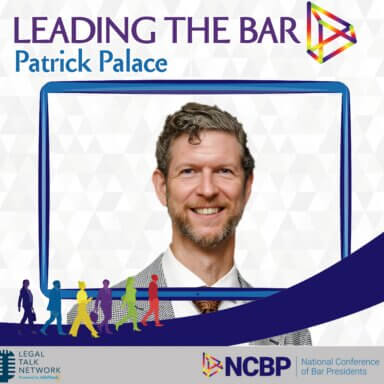
PATRICK A. PALACE is the owner of Palace Law and Palace Personal Injury Law Group. Palace Law...

Amanda Arriaga is Chair of the National Conference of Bar President’s 21st Century Lawyer Committee. She was the...
| Published: | February 2, 2026 |
| Podcast: | Leading the Bar |
| Category: | Career |
Six months into his presidency, Patrick Palace joins host Amanda Arriaga for a candid check-in on his leadership, priorities, and vision for the future. Patrick reflects on the path that led him to the practice of law and the values that continue to shape his work, especially his dedication to preserving the independence and integrity of the legal profession.
The conversation explores his efforts to create engaging, meaningful programs that make learning enjoyable for lawyers, as well as the mission behind the Leading the Bar podcast as a platform for thoughtful leadership. Patrick also discusses the Pledge to Preserve the Independence of the Legal Profession and the Judicial System and why this oath matters now more than ever.
Looking ahead, Patrick shares what’s next for the remainder of his term, including his hope to support regulators with resources and guidance, and preparing for the NCBP’s two upcoming conferences—the Midyear and Annual meetings.
Learn more:
Patrick Palace:
We need to stand up for our profession and our core values and uphold those no matter what is popular, no matter what politics does. Because this isn’t about politics. This is about maintaining the integrity and the professionalism and the independence of our profession.
Amanda Arriaga:
Welcome to the next episode of Leading theBar. I’m your host, Amanda Arriaga. Today I’m joined by NCBP President Patrick Palace. Well, Patrick, today it’s just you and me and we’re chatting together as a six month check-in to see how your term is going. This episode airs the week of our mid-year meeting in San Antonio, so I’m happy to invite y’all to my home state. The audience has heard you and your insights in many of these episodes, but I want them to get to know you as a person a little more. So we talked in a previous episode about why you wanted to lead the Washington State Bar and NCBP, but why did you want to be a lawyer?
Patrick Palace:
Well, alright, sure. Start with easy ones. Let me say this. Thank you, Amanda. I mean, I love being on this podcast with you and while we’ve had the chance to kind of co-host and do some things, we’ve never had the chance to sit down and have a cup of coffee and have this conversation. So I’m looking forward to this, but alright. Reasons I want to be a lawyer to start this thing out, huh? Well, I guess it’s as simple. I came from a household where it was important to do something for your community. My father was a social worker. My mother worked for and supported people with cerebral palsy. I grew up in a household where my mother would throw us in the station wagon and we would head out to some creek to watch to make sure that people weren’t polluting it. We had some guy in a neighborhood that had an insecticide company and was dumping pesticides into the creek.
And so we would stake out the creek after school and stop him if he was there to do it. So I think I came from this belief, this household where we have a duty to do in our daily lives as part of our community to protect people, to look after others, to help people less fortunate. And I think that’s probably the impetus that I came into saying I want to be a lawyer. Although the lawyer was not the end run for me, it was not the end of the goal. The goal really was to go into government work. I really wanted to be in Congress, the legislature where I could make the biggest impact to help the most people as I have grown up and the years and the decades have passed, that idea of public service through Congress to me hasn’t been as fruitful or productive as the work I can do as a bar leader and as a lawyer pursuing cases and trying to make better law and be as a bar leader and trying to make a better profession. And so I’ve stayed right here. I never took that second step to get into politics I thought I would want to do, but it turns out this was a better step.
Amanda Arriaga:
Well, I told you before, but there’s still time. But I love hearing that essentially you grew up with Erin Brockovich and she was like, watch this creek and shame those people.
Patrick Palace:
There’s some, it’s funny because Erin Brockovich and I have talked about something like that, about our backgrounds anyway, but yes, you’re right.
Amanda Arriaga:
Yes. And that’s why today still you love Patrick’s Creek and you want to be around water as much as you can. I get it
Patrick Palace:
That true or protect the fish in that creek so I can catch him, right? Yeah.
Amanda Arriaga:
So it’s your six months mark as NCBP President, what are you most proud of having accomplished so far?
Patrick Palace:
I think people know that you don’t just subtly become president, like it’s a long process. I was president with the Washington State Bar in 2013, 14 and have been part of the NCBP since then leading up to today where I’m now president. So it’s been a journey as you pass up to state bar president, state bar president to the NCBP. But the last couple of jobs you have before you become president is running the programs, the mid-year and the annual program. And I’m proud of where we’ve brought that process for those of you who’ve been to CES for decades, that it’s talking heads at a desk, maybe at a microphone, and they’re not really very entertaining necessary unless you have a great speaker. And I really wanted to, and I think the executive council wanted to change what we did for our programming to be more entertainment, less talking head CLE, and to put on really a production, some entertainment to bring things to you that maybe are very educational and help you in your leadership path, but also are really fun.
And I think we’ve really kind of transitioned to follow in the path of Clio for those who’ve gone to CLE Con or back in the day omics that really put on a show for you. And that’s really where we’ve headed with the NCBP and I hope we keep going that direction to make this more of a production that gives you all the value of how to be a leader and what to do. So I’m proud of where we’ve headed there. I’m also very proud of this podcast, Amanda, and you’ve been an important part of helping me bring this to fruition and the committee to come up with the ideas to create this, but giving us this voice of leadership and the opportunity to share the diversity of life experiences and leadership that we have in the NCBP and at our executive council, I think really is critical.
So much we have to offer and so many ways we can help steward leadership and build leadership. And this podcast is one of those megaphones to be able to do that. And I’m very proud of this podcast. And then the other thing that’s happening is this pledge, and I know we’ll talk about that more, but I think it’s important that the NCBP has some unifying programs, some unifying campaigns that bring the nation’s bar leaders together under one tent for one purpose to achieve the goals of creating a better profession. And I think that’s the other thing that we’re doing now and will be the wave of the future for the NCBP.
Amanda Arriaga:
Well, since you still have six months to do some more exciting programmings, might I encourage you, you won’t be surprised to hear this idea. Might I encourage you to lean into the edutainment of it all and add musical numbers? I mean, Hamilton people learn through music in Austin. We have done CLE presentations that are full scale musicals. Just think about the song they had it coming. It could be about any bad actors and their ethical violations. This stuff writes itself. I’m sure we could get volunteers.
Patrick Palace:
I will begin composing immediately. Thank you. And I know I have my lead singer available at any given time to bring it down the stage. So thank you for volunteering, Amanda.
Amanda Arriaga:
Thank you. I just think that’s what’s going to bring this country together is more edutainment and you made reference to it. One thing that I really want to talk to you about is later this week we will be in San Antonio for our midyear meeting and you have a special request of the group and a special presentation. Tell us about the pledge to preserve the independence of the legal profession and the judicial system.
Patrick Palace:
Yeah, thank you. It really is something that has been very important to me and these last couple years thinking about what if I had to pick one thing that we could do as barleys cross country, where would it be? And we focused on both our oath and the preamble to the rules professional conduct that really set the values. And I’m talking about the core values of our profession. And I think most lawyers when they take their oath and they raise their hand and they go before a court, it’s more about I’m finally getting in to be a lawyer. I’m finally getting into theBar. And you have your family there and a judge, maybe you’re nervous and maybe you don’t even remember all of the words that you said, but somewhere over the course of your practice, I think every lawyer has that aha moment when we face those rules of ethics or that oath that we took squarely in the face and see it for what it really is and the importance of it.
And I think about some famous figures in history, and there’s so many you can choose from, but John Adams agreed to defend the British soldiers that were charged in the Boston Massacre, probably the most unpopular decision he could have made at the time that jeopardized his entire career. And yet he was clear that the rule of law was more important than popularity. And of course that story’s become famous. We have other lawyers are more fictional like Atticus Finch, right? And to kill a Mockingbird who takes on impossible case, there’s no way to win. And he realizes that this is a moral judgment that we all have to go through. And I think whether you’re faced with theBar complaint or opposing counsel doing something that you really question or you take on a case that you just know you can’t win and you’re taking anyway, there’s lots of situations that we as lawyers can get into over the course of our careers that make us look more carefully at what our duties are.
And our oath is when it really counts. And what this pledge is, is an opportunity for lawyers to come back and revisit that oath, that set of core values that we have as lawyers that help us keep the practice of law independent and support the independence of the judiciary and support our constitution, both state and federal to really make sure that we give public confidence in the judicial system and in the legal system and fight for justice for all and protect due process. All these things that fit into I think our important core values. But the pledge was written really in response to the reality that I think most lawyers know oh so well, that there are great big changes going on, polarization and uncertainty as being a lawyer at this time and technology is reshaping how legal services are delivered. The judiciary and legal profession are being drawn into legal controversy simply for doing our work and for their work.
And it seems important that we can’t just sit by silently neutrality or an acquiescence that we need to stand up for our profession and our core values and uphold those no matter what is popular, no matter what politics does. Because this isn’t about politics, this is about maintaining the integrity and the professionalism and the independence of our professions because we are really the guardians of our own institutional integrity. And I think that together, we as lawyers really are the bulwark for justice. And it doesn’t mean that we have to agree on every issue, just that we have a set of core values and principles where disagreement is possible within the rule of law. And that really is kind of the background for why we created this pledge.
Amanda Arriaga:
And that’s sort of why I asked. It wasn’t random. Why did you want to be a lawyer? Because as we look at the oath and the pledge, if everyone thinks about why they wanted to be a lawyer, my guess is they have a pretty similar story. It’s usually truth and justice. It’s sometimes also money, but it’s usually truth and justice. So thinking about why you wanted to be in this field at all and then coming full circle to why is it still important today? Makes perfect sense.
Patrick Palace:
Well, there’s parts of this pledge that I think as you hear ’em again, right? We all gave this oath. We all know what our rules of professional conduct are and most states, all states have them listed. Then preamble, these core values I want to go through, if you don’t mind, and just highlight a couple of these pieces of this pledge. There’s seven of them, and I won’t go through all seven, but I do encourage people to take a look at the pledge. But the first one is the one that you take when you raise your hand in your state, and that’s to uphold the rule of law and the constitution to support and defend the constitution. That’s kind of a our job to do that. The second one is preserving the independence of the profession. And as I’ve traveled around the countries this year and talked to bar leaders and spoke at conferences, I’ve had the pleasure of being able to dig a little deeper into every state’s unique rules.
And I really like Montana’s rules. Montana is kind of like the wild west in some ways. They’re a very tight bar, but they really, really believe in their independence. It’s really important to them. And they wrote this language in, and we put this into our pledge that self governments of our profession safeguards the public from tyranny and ensures that justice remains free from political influence. And I think that is kind of a mantra in Montana, and I loved their independence and it’s written very strongly in words like that into their preamble. Another part of this pledge is upholding legal process and respect for the courts. And I think in this day and age where in politics, it’s okay to der or undermine district court judges or judges in our system. And I think not only does that fly contrary to who we are as lawyers, but it does great harm to the public perception of the credibility of our judicial system.
And it does great harm to us as being an independent profession that is not affected by politics or politicians or money or power that we run by our rules and our core values. I think maintaining that independence and that respect is really, really critical. And then the other one that fits very much with that is preserving public trust and confidence in the legal system. When people give up on the justice system, you’re giving up in part on the dream of democracy. There’s no longer an equal playing field, an A level playing field. So I think preserving public trust is critical. The other things that I’ll just touch on these that are part of the pledge and ensuring access to justice, advancing professional excellence and ethical leadership, right? The ideals of truth and integrity and service and that we as bar leaders in particular, but all of us as lawyers are leaders and need to be servants and mentors for those who we bring into the profession.
And last is a pledge to collaborate with one another across jurisdictions and disciplines and perspectives to strengthen the unity of the profession. And I think that unity is important if we are to be guardians of this profession and protectors for its future and stewards for these core values that define who we are as lawyers and have defined who we are as lawyers for at least 250 years, who define the John Adams of the Atticus Finches of this world. So there are professional remains, independent and a force for truth and justice and freedom. And that’s really at the core of why we’ve created this pledge and why we’re asking everyone to participate in this pledge
Amanda Arriaga:
For our audience. We can put a link in our podcast notes to the full text of the pledge and also a link to the NCBP website where the pledge will also live.
Patrick Palace:
And I hope everyone will consider, and as we as members of NZBP and I and perhaps you, Amanda, travel around the country over these next months talking to bar leadership and to bar conferences and asking people to sign, I think there’s importance in everyone being on the same page and renewing their pledge and renewing their oath. And it’s important when we can all stand together in defense of our profession and renew our vows and renew our oath. Again, not as a political act, but as a reminder of who we are as a profession and the core values we’ve carried through for generations. And I’m hoping that everyone will join us in the recognition of this document and recognition of those oaths that we have taken as lawyers in every state across the country, and to declare very clearly who we are and where we came from, why we took the oath, that we stand for justice and independence in a better society for all. And that will be truly the bulwark to protect and insulate our profession from whatever outside influences it may be out there trying to change or modify who we are and what we do. And I encourage everyone, all of you to go to the website, to read the pledge, to sign the pledge, to put your name on it, to reestablish who we are and what we do and continue to protect this profession to be independent.
Amanda Arriaga:
I have a logistical question for you. We know that not all lawyers are part of NCBP. Not all lawyers get to lead a bar association. Not all bar associations are members of NCBP. If you are one of those folks who are interested in the pledge and want to do something to help, but you’re not one of our members, can they still participate?
Patrick Palace:
Yeah. This pledge is for all lawyers. All lawyers are leaders, all lawyers take this oath, take their oath to become a member of theBar. So this is for all lawyers. We’re reaching out to bar presidents and to bar boards to be the foundation for the endorsement of this pledge. That’s why it’s important to have all bar presidents and boards signing off and building this. And we’re also reaching out to a committees and organizations, affinity bars, specialty bars, local bars. I think it’s important that everyone feels involved, that everyone feels that it’s, and I’ve said this before to audiences that so much of this oath, it really is about our own behavior. It’s not just promising to do something. It’s not just I’m a lawyer, I stand up in court and I advocate. It’s about your behavior, how you play this out every day. And so that’s not about being a member of the NCBP, that’s not about even being a bar president. That’s about being a lawyer who values their profession and who they are and takes pride in the generations of history, the shoulders that we stand on. So yes, everyone can sign this and hope everyone takes a look and a read at this pledge and joins us.
Amanda Arriaga:
Do you have a goal, I’m thinking about a thermometer with that gets higher and higher as you get more signatures. Would you agree that if you got, I don’t know, 500 bar associations, you would sing a solo in our upcoming lawyer c musical,
Patrick Palace:
As tempting as it is to want to be on stage and sing with you? Amanda, I have to tell you that really the goal of this pledge is the visibility of it, not actual signatures. And I’m a lawyer who loves data and metrics and KPIs. It’s a great way to say, are we successful at coming signatures we have, but at the end of the day, it’s really about getting visibility. The more people that read it and hear this and engage in it, the more successful we are, whether or not they sign it. And I hope people do because I think that helps the visibility, but that’s not for me. What defines success here. Success is maintaining an independent profession and maintaining all of these core values and keeping them strong for yet another generation as we move this profession into new and fresh hands.
Amanda Arriaga:
So a different way that the audience could participate besides just signing the pledge is maybe taking the pledge and adding it to their local bar journals?
Patrick Palace:
Absolutely. Absolutely. I think we saw at a law day last year, there were some bars who took their oath again on law day, and I love that idea and encourage every local bar leader to reestablish their oath, to take the pledge again. And if everyone did that across the country, it would be a beautiful movement supporting our profession and the independence of our profession and that our core values can’t be bought or changed or moved or shaken. It’s who we are. It’s our bulwark. So I love that idea and strongly encourage to put this in your bar journal to discuss it at your board meetings, to encourage the courts to open up to do the oath again. I think that’s a great idea.
Amanda Arriaga:
So please, audience, go to the website, reach out to us, and we have many different ways that you can participate in it, interact with us and this oath. Is there anything else you want to say about the pledge before we move on?
Patrick Palace:
Just that I think this is really important at this place in time. We’re really living in a time of some uncertainty. I think for all of us as lawyers, and when we double down on our core values, I think it brings back the certainty and helps those around us who aren’t lawyers, who are citizens, who are unsure of what they’re reading in the news or what to do or who’s right or who’s wrong. They know that we as lawyers stand behind centuries long values and we are unshakeable and we are independent and they can trust us and they can trust their courts. I think that’s just critical in this day and age. And I don’t know if I would’ve said that 10 years ago with the VE that I can say it right now and in 2026, but I think it’s really important today that we double down on these principles and stand up for who we are.
Amanda Arriaga:
Well, I hope that people will join you even though there is not a specific metric of how many signatures you need. I hope that people will consider it whatever that support looks like for them. So besides the pledge, what do you hope to accomplish for the remainder of your term? You’ve got six months left, surely you’ve got more ideas.
Patrick Palace:
Oh, that old question.
Amanda Arriaga:
Yeah.
Patrick Palace:
Yeah, I do. The thing about being a lawyer leader, especially a president, is you really only get a year and we say at the NBP President for a Year, leader for life. And so while I have all these things that I would love to see the NCBP accomplish, I think the reality is that when my term ends and Juan Thomas, my president-elect steps up, we’re just continuing on in the work and I will continue being a bar leader and continue to support the NCBP and support bars across the country and what they do. I do hope there’s a couple of things we can get done before my term ends and before the term of our executive council lands. I think there’s a second part to this pledge, and it’s where this pledge naturally goes, which is that when our profession is under pressure, there is a group of unsung heroes out there who really are at the precipice of protecting theBar.
And that is all of our regulators in each bar that stand by our rules of ethics. And I’d like to help those regulators give them courage to act pursuant to our rules and to make sure that they’re properly resourced and to give them support. I think it’s a really hard job and a very unpopular job to have when you are looking at the actions of lawyers and deciding whether they fit within our rules or not. And I think a natural part of the pledge is to support those who make sure the pledge is followed, that we all perform the duties and our oaths that we are taking. And I think that’s an important part. That may be stage two. Part two for me is writing another document. Now this pledge will likely be at the a annual meeting as a resolution, and I’d love to have an adjoining resolution to it as well that helps support our regulatory council across the country.
It’s also worth noting that we have not one but two huge conferences coming up. So the midyear that’s happening in San Antonio, and then we return to Chicago and have our annual, and that happens on the 250th anniversary of the Declaration of Independence. And we have a big celebration and again, some recognition about what the Declaration of Independence stands for and whether it’s relevant to us today and how it’s relevant to us today. I’m happy to talk about that. But before I get there, me just say that our conferences are going to be talking about these kind of things and talking about the declaration, and we have speakers coming from all over the country to engage in this conversation. We have LA Day coming up where we’re going to be out there fighting to protect things that are really important to our profession as we lobby our Congress to provide adequate funds for things like the Legal Services Corporation and funding the Public Defenders Act and things like that. So there’s lots of good work to be done in the remaining year for the NCBP, and I’m proud to be part of it and thankful for the support of executive council and the many, many hundreds of bar leaders across country who come together to make this profession stronger, unified, smarter and better, and continue to grow it for the future.
Amanda Arriaga:
There are also, of course, more episodes of this podcast coming, and this was mostly your brainchild to do a podcast. I get to help host it, but you really helped make sure that this happened under your watch. You live a podcast and they’re going to keep going for a while.
Patrick Palace:
I think that’s exactly right. And I love that the topics that are coming up, and I don’t want to give a spoiler alert, but there are so many great podcasts coming, Amanda, that you and your committee have put together, and I can’t wait for all of that. I hope everybody listens and continues to engage.
Amanda Arriaga:
So another question just to lead us out, because this has been a very academic, in some respects, conversation. What does the audience not know about you that they should know?
Patrick Palace:
Wow,
Amanda Arriaga:
It can be big or small. Do you have a nickname? Is it Patty Powell? Is it Trick? Could it be one of those?
Patrick Palace:
No. When I was living in Chicago, I went to law school there. My name is Patrick and I may be Irish, but in Chicago it’s Pat. Everybody calls me Pat. And when I used to run around the courtrooms, there was a lot of judges who were P-A-D-D-Y Patty, which is a more Irish way. Well, here’s something that maybe people don’t know. I always thought I was a hundred percent Irish and I have identified Irish. My brother’s name is Michael. My sister’s name is Eileen, right? But I have this funny last name of Paralis, which doesn’t sound very Irish. So we’ve had this debate among my siblings, what we really are. And so of course I went to 23 and me to find out exactly what we are. And lo and behold, I found out that while I may be all northern European, Scottish, Irish Welch, there’s 16% of me that is not just Italian, but Sicilian to be exact, 16% of me is Sicilian. And I found out with a little bit of research that I am not the first or the second, but indeed I’m the third Patrick Palace. And the first Patrick Palace was a tailor in Sicily who came to this country and married lo and behold an Irish woman. And so we are mostly Irish, but I am 16% proudly Italian Sicilian. So there you go. There’s the Untold truth.
Amanda Arriaga:
And now 23 and Me has all of your information as well and information about your family. That’s okay. We all did it when it became the thing.
Patrick Palace:
Well, you get curious, right? You get curious about this. Do you have a story to tell yourself, Amanda, about your heritage?
Amanda Arriaga:
Well, there was one Christmas and all of my family did it. And I guess I’m not surprised. I’m from south Texas, very south Texas, and so I assumed it would say Mexico, but I am mostly Iberian, so I am mostly a Spaniard, like 68% Iberian. So the audience can’t see me right now, but I am very pale, and I think that explains why that happened.
Patrick Palace:
Well, I love that it doesn’t surprise me looking at you because you are kind of hard to tell where you’re from. When you look at you. Of course, when you speak in Spanish, it gets a little bit easier. But anyway, I love that looking at you and I you can’t judge a book by its cover.
Amanda Arriaga:
And that’s how we’ll end this episode. Thanks for this chat. I think that we need to have these presidential check-ins to make sure, I mean, if you were president of Washington state in 2013, then gosh, more than a decade later, you’re still being Leadery. You still care about lawyers and still want to serve. So you’ve had a really long runway to get here, and I hope that we’re accomplishing all that you wanted to have happen.
Patrick Palace:
Well, it’s such a pleasure to be part of the NCBP and for anybody who’s on a leadership journey wherever you are, I will tell you, it is so very satisfying to be able to serve with this amazing group of bar presence from around the country who have all served. This is like the advanced training course from our leadership and coming to the NCPB conferences at the annual meeting and the mid-year. You get to really see all of that leadership in action with every program and the things that we do. But no, it really is an honor to be here and to talk with you and to be part of the NCPP and this incredible family that makes up this bar leadership across this country. I feel very honored and very lucky to be part of it. And I’m thankful, Amanda, to have you doing these podcasts and continuing to push out the things that are critical to our profession and being allowed to be a voice on this podcast with you. Thank you. Thank you. Thank you for that.
Amanda Arriaga:
Well, thank you for being here. Thanks to the audience for listening to this episode. For more information about NCBP and how you can become a member or get involved with the pledge, visit cbp.org.
Notify me when there’s a new episode!

|
Leading the Bar |
Bar presidents share strategies, tools and insights for attorneys growing into leadership roles. Learn from real stories of growth, crisis management, and innovation in NCBP's Leading the Bar podcast. Listen monthly for compelling stories the next generation of lawyer-leaders can use to develop skills, confidence, and vision to lead with purpose and integrity.