
|
|

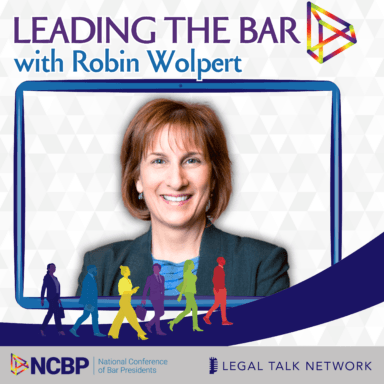
Robin Wolpert is an accomplished appellate practitioner, business litigator, and white-collar criminal defense attorney. With her unique...

Amanda Arriaga is Chair of the National Conference of Bar President’s 21st Century Lawyer Committee. She was the...
| Published: | April 20, 2026 |
| Podcast: | Leading the Bar |
| Category: | Career |
This bonus episode of Leading the Bar features a special installment from the Council of Firsts series, which spotlights trailblazing leaders who were the “first” to break barriers in their bar associations.
In the next episode of the Council of Firsts, Amanda Arriaga, first Latina president of the Austin Bar talks to Robin Wolpert, Past President of the National Conference of Bar Presidents (NCBP) and Past President of the Minnesota State Bar. This episode was recorded at the American Bar Association/National Conference of Bar Presidents meeting in Louisville, Kentucky. To learn more about NCBP, visit https://ncbp.org
Amanda Arriaga:
Welcome to another bonus episode of Leading the Bar. I’m your host, Amanda Arriaga. With me as always is Patrick Palace, NCBP President. Today we’re looking back at an interview with Robin Walpert when she served as NCBP president two years ago. Patrick, would you agree that this discussion I had with her is just as relevant today as it was last time?
Patrick Palace:
It really is. You feel like time changes, but Robin’s idea is about these foundations of democracy and who she is and why we do what we do are timeless.
Amanda Arriaga:
Yeah. And she is an amazing leader, mentor, lawyer, professor, mom. I had the occasion to get to know her daughter, and you get all of that in this episode.
Patrick Palace:
Yeah. And the thing about Robin is, I mean, I think she’s kind of a sleeper. She’s friendly, she’s smart, yada, yada, yada. But when you find out about her background and then you hear her story, you realize she’s a genius. I mean, here’s somebody who’s got multiple advanced degrees, including a PhD, goes back to pick up her final degree as a lawyer, that last thing to pick up so she can do the things she wants to do. And then you understand why she has such a clear vision of the world, about democracy, about what it means to be a lawyer and who we are. And I’ll tell you everything about this episode that you did, Amanda, is inspiring.
Amanda Arriaga:
She’s not just a genius. She is a genius you want to hang out with. And I’m not sure that’s true for all geniuses. Some geniuses are too in their heads and it’s hard to talk to them, but Robin is the opposite of that.
Patrick Palace:
And also so humble. And I thought we had already given out the Humble Award to Nate Alder when we did that. He was the king of humble. But honestly, Robin is right there. I think this is one of those hallmarks of great leadership that there isn’t that I, me, I, me thing going on. It’s so selfless and so focused on doing something important for all of the right reasons. And you ask her a question about how can people follow her? And I’m not going to say what she says, but you know what? I felt like it was a moment I needed to sit down and pay attention when she talked because it really meant something when she talked about her philosophy about following her.
Amanda Arriaga:
Fun fact, when Robin gave me the list of folks to interview at this meeting, she didn’t list herself. And someone dropped out and she was a last minute villain, did it kind of reluctantly, and this is one of the best ones we had. She even tried to turn the tables and interview me about doing a podcast, and we just never aired that one because that is not as interesting as listening to all the great things Robin has to say.
Patrick Palace:
Without giving away what we’re about to talk about, because I want everyone to hear this for themselves. What did you think about her discussion of democracy? And I don’t mean intellectually. Did it make you feel something when she talked about democracy?
Amanda Arriaga:
Oh yeah. Robin makes you want to do things and be things and not just talk about them. So I encourage people to listen for the hashtag of the episode.
Patrick Palace:
Yeah. Well, we could sit and talk about this all day long. In fact, I’d like to, because there’s so many great things out of, but you got this podcast run.
Amanda Arriaga:
Yeah, let’s listen in. Welcome to the next episode of the Austin Bar Association’s Council of First. I’m your host, Amanda Arriaga, first LatinaBar president. In today’s episode, we’re doing something a little bit different. We’ve partnered with the National Conference for Bar Presidents to do a series of interviews with bar leaders from around the country here in Louisville, Kentucky. So I’m happy to introduce you to all of these leaders that you might not know because they’re not from Austin. Today, the Austin Barr talks to NCB President Robin Wolpert. She invited us to record some episodes of the Council of First at the annual National Conference of Bar President’s mid-year meeting. So Robin, I want to start from the beginning. Why did you want to be a lawyer?
Robin Wolpert:
Well, I started my career interested in the role of law, so I got a PhD in political science. So my field was political psychology, constitutional law, and it’s something called cognitive and behavioral economics. It’s like how you quantify public opinion and views of institutions. And so I loved the rule of law and I wanted to study it deeply, so I became a professor. And then I was teaching, my tenure track job was at University of South Carolina, and I’d been teaching for a while. I started at Georgetown and then at South Carolina. And after teaching for a while, I was like, I kept inspiring my students about all these people who created social change through the law, like Martin Luther King or Thurgood Marshall or Ruth Bader Ginsburg and how they made a huge difference in society. And then I just thought, I’m not in action like I’m teaching people and I have knowledge about the law, but I want to be in action and do it myself.
So I decided to go to law school so I could make a difference in people’s lives and create social change.
Amanda Arriaga:
Well, it’s funny because one thing that I learned about you is your LinkedIn profile describes you, you describe yourself as a lawyer, leader, and political scientist working to enhance justice inside and outside the courtroom, and you’re most inspired by wicked issues facing society and people. So this makes perfect sense that it’s because you started as a professor of political science, and then you shifted into taking it into your own hands. So kudos for you. Some people would’ve just stayed on the path of being a professor, but you want to do things and make the change.
Robin Wolpert:
Yeah. I want to be the one in action.
Amanda Arriaga:
Yeah, that’s wonderful. So one of the ways you’re making the change is through NCBP. What does NCBP mean to you?
Robin Wolpert:
So you know how words are symbols and so some things are beyond words. So NCBP is like that for me because it conjures up passion, deep relationships with people where we’re all committed to making the world a better place. And there’s this energy at NCBP. So it’s like you can barely grasp it in words, but there’s an energy within NCBP where people are really committed. And I say word really. I mean, it doesn’t even describe what we do. We’re so committed to making bar leaders the best they can be, that we’re unstoppable about it. We will do everything we can and we want to be creative and innovative. And NCBP is also kind of a breathless place. If you come to our meetings and you started coming this year, but over time, what I’ve seen is the pace is breathless because someone will have an idea and then someone will blurt in and add something and then it just builds and builds and builds.
And then the whole group creates something that no one person could ever have dreamed of. And it’s because of the diversity of points of view that you see with NCBP, the depth of experience that people come with from all backgrounds, all kinds of experiences. And so I think we offer unique product that no one else could offer, which is being there for bar leaders to be the best they can be. We’re like the unlockers of potential, of human potential and possibility. So I think of us as possibility. And then NCP, it’s also curiosity and awe. We’re in awe of other human beings and what they could do for the world. And we’re curious about other people and other backgrounds. And so we’re inclusive. We’re an organization where everyone belongs here. So I would say we’re an organization where I would say action. We’re in action, we’re in passion and we’re going to make the difference.
We’re going to make the difference in the world.
Amanda Arriaga:
Well, and to tie together your background as a political scientist and you’re interested in rule of law, you now want to add that to some of what NCBP is looking at. So why is it important not just to talk about rule of law and democracy, but as lawyers to do something about it?
Robin Wolpert:
We can read books about democracy and we can read books about the role of law. But actually Walt Women talked about democracy as an unfulfilled promise of America. So he said, Democracy is like a poem. It’s an unfulfilled poem of America. And I always think about that because every person has to rewrite all the time and recreate what democracy means. And that’s why if we’re co-creators of what democracy means in terms of who participates and what ideas get to be put into action to make people’s lives better, democracy is actually a vehicle for human potential, for possibility, for unlocking the liberty and personal expression of everyone. Democracy goes hand in hand with the best health outcomes. Democracy goes hand in hand with economic prosperity and happiness. In fact, the World Happiness Report that comes out every year talks about the inextricable link between happiness and individual prosperity.
So if democracy is a way for individual liberty and self-expression and potential to be realized, why wouldn’t we all be all in the game of democracy? So you could read about it, but then you can go do it. And when you’re in action, there’s something else that happens when you’re in action. You become democracy, you become that freedom, you become it because you’re expressing it. Who you are is freedom and liberty and individuality. So I like being in action because it actually fulfills human potential. But in terms of what we’re doing, rule of law is essential to so many things we take for granted. Economic stability. Just thinking about the fact that there are companies with jobs all depends on the rule of law and stability and the rule of law and democracy. What people can say and what fields they might go into, what they might contribute as an engineer, as a physician, as a lawyer, whatever you might be, as an artist is all dependent on having a stable rule of law that permits people not to worry about survival, but to then unlock what they can do.
So that’s why we’re in the game of democracy in the end.
Amanda Arriaga:
Well, and so a potential slogan for NCBP, or at least the hashtag of this episode I think is become democracy.
Robin Wolpert:
Yeah.
Amanda Arriaga:
Join NCBP, become democracy.
Robin Wolpert:
And be it.
Amanda Arriaga:
And be a democracy.
Robin Wolpert:
Yeah.
Amanda Arriaga:
So besides rule of law, the other thing that you’ve been really passionate about embedding in NCBP is DEI. Why is that so important to you to embed DEI in all that NCBP does?
Robin Wolpert:
So one of the biggest things about NCBP is that everyone belongs here. And I think that when you know that you belong everywhere, then that empowers you to contribute so much. And so why wouldn’t we want to create an environment where everyone belongs here? And so that means we are going to be better than any one person could be. And like I was telling you about how NCBP works, that breathless pace of innovation that happens at meetings where people contribute from all sorts of perspectives, and then we get this product, this idea that we’re going to help promote for lawyers and bar leaders, no one else could have created. And when you think about that kind of creativity and innovation, it’s just not possible without everyone belonging here. So how do we embed it? Well, we make sure that everyone feels welcome and we value difference, but we don’t just say, I value difference.
You have to be in action on it. So people know when you’re authentic about valuing difference. You can say it and then you watch people’s behavior and they don’t exemplify it. They’re not it. But you know when people are really welcoming and they really do value difference because they’re like, wow, you’re different from me and that’s cool. How boring is it to just hang out with people just like you? How boring? It’s like listening to yourself talk all day. That’s so boring. But if you hear from other people, you’re like, “I want to be in awe. I want people to shake me up with something new, something I haven’t heard before, another way of saying something or another way of thinking.” And that’s the belonging really makes that happen. And that’s again, what NCBP stands for.
Amanda Arriaga:
So from all that you have seen and everything that you’ve researched, all of your background, do you think the legal profession is going in a good direction for being more diverse, equitable, and inclusive?
Robin Wolpert:
I think that all the DEI work has created a floor and expectation that of course DEI is important. And when you have that floor, then people start to internalize it. And so people I think will say diversity is valuable. Even if they don’t agree, they know that that’s the way the world is. And so we’re creating a reality based on agreement. So agreement, the way reality happens is we decide what reality is based on agreement. And I think there is a baseline agreement in our profession that diversity is valuable. And that is important because then you can escalate efforts to really create that inclusive excellence that we just heard about in one of our programs today. Inclusive excellence begins at bottom of saying, “Of course, diversity is important.” And then once you start talking about it enough, you start being it and once you be it and you’re in action, things happen.
So I don’t think you can erase that from people. You can’t erase it because you just see the benefit every day in your interactions. So once you be it, you can’t unbe it. It’s who you are.
Amanda Arriaga:
What advice do you have for lawyers who want to follow in your footsteps?
Robin Wolpert:
I would say unfollow me. Don’t follow me. Unfollow me because every individual is so unique and so precious and special that if they can achieve the greatest gift in life, which is to be yourself. So if your greatest gift in life is to be yourself, then you don’t want to be following anyone. You want to go your own path and you want to contribute what’s uniquely yours. And so that’s what I would say. It’s find people who can help you, teach you how to move up and get the experiences you want so you can be the best lawyer you can be and be the best bar leader you can be, but always bring that precious, unique self and be that self in your life and you will have really achieved exactly what you should be doing. Well,
Amanda Arriaga:
Thank you so much for being here today. I think that the audience is going to love this discussion and I appreciate it very much.
Robin Wolpert:
Thank you so much for having me.
Amanda Arriaga:
Of course. On behalf of the National Conference of Bar Presidents and Patrick Palace, thank you for listening to this episode of Leading the Bar. For more information about membership, getting involved or signing the pledge, visit ncbp.org.
Notify me when there’s a new episode!

|
Leading the Bar |
Bar presidents share strategies, tools and insights for attorneys growing into leadership roles. Learn from real stories of growth, crisis management, and innovation in NCBP's Leading the Bar podcast. Listen monthly for compelling stories the next generation of lawyer-leaders can use to develop skills, confidence, and vision to lead with purpose and integrity.