
|
|
Karol Corbin Walker has built an impressive national reputation. She is a partner with Kaufman Dolowich, LLP...

Ms. Torres handles civil litigation matters and has extensive experience in civil rights and governmental liability matters....

Kay Hodge is a partner in the firm of Stoneman, Chandler & Miller LLP, where she represents...

Amanda Arriaga is Chair of the National Conference of Bar President’s 21st Century Lawyer Committee. She was the...
| Published: | December 1, 2025 |
| Podcast: | Leading the Bar |
| Category: | Career , Women in Law |
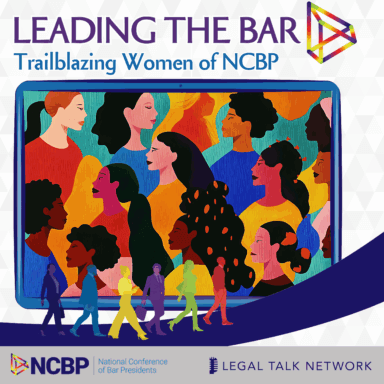
The National Council of Bar Presidents has had only 10 female presidents in its 75-year history, but women have become increasingly prominent in leadership in recent decades. In this episode, Amanda Arriaga speaks with three of the NCBP’s female presidents about their leadership experiences and their efforts to advance diversity within the profession. They underscore the importance of leaders cultivating strong relationships and acting as a source of encouragement and support for those who follow in their footsteps.
Karol Corbin Walker:
Don’t be bashful about asking for help because people are willing to help you, many of whom do not look like you. Forget labels and look at people as individuals, and if someone’s willing to give you a helping hand, take it, but make sure you pay it forward.
Amanda Arriaga:
Welcome to the next episode of Leading the Bar. I’m your host, Amanda Arriaga In the 75 years of the National Conference of bar presidents, we’ve only had 10 female presidents. Today we talk to three of those trailblazing women. Kay Hodge served as NCBP President from 2007 to 2008 and was nnc BP’s first Asian president. She also served as past president of the Massachusetts Bar Association. Mary Torres served as nnc BP President from 2009 to 2010 and was nnc BP’s first Hispanic female president and was the first Hispanic female president of the New Mexico Bar. Karol Corbin Walker served as NCBP President from 2012 to 2013 and was our first African-American female president, and she was the first African-American president of the New Jersey State Bar Association. All of these ladies have been active in the American Bar Association and served as trailblazers in that organization as well to list every accomplishment would take up all of our time, so I think we’d rather hear from them directly. Thank y’all for being here today.
Kay Hodge:
Thank you. Thank you. Thank
Amanda Arriaga:
You. One thing you have in common is that your leadership in NCBP was at a similar point in time in the late two thousands, early 2010s, but I want to start with the temperature when you were Bar Association president. So Kay, what was the biggest issue you dealt with in the Massachusetts bar when you were president in 1994?
Kay Hodge:
The issue that I really focused on, and the issue that I have kind of worked on in the Bar for all these many years is the issue of diversity, and it is to include and make sure that young people know about the opportunities within the profession of law. I spent a lot of time, I think my first tour on the, then it was called the Commission on Minorities within the American Bar Association. I learned how few women and how few attorneys of color existed in this entire United States. And when you’re talking about an all white, all male, essentially profession, and we were the most white and most male of all the professions, you suddenly realize that part of the issue isn’t just it is to get young people who were women and minorities to decide that it was worthwhile to consider becoming a lawyer. And so that was really became a focus of both my state bar presidency and as well as when I became NCVP President.
So basically, I think that what I spent a lot of time talking about and doing was that issue, but it coupled with a second issue, which I think is, and unfortunately it continues to be an issue today, and unfortunately the issue of diversity continues to be an issue today, and that is the issue of civic education because a piece of the puzzle was to be able to get young people to understand the role of lawyers in our society and why it was important to become a lawyer. And that was something that was not really even discussed.
Amanda Arriaga:
And it’s interesting because that is still going on today. We serve on the American Bar Association Pipeline Committee where we’re still talking about how to make kids excited about being lawyers and that civics education. We’re always trying to figure out how do you do that? Not everyone gets to go to a girl state or boy state, so what else is there to talk to kids? And I say kids, because we’re starting earlier with K through 12, we know that we can’t just find people in college and hope to entice them to be lawyers. We have to start talking to them sooner. So it’s interesting that you’re carrying that flag in the nineties, and that is still as important today.
Kay Hodge:
Well, I worked with Bill Paul on creating what is now the Pipeline Commission. And so at the time, and it was an adjunct to almost the commission on then called Commission on Minorities. And the fact of the matter is, is that we really did concentrate. People were spending time in high schools, going to high schools and talking to students on one day off basis, but that wasn’t enough to get young people to understand what it meant to be a lawyer and why they had to commit to deciding to do that, both as they began their collegiate careers and as they moved on from there.
Amanda Arriaga:
Thank you. Mary, what were you dealing with in New Mexico in 2002?
Mary Torres:
Well, unfortunately, we were dealing with a unionization attempt by our state bar, and that just took up, I believe my entire year. I remember being really ticked off at the former, my predecessor, and I told him, you only had to decide whether to have key lime pie or pecan pie as a dessert for convention. I had to deal with a whole unionization thing. And because we were a mandatory bar, it was a question and we were in arm of the Supreme Court, could we even be unionized? So that was just a huge issue. I remember as bar president
Amanda Arriaga:
Karol, what about New Jersey in 2003?
Karol Corbin Walker:
Well, in 2003 when I became president, I became president at a time where I was 20 years younger than my predecessor and 20 years younger than my successor. I was president 22 ago and still the youngest female president so far. And we’re coming up soon and we’ll have our first black male president. But some of the issues that we had to address there was making sure that our bar was inclusive. And during my administration and one of the people who were very involved with the, a past president of New Jersey, Tom Pro always reminds me that during my administration, that’s when we created for the first time our LGBTQ now plus committee. So it was really important to make sure that we were an inclusive bar, not just by ethnicity, but by gender and all facets of any lawyer in our community. And that was one of my main goals,
Mary Torres:
Amanda, in New Mexico. We were so fortunate that because we are a majority minority state, we really didn’t have to worry about diversity in our bar, didn’t have to worry about diversity in our courts. We have a five person Supreme Court, and when I was bar president, it was a majority Hispanic on the court. So always for Hispanics, we always kind of saw ourselves in the courts in the Courtroom. And not a lot of Hispanics are involved in our bar, but we’ve not had any kind of glass ceilings for people of color in our bar, which I’ve noticed. So we just don’t have, I’m listening to both Kay and Karol and really fortunate that New Mexico didn’t have that. And I do remember going into a meetings and NCBP meetings thinking, we just don’t have that in New Mexico. That kind of a diversity problem in New Mexico.
Kay Hodge:
Yeah, you’re very lucky. Very lucky.
Mary Torres:
Yeah, very.
Amanda Arriaga:
So then Mary, when you became NCBP President, did you now have to address some of those issues now as president of all the presidents?
Mary Torres:
Sure, and I remember having these meetings and I don’t remember what they were, but I think we used to have ’em on Thursday afternoons of the NCBP meetings where we would go around and introduce ourselves as being the first Hispanic State bar president, just things like that. And I remember I started with NCBP in 2001 going to those meetings and the list was very small of people that were the first people of color, but then going through my tenure, we had more and more and more diverse people showing up, so then we’d have a longer list of folks. I don’t know if Karol and Kay, if you remember that, but that was just really exciting to see that kind of growth. Of
Kay Hodge:
Course, it was some successes definitely, which is important because that’s what sustains you and keeps you moving forward.
Mary Torres:
And I don’t know if they even still do that at the NCBP meetings, who’s the first and stuff like that, just because there’s been so many, right? There’s been so many people of color and women advancing that. I’m not sure that they even do that. But I do remember in 2002, that was such a big deal.
Karol Corbin Walker:
I should have met the gentleman who’s going to be the first African-American president of the Iowa State Bar Association. So it’s still happening. Sad to say, we’re still saying first, but I think it’s important for people to understand that first is a good thing as long as it’s not the last person of any gender, ethnicity and all. And you have to start somewhere.
Kay Hodge:
Definitely. Yeah, all Karol, so true. So very, very true. And the sadness is that we keep taking a step forward and a step a little half step backward, but we’re still making progress. I mean, if you look around, there are a whole lot more women. Unfortunately, the number of lawyers of color, it is good and it’s getting better, but I think that I’m a little bit less patient than I was when I was younger.
Karol Corbin Walker:
But our numbers are dwindling. I mean, I chair the ABAs Commission on Women and Profession, and we’ve had studies going back early two thousands, 2015 and even later years. And the number of color female partners or even female partners across the country, it’s dwindling. And people leave for a variety of reasons, and particularly it’s worse for women of color in the medium and large firms.
Kay Hodge:
But I also want to say that one of the things that became intriguing as I have gotten more involved in all theBar national Bar work is the fact that I am not sure that larger law firms are the future in any event. And we keep looking to success within them as sort of a measure of something. And I’m not sure what it’s a measure of. I think that the vast majority lawyers, successful lawyers tend to come from smaller firms and solos. And I think that that’s all to the good. But the organized bar needs to recognize that and embrace it rather than looking just to the largest law firms around.
Karol Corbin Walker:
You’re absolutely right. Okay. And the law school is showing us that with the number of female lawyers who are graduating, and it’s over 50%, which is great. That’s encouraging, and I agree with you,
Kay Hodge:
But let me also say this, one of the things that you read is there was a recent New York Times column about the fact that when women became the majority of the lawyers, it would be the demise of the profession. And what they’re really referring to is the earning gaps between women and men. And I think that, again, that’s a focus on the larger firms. I’m not sure that it’s this focus on, there are extraordinarily successful women owned firms and extraordinarily successful firms of color. And I do think that a piece of the puzzle has to, to kind of rethink how the law is practiced.
Amanda Arriaga:
We also, when we talk about leadership positions in bar associations, need to make sure that we are explaining the value of a bar association to lawyers. There are some folks that think, I don’t want to go to a meeting. I have a family I need to bill. But for some of us, I always say, I’m a joiner. I like to be involved. It makes me happy to be involved. This is where my friends come from because I’m a big nerd. So we need to also let people know, share your leadership experience here as well. Mary, how did you find out about NCBP and why did you want to be president?
Mary Torres:
Sure. I found out about NCBP from my executive director. She was active in nabe and in the New Mexico bar, the president elect and president would go to the A meetings and to BLI. And I remember her telling me about that. And I remember my first A BA would’ve been mid-year meeting because I became president-elect in January. So it would’ve been the mid-year meeting how exciting it was, and to be in NCBP. And she introduced me to people. She was very good about introducing me to NCBP folks. And I remember meeting Roseanne Lucianic and Pam Robinson at that time, and just getting involved, I think from their encouragement as well. But I do thank my executive director, and I think that it still continues that way in New Mexico for sure. Is the executive director kind of pointing you in that direction?
Amanda Arriaga:
Kay. How did you find NCBP?
Kay Hodge:
Well, what it was is that once you became, you were going through the chairs to be state bar president, then you could attend NCBP meetings. And in that process, I met some amazing people. And see, I am very much like you are Amanda. I don’t know if that makes me a nerd or what it makes me, but like I say to people, I don’t really have as many advocations as I probably should, but one of my advocations happens to be bar associations. I mean, that’s where I often for my time away from work, et cetera. And it’s because of friends and people that you meet and who you enjoy spending time with.
Amanda Arriaga:
Karol, how’d you find NCBP?
Karol Corbin Walker:
It was an institution within our Bar Association. I became the first vice president in 2002, and they would always have the president and the president-elect. But within two weeks of our installation of May of that year, our president-elect, God rest his soul, had a massive heart attack at his desk at 51 in died.
Kay Hodge:
Oh my gosh.
Karol Corbin Walker:
So that propelled me, and that’s how I was introduced to NCBP for the State Bar Association, but it was part of our fabric for many years because we had many people who were very involved with the a, a many people who were involved with the National Conference of bar presidents, and that was part of coming up as a leader in the State Bar Association. So that was my first introduction, that 2002. And once you get to NCPP and you see the benefit of the programming and the training that you get as a new bar leader, it’s just infectious. It really is. And all of us here are a state bar, county bar specialty bars. We’re all bar junkies. And I say that in a good way because being part of bar associations in that community has enriched my life professionally in countless ways. I think that’s something that some people discount when they say, I don’t have time for it. When you look at the benefits you get, I believe it’s something that you should sit back, explore. And I think once you do that, you’ll realize that’s something that you definitely want to do.
Amanda Arriaga:
Well, and I think we are lucky that we had the benefit of being part of organized bars that told us this existed. One reason that we’re doing the podcast is to reach more lawyers, more bar associations. Just in Austin alone, we not only have the Austin bar, but we have the related Hispanic bar, African-American bar, Asian bar, south Asian bar, women bar, mother’s bar, and all groups, all the affinity bars. Everyone’s welcome to join us. One thing I loved was that when I had a problem, there were people I could talk to that already had that problem and that knew how to deal with it so that I wouldn’t fall on my face. Maybe I still did a little bit, but now I can use what I learned to help other people not fall on their face. And that’s sort of the benefit of this community.
Mary Torres:
Totally agree. Totally agree with that.
Kay Hodge:
But it’s also important that you learn to make friends, that you make friends among theBar. And so in addition to the professional experience, I just find personal enrichment of just the community of people that you know and that you really spend time with.
Karol Corbin Walker:
I agree with you, Kay. And I think that’s great. At a national level, I think most of us are also involved with our National Affinity Bar Associations. And being part of NCBP, you get to know a lawyer in every state, all 50 states, and all of us know lawyers in all 50 states. And I think that’s important because it’s growth. And I think socially you do make great friends. And I have wonderful friends that I met through NCBP who are very dear to me.
Kay Hodge:
And many times those friends come from parts of the country that very little about and have a perspective. The current divide in our country is in part a product of the culture and the backgrounds of various individuals. And I do think that I know some extraordinarily gifted and wonderful people who have quite different political perspectives and views, but I can value them because I know them from our joint efforts to work together in theBar. And I think that that is something that has really helped us. We all are committed to the practice and to the ideals that are enshrined in the constitution. We may differ as to how to get there, but we all believe in we have a common goal and a common understanding that is what I think is generally missing in our society at large, and we need to figure out how to make it all work together.
Amanda Arriaga:
So moving away from the organization to leadership, sort of in general, do you think since you were your state’s bar president and NCBP President, people are more receptive to being led by females and specifically women of color? I’m going to start with K since you started the earliest.
Kay Hodge:
I don’t know. I don’t know what they think. I’m not sure that I could express the view of others like that. I think that there have been enough, and I think what Mary has said is really important, and that is that if you see and you experience a lot of individuals who are different than you are, then you are less likely to see the difference. And I think it’s easier to follow and to be led in that way. I don’t think people see, oh, so-and-so is an Asian president and therefore they act this way, and so-and-so is a Hispanic or a Latina president, so they act this way, or an African-American president acts this way, rather. I do think that people have gotten at least familiar with the concept of what the leadership role is about. On the other hand, I’m not sure any of us could say whether people find that to be positive or negative. I think that what they have done is that they have then elected others who are different and who have not reflected necessarily what was then the majority.
Karol Corbin Walker:
But I think what we can say is that as a result of our leadership experience, we have allies that don’t look like US allies that come from the different experience that you talked about, Hey, whether geographic, ethnic or all these other facets that are part and parcel of our inner circle, our individual communities, because of us being leaders in NCBP, our respective state bars be involved at the A level and leadership roles. And I think that’s something that has innu to all of our respective benefits.
Mary Torres:
I agree with both of you. I’m trying to think, did I have any kind of crystallizing moment when I thought that people were, oh gosh, Mary’s a woman and she’s leading. And I don’t think so. I don’t think there was anything like that of we’re being led by women. There were pretty few state bar presidents in New Mexico that were women. I think I was like the third, maybe the third woman. And now we just, we’ve had just a slew of women. So I’m thinking that again, that’s fine. But I also think our state might just be pretty unique because of the majority minority view. I think we are a very unique state in that regard.
Kay Hodge:
I think that you are a step ahead, Mary. I mean No, no, no. I’m serious. Because it eliminates one of the big barriers. I mean, at least you’ve got a certain area that at least is reflected in the vast majority of your community and in theBar, and therefore it has eliminated the differences. I mean, my issue in Massachusetts was quite frankly, the fact that there were so few Asians we could have continued to meet in the phone booth, still have been able to accommodate others. And it’s only recently that we’ve seen any number of Asians come into our community, which it made me envious at one point when I would go to places like California or the West Coast and see so many other Asian lawyers. However, I think that it’s now expanded and the opportunity has now been presented to lots more Asian young people, and they are answering the call, if you will.
Amanda Arriaga:
What advice would you give to upcoming female lawyers who want to be in leadership positions? Karol,
Karol Corbin Walker:
Be your authentic self. Understand the unwritten rules. There are always meetings before the actual meeting. And try to align yourself with people who will be able to promote and help you achieve your goal. Don’t be bashful about asking for help because people are willing to help you, many of whom do not look like you. When I was coming up and I was at a medium and large firms, my mentors, my sponsors were Caucasian, Italian guys who definitely didn’t look like me, but wasn’t threatened by my outwardness and my ability to communicate in a certain ways. And they supported me for partnership. They supported me for a lot of different things, and they exposed me to theBar association. There’s one partner that if it wasn’t for him, take me to different bar associations and introducing me to certain people and putting me in certain rooms. I would not have had those relationships that enabled me to become the first black president of the state bar in New Jersey. So I think that’s important for women to realize that forget labels and look at people as individuals. And if someone’s willing to give you a helping hand, take it, but make sure you pay it forward.
Mary Torres:
Definitely that paying it forward I think is really important. What I would do to encourage women, and I still feel like I do encourage women, and I get asked often from women in the New Mexico bar, how did you do it? What can I do? And I’m always willing to lend some advice, et cetera. But I think what’s important, and I remember, I think I heard this from you, Karol at one time, as you go up the ladder, make sure you’ve got your hand behind you to pull others up. And I do that, and I really try to do that. I try to do that even in my practice. There’s a younger lawyer that I’m opposing counsel with, and I’ve called her a couple of times and just tried to steer her and try to mentor her, et cetera. And I don’t know if I’m helping her or not, but I just feel like I want to do that to try to mentor.
Kay Hodge:
One of the things that I’m finding interesting is I’m the oldest of certainly the three of us probably. And the thing is, is that I am finding that the generational differences are becoming far more stark and important for us to kind of think about and how we deal with it. I think the younger generations are not as motivated by the same things that we were motivated by. And so when you get into things like mentoring, I found mentoring easier years ago. I’m finding it harder and harder because just putting myself and mentally into the same place as those young people, it’s very hard because their whole worldview and perspective is so different than mine. And the whole, you’ve got to expect to work hard. You’ve got to expect to have to overcome and keep grinding away and doing the best you can and et cetera, and et cetera, is not necessarily a currently accepted perspective.
Mary Torres:
And I definitely agree with you on that. My husband and I take our 14-year-old grandson to dinner once a month, and my husband is encouraging, Santiago, you should think about going to law school. You should think about being a lawyer like your grandma. And he’s like, no way. Grandma works too hard and I don’t want to work that hard. So in a way, I think about, gosh, what kind of message am I sending to my grandson about being a lawyer? And what he sees is that I’m always working right, but I am a sole practitioner, but he sees that I work, I work hard, but he also sees that I enjoy it and that I have a lot of good friends. And that’s what I encouraged him about. I said, you know what? You meet a lot of people and you grow as a lawyer.
You’re always growing. And I told him, I said, right now in my practice, I’m doing work that I absolutely love at this stage of my life, and I’ve been practicing law for 30 years. I feel like this is the first time that I’m really doing great work. I finally feel after 30 years I’ve hit my stride. So I’m trying to explain that to my grandson that it’s not just all about hard work, but it’s fun and you are always learning and you’re always doing something new and learning something new and meeting new people. So I’m hoping he’s saying that, that it’s not just all the work. Right.
Amanda Arriaga:
Mary, you’ve created your own pipeline program in your household.
Mary Torres:
Well, I hope so. I hope so.
Amanda Arriaga:
But it’s because that’s part of going back to the pipeline is there’s all kinds of jobs lawyers can have.
I never wanted to work for a law firm. I love public service. I’ve always wanted to do government work, which gives me free time to do all of these other extracurricular things that I love to do. And I think that we have to make sure that if people want to be lawyers, we show the scope of it, be an elected official, make good choices, make changes. You can be a judge. You can be in the legislature, you can work at a G law firm. That’s great too. But there are all of these options. And in order for our profession to be good and stay good, we need people in all of those places.
Kay Hodge:
Absolutely. Yes. And we also need to make sure we encourage young people to do that, younger lawyers to think about those other options.
Karol Corbin Walker:
One of my mentors, daughter with whom I was very close, went and worked for a huge New York law firm, and they make all this money and they do all these different things and they realize at a certain point, I need something more. And now she’s a public interest lawyer, and that really excites her and she loves it. I have a granddaughter who graduated five years ago. She always wanted to do government work. She’s a public interest lawyer. We have the one year, she has a 1-year-old term, 1-year-old yesterday. We have the Halloween party tomorrow for the little one rowing. But she too always wanted to do that. So I tell people, look at it from the perspective of what’s going to make you happy. We all have been involved in the law for a while. I have some of my former partners who have retired.
They’re golfers. They’re enjoying themselves. I’m not a golfer. I still love the practice of law. I still enjoy participating in bar associations. I don’t work nearly as hard as I used to work, but I still love trials. I still love helping the younger associates and being parts of a team to help the client achieve their respective objective. So as long as you are enjoying what you do, I say continue doing it. And if you don’t enjoy it, don’t complain. Do something about it. Life is very short. I’m not trying to be morbid, but I don’t think it’s good for you to stay in a place that’s not satisfying your soul.
Kay Hodge:
Very well put, Karol.
Amanda Arriaga:
So for our last question, if we went back to where you started and became a lawyer, what if you took the other path you were thinking about? What would you be doing if you weren’t a lawyer, Mary?
Mary Torres:
Well, in my former life, before I became a lawyer, I was a high school teacher. And so I loved teaching and I think that’s why I’m a great lawyer is because I can explain stuff to a class so I can explain things to juries, what I have continued teaching. I don’t know if I would’ve continued teaching. I have a lot of respect for that because I was a teacher and I love doing it, but really, I can’t think of what I would be doing if I weren’t a lawyer. So I really think this was the right move for me, that definitely the right decision for me to make. So I am not providing the answer perhaps that she wanted, but then perhaps I am that I think this is the greatest profession for me to be in and for others to be in because you really, you are helping people out and you are providing a voice sometimes to many that are voiceless.
Amanda Arriaga:
Kay. What would you have done?
Kay Hodge:
I think I agree with Mary. I can’t think of something else that I would do. I mean, I keep wondering what do I want to do when I grow up? And I can’t think of anything that I would rather be doing. I like doing what I’m doing. I am blessed. I pick up on what Karol Corbin Walker said. I am so lucky that I can represent the clients that I can represent and that the issues that I have been able to be hired to pursue are issues that matter to me and that are important. So I continue to be extraordinarily interested and I find them extremely interesting. With that said, I cannot imagine not feeling terrifically excited about everything that I do. And yeah, at some point when I’m getting that writer’s block or I’m having trouble working, I just finished several writing brief projects.
And when you’re in the middle of a brief and it’s taking you forever to get that particular argument right, you sometimes say, Ugh, I just assume you doing something else. But that’s a momentary issue. Sure. You work your way through it, you get it done, and when you get it done, you say, okay, I got it. That sort of says what I want it to say. And so I’m doing what I think I would like to do, and I’m doing what I think I really love. And so that’s why I can continue to do it, even though many, many of my colleagues have long since retired.
Amanda Arriaga:
What do you want to do when you grow up? Is my number one favorite question to ask at work. Because to Karol’s point, if you are in the wrong spot, you might not be happy at work. So if you can tell me as a manager, as a supervisor, what it is you would rather be doing, then we can make sure that you get there. Karol, what about you? Is this what you always wanted to do?
Karol Corbin Walker:
Well, I think it was Destiny when I was in the second grade, brought the report card home. Karol’s a great student, but she’s an excessive talker. And when I was in high school, under my picture, it says, I will either pursue a career in law or medicine. I quickly learned I did not The stomach for the blood and gore that you have to deal with for a doctor, I have cousins who pursued that and they’re doing very well. God bless them. And if I wasn’t very good at math, I would’ve been an accountant. So because I was an excessive stalker when I was younger, I think that I was destined to do this. But I did have a career before at law. I was a revenue officer with Internal Revenue Service, and I enjoyed that job having my shield as a revenue officer. I felt like Elliot Nest days and things of that nature.
But law was something that I was always drawn to because you can help people and you do. And what Mary said, it gives you a lot of pleasure to help people who have been disenfranchised, not having a voice, that you can be their advocate. And I believe all of us on this and involved in this podcast today, we have jobs, but we also do a lot of community work. We’re on different boards where we’re addressing those things that need to be addressed in our respective communities. And I think having that law degree allows you to help others in that way.
Amanda Arriaga:
Thank y’all so much for your insights. Thank you for what you did for your states, for NCBP, for inspiring everyone to follow in your footsteps. I know that the audience is going to love this talk. Your bios are going to be available to our listeners, and so I would not be surprised if people did not reach out to you to say thank you for what you do, or maybe to ask you to be a mentor.
Karol Corbin Walker:
Well, thank you, Amanda, for coordinating all this and doing everything that you do. Yes. Thank you.
Mary Torres:
I totally agree. Thank you, Amanda. It was great. Thank you for reaching out. I appreciate it very much.
Notify me when there’s a new episode!

|
Leading the Bar |
Bar presidents share strategies, tools and insights for attorneys growing into leadership roles. Learn from real stories of growth, crisis management, and innovation in NCBP's Leading the Bar podcast. Listen monthly for compelling stories the next generation of lawyer-leaders can use to develop skills, confidence, and vision to lead with purpose and integrity.