
Cornell’s frat house case, California’s court reporter shortage, and a client armed with AI and 83 questions. The Case Doctors weigh in.
|
|

John G. Simon’s work as Managing Partner at the firm has resulted in hundreds of millions of...

Alvin Wolff has practiced personal injury law for nearly 40 years. During his tenure, he has handled...
| Published: | November 3, 2026 |
| Podcast: | The Case Doctors |
| Category: | Litigation , News & Current Events |
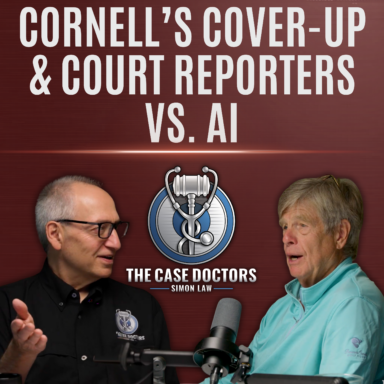
Two years after a horrific alleged assault at a Cornell frat house, the Cornell Seven case is finally getting national attention, and John Simon and Alvin Wolff want to know why the university kept it in-house instead of calling the police. They explain why a written policy is worthless if nobody enforces it. Then, California’s court reporter shortage forces the courts toward electronic recording, and the doctors debate whether AI will put court reporters out of work. In the mailbag, a grocery store manager won’t stop apologizing to an injured client. The doctors explain why “sorry works” and how it can raise or lower a case’s value. They also take on a client who sent his lawyer a 60-page AI-generated “Definitive Legal Strategy for Making Them Pay” and 83 questions for the defense.
Special thanks to our sponsor Simon Law Firm.
Christine Byers [00:00:00]:
Dear Case Doctors, my client slipped on a wet floor at a restaurant and suffered a back injury.
Announcer [00:00:05]:
Welcome to The Case Doctors.
Christine Byers [00:00:07]:
He has since started using AI to manage his claim.
Announcer [00:00:11]:
With John Simon and Alvin Wolff.
John Simon [00:00:13]:
I would tell your client to get on AI and find another good lawyer.
Announcer [00:00:17]:
The show where 2 of the greatest legal minds offer you advice on your cases.
Alvin Wolff [00:00:21]:
I disagree with you. I mean, I think anytime my client gives me something that might be useful, I appreciate it.
Announcer [00:00:28]:
The Case Doctors will see you now.
Christine Byers [00:00:36]:
Welcome to The Case Doctors. I’m your host, Christine Byers of Simon Law, and I’m joined by The Case Doctors, John Simon and Alvin Wolff. Between them, they have more than 80 years of experience as plaintiffs’ attorneys, so there really isn’t a scenario they haven’t already encountered on a case and figured out how to handle it. Now they’re offering you the chance to tell them about your various problems or issues coming up in your cases and hear how they would handle it. But first, let’s turn to some of the civil cases making headlines and hear what the case doctors have to say about them. Our first hot topic today, very hot topic in the legal world, the Cornell 7 case. Now, just briefly, nearly 2 years after allegations of a horrific sexual assault inside a Cornell University frat house first surfaced, the case known publicly as the Cornell 7 has finally gained national attention. Sexual assault on campus is not a newly discovered danger.
Christine Byers [00:01:32]:
Universities collect crime statistics, conduct campus safety climate surveys, regulate Greek organizations, implement alcohol and sexual misconduct policies, and educate students about consent. But cases like Cornell raise an important question: have safeguards evolved alongside what institutions now know about risk?
Alvin Wolff [00:01:54]:
When I was in college at WashU, The college tried to keep criminal activity in-house. So they would try to take care of it. They’d get the students in, they’d call the parents, and they’d mete out what kind of punishment they thought was necessary. And it was things like somebody selling marijuana, things like that. When you get into allegations like rape, trying to keep that in-house is probably no bueno. I mean, it’s just not a cool thing to do. I mean, what these guys did was very extremely serious. Cornell should have gone to the police right away.
Alvin Wolff [00:02:40]:
There should have been an investigation. And these kids should have had the book thrown at them. They should have been put in jail. They should have been granted bail, and they should have had a criminal trial. I can’t believe this went on for 2 years before anybody got serious about it.
John Simon [00:02:58]:
Yeah, it’s— I feel the same way. I mean, it’s just shocking what, what I have heard about it, um, you know, that they just didn’t do anything sooner is— it just raises way more questions. Back when we were in school, uh, we didn’t have all the social media and all the other stuff, and that, you know, it kind of distorts— I mean, you don’t know exactly, um, you know, You hear all kinds of different information. And the more time that passes, one of the big problems is starting the investigation or opening up a year afterwards or 2 years afterwards. Witnesses are gone, memories aren’t there. And that’s another very important reason to report it immediately so that things can be done right away. You can get people’s statements. Evidence doesn’t disappear.
John Simon [00:03:44]:
Witnesses don’t disappear. Witnesses’ testimony doesn’t change. And, you know, those are all of the, you know, more reason why this needs to be, you know, identified, reported immediately, and acted on immediately.
Alvin Wolff [00:03:59]:
Yeah, this was my first criminal case. Instead of it being a frat house, it was a trailer park with 3 guys and 1 woman. And my guy got charged with rape and got convicted, and we got it reversed on appeal. But the system got to take him through it and the jury got to hear the evidence and they rendered a verdict.
John Simon [00:04:23]:
Yeah. And the system is here. It can’t work if you don’t use it, if it’s not reported. And it’s just, it’s an entire, it’s a bypass of the entire criminal system. I mean, this is not something that, you know, is some minor deal that, you know, the university should be able to handle in-house. You know, it should have been handled a lot differently than it has been.
Christine Byers [00:04:47]:
One of the issues that has come up in this case from a legal perspective is fraternity houses and off-campus housing do not exist outside the university ecosystem. These properties are selling in close proximity to campus. There’s walkability, student-centered amenities, and access to university life. In every practical sense, they are extensions of the student ecosystem. The relevant inquiry should therefore look beyond labels and beyond traditional notions notions of property control. Who owns or controls the property? Who is the intended population? Who benefits from and relies upon the housing? How integrated is the property into university life?
John Simon [00:05:26]:
Well, I mean, I think you’re kind of going into the, you know, the civil liability maybe also, you know, apart from the individuals involved. I mean, I guess we’re asking, should the school be doing something, you know, to prevent it? You know, should the school be looking into this, you know, so it doesn’t happen?
Alvin Wolff [00:05:44]:
Well, I think they overstepped their bounds because they banned parties now in fraternity houses, which I think is un-American to do that. I think they are overreacting probably because of all the negative publicity. And, you know, that will eventually fade.
John Simon [00:06:10]:
So how long— how late was the reporting? How— it wasn’t reported to the authorities at all?
Alvin Wolff [00:06:15]:
Cornell handled it internally. And I’ll bet if the victim went to the police, it would have been handled differently.
Christine Byers [00:06:23]:
This kind of also touches on the civil parts of this case. A written policy is not a safeguard unless it works in practice. Universities rarely suffer from a shortage of written policies. They have alcohol rules, event management plans, sober monitoring policies, and more. order requirements, and the list goes on. The critical question is whether those safeguards function.
John Simon [00:06:41]:
I think the big question there is, what was the history? What, what is— what’s the history at that school? Uh, has this happened? How often has it happened? Has it been reported? How’s it been handled before? Because that really puts them on notice. Uh, you know, it’s a college campus. I can’t imagine they don’t have, you know, a fairly extensive history of some, some incidents. But, you know, what are they? And I guess the big thing too is not just did they have prior incidents, But what did they do about those incidents? How did they handle the prior incidents? And also, what, if anything, did they do to— did they change anything? So in other words, if you had incidents similar to this in past years, if it’s happened once, that’s one thing. If it’s happened 2 or 3 dozen times, that’s another. And the other question is, where did these policies come from? How old are they? Have they been changed? Has anybody reviewed them? And it’s one thing, as you said, they have policies. Another thing, what are you doing to enforce them? Does there any teeth to that? How do you enforce them? You know, how about the history of the individuals involved too? I mean, that’s something that would need to be looked into.
Alvin Wolff [00:07:41]:
Well, we have policies in every case that we handle. This is no different than any case we have against a manufacturer, against a retailer. They have policies, and usually they have them that they can say, look, we have policies. Where we get our juices, they don’t enforce them. And they turn a blind eye when the policies are violated. And that is probably what happened here. I mean, my son went to Cornell. If they had alcohol policies there, they certainly weren’t enforced 20 years ago.
John Simon [00:08:21]:
We handle quite a few sexual assault cases. Hospitals, healthcare facilities, hotels. And I will tell you that what I see more often than not is there’ll be some internal investigation. There’s always some type of internal investigation at the facility, and they will just ignore the evidence. I mean, we had one case where within 24 hours, the facility, it was a hospital, did their own internal investigation and said that there was no merit because the hospital’s regulations require them to report these things to the state. And it wasn’t reported. And, and the thing in that particular case, they still hadn’t— the internal police force at the facility hadn’t even interviewed all the witnesses yet to it. And so all of a sudden they’ve got this, you know, within 24 hours they’re saying— so again, you know, do they— did they have the policies? They did.
John Simon [00:09:19]:
They had the policies to report it. They had the policies to investigate it. But, you know, it was kind of like a half-ass attempt to follow it. And in essence, they really didn’t follow it. And I think that made it even worse because the assault, it wasn’t by somebody employed by the facility. And so the issue was, if you’re going after the facility for something that happens to a patient there, the question is, what protections do they have in place? And as you said, what do they do about it? Do they actually follow them? So it’s one thing to have the policies. And I can’t imagine major universities don’t have policies on this. But the question is, who’s enforcing them? And have they been? And what have they been doing?
Christine Byers [00:10:03]:
Turning now to another hot topic, the court reporter isn’t there. Now what? So for years, court reporters used their powerful union lobbyists in Sacramento to successfully thwart every reasonable attempt to devise a common-sense approach to the serious and well-documented court reporter shortage. Meanwhile, local superior courts, judges, the litigants, and their lawyers struggled every day with real and legitimate shortage of court reporters. Again, this is in California. So refusing to compromise led to a decision that many lawyers and judges have advocated for years in the courts. They must now establish electronic recording systems when a litigant can’t afford a private court reporter and an official court reporter is unavailable. The California Supreme Court recognized that out of necessity, our courts must join the 21st century. But for trial lawyers on both sides, the more immediate question is, what does this decision mean for us and our clients, and what should we be doing differently now?
John Simon [00:11:06]:
Well, if it’s going to be recorded, it needs to be recorded by an independent third party. I would say that you still need some safeguards. I see some transcripts a lot of times where the recording picks something up that the transcript didn’t. But again, I think you still need to have an independent third party doing the recording.
Alvin Wolff [00:11:28]:
And I believe that AI is getting so good at this point that you’ll be able to put recordings into the system, and if there are mistakes, The parties ought to be able to mutually rectify those mistakes. I don’t think it’s a bad idea. These court reporting expenses have gotten ridiculously expensive. They nickel and dime you for anything, for archiving, for copies, for email, for digital versions. I mean, you can take a 20-minute deposition and get a bill for $1,000. It’s just— It’s gotten ridiculous. Just the other day, my client had recorded a visit with a doctor, and I downloaded it into Claude and said, type it up for me. And it was done in 10 minutes.
Alvin Wolff [00:12:29]:
And I would have given that to my paralegal, and it would have taken her a whole day to do it.
John Simon [00:12:35]:
Yeah, it does seem like it’s You know, pretty outdated that we’re still doing it with reporters. But, you know, it’s, you know, the more that the accuracy of the recording systems, you know, the more we can trust them to be accurate, I think that that’s going to help. But certainly I can’t imagine in what, a couple of years, 4 or 5 years from now, they’re not going to be doing that in more widespread just with recording devices versus having a reporter there.
Christine Byers [00:13:01]:
What is your preference? Do you prefer a court reporter being there or are you going to be fine with that whole industry going by the wayside from AI?
John Simon [00:13:10]:
I don’t know. It’s just doing it for as long as I have with a reporter. I don’t know why, but I just have some comfort in having a reporter there.
Alvin Wolff [00:13:18]:
I prefer a court reporter that I’ve worked with before because you can get some court reporters that make a lot of mistakes. So it’s case by case.
Christine Byers [00:13:29]:
For trial lawyers, the distinction matters. If you have a client who cannot afford to pay a private court reporter and the court does not have one available, Don’t assume the client is simply out of luck. The new decision gives counsel a basis to ask the court to provide an electronic recording so the proceeding has an official record. This means lawyers should start thinking about this issue before ever even walking into court.
John Simon [00:13:53]:
So here’s a question I have is, if the parties agree to do it by electronic recording, and I think most probably would, what is there— is there some Prohibition to— do the courts accept that, or are there some courts that don’t accept that?
Alvin Wolff [00:14:09]:
Well, I’ve been doing a lot of hearings in court where we just talk into a microphone and it gets recorded. I don’t see that we have a court reporter on every hearing.
John Simon [00:14:19]:
Yeah, I think the time is— you know, the times are changing, as they say, and I think that’s where it’s headed. And actually, I’m surprised it hasn’t, you know, gone there sooner. Because think about, we record everything now. Everything’s recorded. I use the same reporters all the time. And so we’ve got a good relationship with them and, you know, they do a good job. And so I think that, that, that’s why we don’t see some of the things that other folks might be seeing.
Alvin Wolff [00:14:46]:
And fast pay makes fast friends.
Christine Byers [00:14:48]:
All right. Well, thank you, gentlemen. Time now to turn to our email inbox for the cases our viewers have sent in for the case doctors to diagnose. Now, just so everyone knows, we’re not going to reveal where these cases came from. We’re not going to name any names or firms to protect the confidentiality of the cases. Instead, the Case Doctors are going to focus on just the issue in each of them. So as they say, the Case Doctors will see you now. First up, the apology that keeps on giving.
Christine Byers [00:15:17]:
Dear Case Doctors, my client was injured when a grocery store employee left a spill unmarked. The store manager apologized at the scene, and we have a witness who heard it. Now, the manager has apparently taken up a personal mission to make things right. He has sent my client flowers, a fruit basket, a handwritten apology, and most recently, a coupon for free groceries. The client thinks the manager is a wonderful person and wants to invite them to Thanksgiving dinner. How do I preserve a potentially useful liability admission when my client is trying to turn the defendant into family?
John Simon [00:15:52]:
So I’ve got an idea. Take the guy’s deposition and see how he does for your client in the deposition. And maybe there won’t be any more holiday invites.
Alvin Wolff [00:16:02]:
And sorry works. I mean, I think statistically in malpractice cases, if a doctor apologizes for a mistake or a bad result, people are going to be less likely to move forward with the case.
Announcer [00:16:16]:
Interesting.
John Simon [00:16:16]:
Along those same lines, my daughter Mary is doing a presentation. She may have already done it. And it had to do with so-called nuclear verdicts or verdicts that were like 10 or 20 times more than what the demand was or offer. And believe it or not, there have been a lot of studies out there on cases. And one of the studies that she had, I think it looked at the top 100 in the past 4 or 5 years, the top 100 considered verdicts that were way unexpected or out of line. And the one thing that they all had in common was that not in one of them, not in a single case, did the defendant accept any degree of responsibility for what happened. And again, these are cases where shit happened. I mean, they’re horrific injury.
John Simon [00:17:02]:
I mean, if they’re the biggest cases, you know, over the last 4 or 5 years, you know, there’s something going on, right? Mm-hmm. And for none of them to accept any liability. And again, I get that. I mean, I see cases all the time where You know, I’ll take the deposition of the defendant or a corporate representative. And if that person comes in and, man, they’re real straightforward, they’re honest, they acknowledge what happened, my case is getting less valuable every— with every sentence that the person’s saying. If they come in and they’re just a smartass or sarcastic, I’m happy as hell. I’m just—
Alvin Wolff [00:17:36]:
You can’t polarize it otherwise.
John Simon [00:17:38]:
Right. It’s— and, you know, and speaking of apologies, There’s a lawyer that I know who’s in the inner circle, and he was trying— I think there were airline cases that were admitted liability, and they were capped somehow on the damages. And so the— and I believe, I think it was against the manufacturer, the plane manufacturer, and they had several of these that they were trying. And all they heard through the whole trial, every witness for the defendant was, We’re so sorry. We’re so, you know, plane went down, a bunch of folks died. We’re very sorry. We’re so sorry. We’re very sorry.
John Simon [00:18:13]:
The whole damn case was, and liability wasn’t an issue anymore. It was all about, we’re just so sorry. We’re so sorry. And the first thing he said in closing argument was apology not accepted.
Announcer [00:18:27]:
Mm-hmm.
John Simon [00:18:28]:
Because that was the whole strategy was to, you know, to kind of whittle away or lower the damages by, you know, we’ve had this, you know, come to Jesus moment and we’re gonna start doing things right and all of this. But there was no liability issue. And it allowed them to come in and say, we’re sorry, we’re sorry, thinking it would affect the damages. And anybody that’s been trying cases understands that that’s a big part of it. Interesting. Especially, there’s not a deposition I take where at one point or another I don’t ask, an auto accident, truck accident, do you believe that— do you accept any responsibility at all for what happened? A doctor, whatever. And 9 times out of 10, it’s absolutely not. And that helps us.
John Simon [00:19:10]:
It increases the chances of winning on liability. It increases the value of the case on damages. You know, the best defense, especially in a bad case, you know, if you’re a defendant and you’ve got a bad case and you’re, you know, it’s bad, the facts are bad, you got a bad witness, you know, going on the attack probably is not the best plan. I would think
Alvin Wolff [00:19:32]:
he’s right.
Christine Byers [00:19:34]:
Well, like you said, sorry works.
Alvin Wolff [00:19:35]:
Sorry works.
John Simon [00:19:36]:
Sorry works.
Alvin Wolff [00:19:37]:
But, you know, with what this person did, probably none of the sorrys are admissible. Don’t we have a statute here that says, you know, statements of compassion are inadmissible? And now if they said it’s our fault, that’s admissible. But if you say, I’m sorry you got hurt, that’s not any kind of admission.
John Simon [00:19:56]:
The other thing too is laypeople don’t understand that. And some of them are reluctant to— it’s like, wait a minute, did this happen? I’m going to get sued. And so under normal circumstances, if somebody else hits somebody and they’re on the ground bleeding, you’d go up and say, you okay? Is it okay? Whatever. But I think— and it’s unfortunate because I think some people might change how they normally react because they’re anticipating that they might get sued.
Christine Byers [00:20:22]:
Interesting.
Alvin Wolff [00:20:24]:
Yeah, I, you know, I’m sorry you got hurt is not an admission. You know, it’s just, it is what it is.
Christine Byers [00:20:31]:
All right.
John Simon [00:20:32]:
But Thanksgiving dinner, I would, I wouldn’t invite them to Thanksgiving dinner.
Christine Byers [00:20:37]:
All right, back to our letter bag. Dear Case Doctors, my client slipped on a wet floor at a restaurant and suffered a back injury. He has since started using AI to manage his claim. He has drafted his own demand letter, generated a medical chronology, and created a list of 83 questions he wants me to ask the defense. Yesterday, he sent me a 60-page document titled The Definitive Legal Strategy for Making Them Pay, complete with citations to cases that may or may not exist. Do I explain that AI is a tool, not a law degree, or do I ask my client to stop emailing me until the robots pass the bar?
John Simon [00:21:16]:
I would tell your client, to get on AI and find another good lawyer?
Alvin Wolff [00:21:20]:
I would say I disagree with you. I mean, I think anytime my client gives me something that might be useful, I appreciate it. I mean, I don’t have to use any of it, but if they have taken the time to do that work, I’m going to read it, and it may be right on and save me a lot of time.
John Simon [00:21:38]:
So, you know, that’s a good point. But like my wife and I were talking about, I had a doctor’s appointment. And, and she looked up— it was some, some issue, not a major issue or anything— that she looked it up on, you know, on ChatGPT. And it’s got the diagnosis and what I’m supposed to be doing and looking at and all of this. And, and I went into my regular doctor’s office, and of course I didn’t say any of that. And then I didn’t, because it’s, it’s— what if somebody comes into your office and they’ve already got it figured out, right? I guess it’s, it depends on what they do. If they’ve got some, you know, some questions that they think you should ask and they present them to you, That’s one thing, but continuously going on and saying, here’s some questions and here’s this and here’s this. I mean, I don’t know.
John Simon [00:22:18]:
I just—
Alvin Wolff [00:22:19]:
You know, you’re smarter than me. How would you do it?
John Simon [00:22:22]:
Well, I don’t— well, here’s the thing.
Alvin Wolff [00:22:23]:
And you have more people to help you than I have.
John Simon [00:22:25]:
Well, okay. All right. Maybe. Maybe. I don’t know. It just seems like that— I mean, I don’t know what the heck to do sometimes. You know, case comes in, you got to look at it. You got to— you know, it’s almost as if And maybe I’m overly sensitive about it or whatever, but it’s almost as if the client is— it’s sort of suggesting I don’t know how to handle a case.
Alvin Wolff [00:22:50]:
No, no. Because, you know, so I do a lot of med mal. And every time someone comes in, it’s a brand new topic that I don’t know anything about. Like what we were talking about before. And if a client comes in with a bunch of stuff that’s going to educate me, I think it’s great.
John Simon [00:23:12]:
So, and the other thing too, like I do some— we do some commercial stuff, some business litigation, and there may be some things that are industry specific. Like if it’s a broker that we’re representing in a broker dispute, then I agree with you. You sit down and you say, okay, it’s your background, it’s your industry, educate me on what’s going on. How do these things work? If it’s somebody who has a, you know, built a dam and, and somebody’s saying they’re at fault, obviously I don’t know anything about dams. I’d talk to them about it. But, you know, you’re representing somebody who has no medical training and no legal training and, and they’re like kind of overdoing it on what needs to be done in their case. And, you know, again, I’m, I’m, I don’t, I don’t, you know, express that to the client, but it does make me feel kind of like, you know, chill, dude, I got it.
Alvin Wolff [00:24:01]:
Well, there can be one Indian chief, and that’s got to be the lawyer.
John Simon [00:24:05]:
Yeah.
Alvin Wolff [00:24:05]:
But if the Native Americans, the Indians want to help, I’m happy with the help. We can agree to disagree on it.
John Simon [00:24:20]:
Yeah, no, I just, I think it’s in what the context of it is and how much— yeah, how much help and what kind of it is, you know, that’s, I think that’s a better way to put it. You know, what kind of help are they giving you and how often? Is it really helpful? I guess if somebody gives me something that’s really helpful and I go, holy cow, I didn’t think of that, that’s good. But if they’re telling me, you know, what interrogatories I need to send out in a case and I’ve handled 3,000 of them, you know.
Alvin Wolff [00:24:47]:
You know, if it’s over the top and you can tell that when you meet with them, whether they want to be the smartest person in the room and let you know how smart they are. You can say, go ahead and handle your case.
Christine Byers [00:24:59]:
This one does sound a bit exorbitant. I mean, creating a list of 83 questions he wants me to ask the defense and a 60-page document titled The Defendant’s Case Strategy.
John Simon [00:25:07]:
What was that case titled? It was a slip and fall case. Yes. I mean, okay, 12 interrogatories should do it.
Alvin Wolff [00:25:14]:
Yeah.
John Simon [00:25:15]:
Not 83.
Alvin Wolff [00:25:16]:
I mean, that’s— well, you can’t ask 83. You can ask, what, 20 or 25?
John Simon [00:25:20]:
Yeah, I think 12 would do it.
Alvin Wolff [00:25:22]:
Yeah.
Announcer [00:25:23]:
Maybe. Okay, gentlemen, that will do it for this episode of The Case Doctors. If you have a case that you would like The Case Doctors to dissect, send us an email at [email protected]. Once again, we will be keeping all names and cases confidential. Thank you for joining us, and we will see you next time on The Case Doctors.

Notify me when there’s a new episode!

|
The Case Doctors |
Veteran trial attorneys John G. Simon and Alvin Wolff answer questions from other attorneys about various case scenarios, offering insight into how they would handle litigation situations. They field your questions about how they would handle a case.