
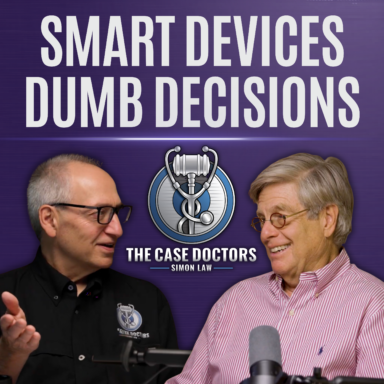
A smart fridge exposes an affair, chairs track productivity, and a "military-grade" phone case shatters. The Case Doctors have seen it all.
|
|

John G. Simon’s work as Managing Partner at the firm has resulted in hundreds of millions of...

Alvin Wolff has practiced personal injury law for nearly 40 years. During his tenure, he has handled...
| Published: | July 7, 2026 |
| Podcast: | The Case Doctors |
| Category: | Litigation , News & Current Events |
The Case Doctors kick things off with a federal court ruling that sent a Sam’s Club slip and fall case back to state court after a judge found the defendant jumped the gun on removal. Then, the hosts explore whether invasion of privacy or emotional distress is the stronger angle with a jury on a case involving data from a smart fridge that tracked a cheating wife’s late night snack patterns. Wolff’s diagnosis? You don’t have to choose. Invasion of privacy is the foundation, and emotional distress follows naturally. Two for one. And do attorneys representing employees disciplined for data collected by ergonomic smart chairs without their full knowledge or consent have a claim with the employer or the chair manufacturer? The consensus: the conduct is fundamentally unfair, and most jurors would agree.
Special thanks to our sponsor Simon Law Firm.
Christine Byers [00:00:00 – 00:00:07]
Her spouse used the data in a divorce filing exposing her affair. Welcome to the Case Doctors.
John Simon [00:00:07 – 00:00:09]
She goes into the fridge to get
Christine Byers [00:00:09 – 00:00:13]
a salami with John Simon and Alvin Wolf.
John Simon [00:00:13 – 00:00:19]
The fridge sends a note to the husband. Your wife is banging someone who’s not you.
Christine Byers [00:00:19 – 00:00:23]
The show where two of the greatest legal minds offer you advice on your cases.
Alvin Wolff [00:00:24 – 00:00:26]
Now, that’s a. That’s a. That’s a hell of a frit.
Christine Byers [00:00:27 – 00:01:04]
The Case Doctors will see you now. Welcome to the Case Doctors. I’m your host, Christine Byers of Simon Law, and I’m joined by the case doctors, John Simon and Alvin Wolfe. Now, between them, they have more than 80 years of experience as plaintiff’s attorneys. So there really isn’t a scenario they haven’t already encountered in a case and figured out how to handle it. Now they’re offering you the chance to tell them about the various problems or issues that are coming up in your cases and hear how they would handle it. But. But first, let’s turn to some of the civil cases making headlines and hear what the case doctors have to say about them.
Christine Byers [00:01:04 – 00:01:52]
This has to do with a Sam’s Club slip and fall. And this is a case that was in the federal court and then it went back to the state court due to premature removal of notice because the August 2025 email correspondence did not put defendants on notice that the case was removable. Their notice of removal was premature and therefore procedurally defective. A federal judge ruled. So he sent a slip and fall lawsuit back to the state court after ruling that Sam’s Club jumped the gun in removing the case. Concluding references to upcoming surgery did not equate to clear notice that the plaintiff’s damages exceeded the $75,000 jurisdictional threshold.
John Simon [00:01:53 – 00:01:55]
Why wouldn’t you want more than $75,000?
Alvin Wolff [00:01:55 – 00:02:03]
Yeah, I mean, I would, you know, I’d rather be in federal court with an unlimited amount, you know, than.
John Simon [00:02:03 – 00:02:04]
Oh, for sure.
Alvin Wolff [00:02:04 – 00:02:05]
Yeah, absolutely.
John Simon [00:02:05 – 00:02:31]
You know, actually, I had a trial once where it was removed to federal court. The lawyer had it remanded and filed a memo with the court saying that this case is worth not more than $74,999.99. Went back to state court, I tried the case for him, and I got a verdict in excess of $75,000. He got sued.
Christine Byers [00:02:33 – 00:02:33]
Really?
John Simon [00:02:33 – 00:02:52]
He got sued? It sounds to me like a waste of time. If your case is going to be worth More than 75, just stay there or figure out a way to keep it in state court and sue the manager or whoever you need to sue to keep non diversity.
Alvin Wolff [00:02:53 – 00:02:54]
Wow.
Christine Byers [00:02:54 – 00:03:00]
Have you had experience with cases in, at the federal level, going back down to the state level and like, what?
Alvin Wolff [00:03:01 – 00:03:45]
Yeah, all the time. I mean, every, every case that we, most of the product cases end up in, in federal court because of, you know, diversity issues. But it happens all the time. And like, like Alvin was saying, you know, you need to think about who your defendants are. You need to think about where you want to file it. I mean, that’s the biggest part of a big part of every case. You know, who do you want to be in front of? Do you want to be in federal court? Do you want to be in state court? What’s the state court, you know, jurisdiction, the county look like? I mean, all of those things go into it. It’s not just get it and file it, but, you know, where can you file it? Now if a case legitimately is worth 50,000 or $40,000, I don’t think wherever you file it, doesn’t make any difference.
John Simon [00:03:45 – 00:03:51]
Yeah. Why would you want to be right? I mean, you just can’t afford to do a case for that little anymore.
Christine Byers [00:03:52 – 00:03:53]
Gotcha.
John Simon [00:03:53 – 00:04:01]
And with Walmart, we say Walmart sells for less because they cut corners with customer safety. I just thought I’d throw that in there.
Christine Byers [00:04:04 – 00:04:42]
Thank you, gentlemen. Time now to turn to our email inbox for the cases our viewers have sent in for the case doctors to diagnose. Now, just so everyone knows what, we’re not going to reveal where these cases came from. We’re not going to reveal any names or firms to protect the confidentiality of the cases. Instead, the case doctors are just going to focus on the issue in each of them. So as they say, the case doctors will see you now. So first up, my client’s smart refrigerator logged late night snack patterns and synced with a family app. Her spouse used the data in a divorce filing exposing her affairs.
Christine Byers [00:04:43 – 00:05:01]
We are claiming the manufacturer failed to adequately disclose how behavioral data could be shared and misused, causing emotional distress and reputational harm. Do we lean more into invasion of privacy or is the emotional distress angle stronger with a jury? It’s synced with a family app.
John Simon [00:05:02 – 00:05:18]
She goes, she goes into the fridge to get a salami and the fridge sends a note to the husband. Your wife is banging someone who’s not you? Is that what you’re talking about?
Alvin Wolff [00:05:19 – 00:05:22]
That is. Now that’s a, that’s a, that’s a hell of a fridge.
Christine Byers [00:05:24 – 00:05:25]
Not exactly.
Alvin Wolff [00:05:25 – 00:05:26]
That is a hell of a fridge.
Christine Byers [00:05:26 – 00:05:38]
So it’s more. It was showing patterns because she was getting he was trying to prove she was having an affair and that she was talking with her. With the gentle boyfriend.
Alvin Wolff [00:05:39 – 00:05:41]
Oh, so the husband didn’t have access to the phone.
Christine Byers [00:05:41 – 00:05:41]
Correct.
Alvin Wolff [00:05:41 – 00:05:43]
But he probably had access to the fridge.
Christine Byers [00:05:43 – 00:05:44]
Correct.
Alvin Wolff [00:05:44 – 00:05:48]
And the fridge, you know, proved. Called her out on it. Yes, the affair.
John Simon [00:05:48 – 00:05:49]
I don’t get that.
Christine Byers [00:05:49 – 00:05:54]
A smart fridge is going to log every time someone goes in and out of it.
Alvin Wolff [00:05:55 – 00:05:55]
Why?
John Simon [00:05:56 – 00:05:57]
Because it doesn’t want you to overeat.
Alvin Wolff [00:05:57 – 00:06:01]
Oh, okay. All right. Or have affairs.
John Simon [00:06:03 – 00:06:05]
The fridge doesn’t want you to have any fun at all.
Christine Byers [00:06:06 – 00:06:13]
You know, she’s trying to tell her husband. What do you mean? I’m not up all hours of the night talking on my phone to some other person that isn’t you.
Alvin Wolff [00:06:14 – 00:06:15]
She told me you were. Right.
Christine Byers [00:06:15 – 00:06:19]
But the fridge told him she was up having snacks at those times.
John Simon [00:06:19 – 00:06:41]
Well, that would be an invasion of privacy. And I think emotional distress goes hand in hand with invasion of privacy. So you got two for one. Really? You don’t have to go for emotional distress and abandon invasion of privacy. Because I think you have to go with the invasion of privacy to get to the emotional distress.
Alvin Wolff [00:06:43 – 00:06:45]
Hmm. Problem solved.
John Simon [00:06:45 – 00:06:46]
Yeah.
Alvin Wolff [00:06:46 – 00:06:47]
Case doctors.
Christine Byers [00:06:47 – 00:07:23]
There you go. All right, here’s our next letter. Dear case doctors, my client worked for a company that installed ergonomic smart chairs that track posture and time seated. The company later used the data to discipline employees for low productivity. We are claiming employees weren’t properly informed of the scope of monitoring and the data use exceeded consent, causing privacy violations and wrongful discipline. Are you bringing in tech experts early or waiting to see how the defense frames the data use?
Alvin Wolff [00:07:24 – 00:07:30]
Yeah, I mean, that sounds ridiculous that they’re going to discipline you based on how you’re sitting in your chair and how often.
John Simon [00:07:31 – 00:07:52]
It seems like an extension of. I know a lot of these firms will see if you’re on Facebook during the day or you’re on a porn channel during the day or how you’re using the company’s computers. They track that data. And I guess the defense for that would be, I’m stretching my legs.
Alvin Wolff [00:07:53 – 00:08:08]
Are they chained to that chair? And they can only do their job while they’re in the chair sitting there. Right. You know, now, if it was an airline pilot or something, I would say maybe that’s a little bit different. They got to be in the seat all the time. They have two pilots or. Or a bus driver.
John Simon [00:08:08 – 00:08:09]
Right.
Alvin Wolff [00:08:09 – 00:08:12]
If he was out of his seat for 20 minutes out of every hour, you’d.
Christine Byers [00:08:12 – 00:08:13]
That would be concerning.
Alvin Wolff [00:08:13 – 00:08:13]
You’d question that?
John Simon [00:08:14 – 00:08:17]
Especially if there was a log and over the road.
Christine Byers [00:08:20 – 00:08:27]
So do you, the question is, do you bring in tech experts early or do you wait and see how the defense frames the data use?
Alvin Wolff [00:08:27 – 00:08:37]
I think you have to have someone initially to tell you that you have a case. So you probably can’t avoid having somebody early on to look at it.
John Simon [00:08:37 – 00:08:47]
Right. I’d want to see what HR’s case was or what their information was before you brought in someone to take a look at it. Because you’re going to have to have access to the data.
Alvin Wolff [00:08:48 – 00:09:14]
Yeah, I think it’s, it’s, it’s the, the case sounds like it’s something that, you know, it’s, it’s bad conduct. I mean, I, I, I don’t like it. I don’t like what the employer’s doing. I think most people wouldn’t appreciate that. It seems unfair. It seems fundamentally unfair what they’re doing. So I think, you know, what would be the claim be a claim against the employer.
John Simon [00:09:14 – 00:09:15]
Right, right.
Alvin Wolff [00:09:15 – 00:09:16]
Would you need the chair for that?
John Simon [00:09:17 – 00:09:19]
Well, you need the data from the chair.
Alvin Wolff [00:09:19 – 00:09:20]
Just the data from the chair.
Christine Byers [00:09:21 – 00:09:57]
All right. And another letter from our viewers. This one is titled the Indestructible Phone Case that wasn’t. Dear Case Doctors, my client’s phone case was marketed as military grade indestructible, but it shattered on a routine drop, destroying the phone and critical work files. We’re claiming deceptive marketing and breach of warranty and it ca financial loss. Would you try this as a class action or is it stronger as an individual economic loss case? And also, anyone have jurors get personally offended by marketing language like this?
John Simon [00:09:58 – 00:10:06]
First of all, I would criticize the client for not using the cloud. I mean, to have a phone and not have a backup is totally irresponsible.
Christine Byers [00:10:06 – 00:10:07]
True.
John Simon [00:10:09 – 00:10:17]
You know, everything they say is indestructible is destructible. I bought golf tees. They said, these will last you for your whole life.
Alvin Wolff [00:10:18 – 00:10:19]
How’d that work out?
John Simon [00:10:20 – 00:10:37]
Well, the first time I broke one, I sent it back to the company and they sent me a new package of teas and they said, we’ll do this once because they keep breaking. But I think, you know, their idea is, you’re going to lose this before you can break it.
Alvin Wolff [00:10:39 – 00:11:24]
Yeah. And with the class action, you know, for that individual, whoever’s handling that person’s case, it’s probably better for that person if they handle it individually. You know, the whole class thing sort of, I don’t know how often does it happen or the, is it, you know, I guess if it’s just broken, if. If it’s. If it’s just broken and. And they’re not willing to replace it, then it’s more conducive for a class because the damages are the same for everybody. But if you’re making a claim that, you know, your information wasn’t stored on the cloud or you lost, you know, there’s some financial loss that probably doesn’t work as a class action because, you know, the damages are so different from each class member. You have to have enough.
Alvin Wolff [00:11:25 – 00:11:28]
Enough similarity in what the damages are to make it work as a class.
John Simon [00:11:28 – 00:11:39]
Well, but let’s say with the towel cases around, everybody gets cancer or whatever they get. It’s a different degree of damages for each person, isn’t it?
Alvin Wolff [00:11:39 – 00:11:41]
Yeah, yeah, it would be.
John Simon [00:11:41 – 00:11:45]
Would it be a mass tort or would it be a class action? And what’s the difference?
Alvin Wolff [00:11:46 – 00:11:50]
Yeah, I don’t know. I mean, how often does. It would depend on how often. How often it happens.
Christine Byers [00:11:50 – 00:12:06]
Also, do you. Have you ever had cases involving products marketed as, you know, indestructible or foolproof? All the things. I know you brought up your golf tees, but have you had any experience, you know, with products cleaning.
Alvin Wolff [00:12:07 – 00:12:41]
Not that are represented as indestructible, but I’ve had cases where components of a product have failed that never should have failed. You know, critical components, you know, part of a fuel system, for instance, in a car, or part of the braking system, you know, a crane, you know, with a. With a. With a backup device. You know, products where they have redundancies built in for safety, that shouldn’t, you know, that shouldn’t fail. You know, those are things that, you know, we see that, but it’s not a specific representation. You know, probably because it’s a component part for the overall product.
Christine Byers [00:12:42 – 00:12:52]
Gotcha. Alvin, how about you? Any product cases where they were trying to sell them as, you know, indestructible or 100% guarantee, all those things.
John Simon [00:12:53 – 00:13:05]
You know, I just got a power washer that the commercial says, you know, you clean everything in five seconds. I can’t even get it on the hose. I can’t even hook the thing up.
Alvin Wolff [00:13:05 – 00:13:08]
Well, it lasts a long time. Then if you don’t, you’re not using it.
John Simon [00:13:08 – 00:13:09]
It’s gonna last forever. It’ll last.
Alvin Wolff [00:13:09 – 00:13:11]
Last you forever, no problem.
Christine Byers [00:13:12 – 00:13:19]
And have you ever had jurors get personally offended by marketing language that overstates a product?
Alvin Wolff [00:13:21 – 00:13:23]
Probably nothing comes to mind.
John Simon [00:13:23 – 00:13:38]
I’ve had jurors get mad with overstatements and medical records. And medical billing. That is not true. Jurors don’t like lies. I think that offends them and makes them angry. But I’ve not had it in the products sector.
Christine Byers [00:13:39 – 00:13:42]
What do you think gets jurors riled up the most?
Alvin Wolff [00:13:43 – 00:13:51]
Not being honest, you know, some trying to, you know, insulting their intelligence, I would say gets them pissed off.
John Simon [00:13:52 – 00:13:52]
Innovation.
Alvin Wolff [00:13:52 – 00:14:17]
Yeah, they. They get it. I mean, as a group, as a group of 12, I think a jury has a greater memory than any person that’s ever lived. You know, they’ll, they’ll remember things, you know, collectively, as a group, they’re smarter than any person. They’re the memory, better memory than any person. And, and, you know, if you give them the information, they get to the right result most of the time, you know, in my experience.
Christine Byers [00:14:17 – 00:14:35]
Okay, gentlemen, that will do it for this episode of the Case Doctors. If you have a case that you would like the Case Doctors to dissect, send us an [email protected] Once again, we will be keeping all names and cases confidential. And thank you for joining us. And we will see you next time on the Case Doctors.

Notify me when there’s a new episode!

|
The Case Doctors |
Veteran trial attorneys John G. Simon and Alvin Wolff answer questions from other attorneys about various case scenarios, offering insight into how they would handle litigation situations. They field your questions about how they would handle a case.