

|
|
Santos Vargas is the president and a past chair of the Board of Directors of the State...

Alyson A. Martinez, a native of Laredo, is the first attorney in her family, graduating from Texas...

In 1999, Rocky Dhir did the unthinkable: He became a lawyer. In 2021, he did the unforgivable:...
| Published: | April 9, 2026 |
| Podcast: | State Bar of Texas Podcast |
| Category: | Access to Justice , Career , News & Current Events |
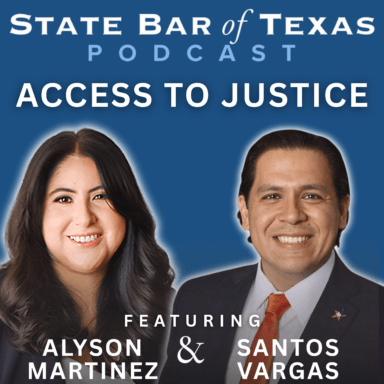
In this conversation, host Rocky Dhir brings together two leaders: State Bar of Texas President Santos Vargas and Texas Young Lawyers Association (TYLA) President Alyson Martinez. They discuss their progress and continuing goals for the 2025–26 bar year, highlighting initiatives aimed at strengthening access to justice and expanding public service.
Special thanks to our sponsor State Bar of Texas.
Rocky Dhir:
Hi, welcome to the State Bar of Texas Podcast. I’m going to cut out the usual intro and cut straight to the chase. Our state bar has been busy firing on all cylinders, and I want to make sure we have time to cover it all. So let’s just jump right in. Santos Vargas is the 2025-26 president of the State Bar of Texas and past chair of the State Bar of Texas Board of Directors. When he’s not presidenting and chairing, he is a litigator at Davis and Santos in San Antonio. His signature initiative this year as president is called Stand With Santos. I hope you’re sitting down because it’s pretty freaking cool. We’re going to hear about it in just a second. And then we also have Alison Martinez. She’s the 2025-26 president of the Texas Young Lawyers Association. I think it’s been years since I qualified for that prestigious organization, but based in Laredo, Alyson is director of the Webb County Community Supervision and Corrections Department and legal advisor for the Probation Advisory Committee of Texas.
She aims to highlight this year public service lawyers in Texas with her project is called For the Public. And now here she is for the record to tell us about it. So there are great things happening at all levels of our state bar. We have the two presidents here to tell us all about it. And like I said, I want to make sure we have enough time to cover everything because there’s a lot going on. So president and president, welcome to the podcast.
Santos Vargas:
Hi, Rocky. How are you?
Rocky Dhir:
Doing great, man. It’s always good to see you. Alyson, how are you doing today?
Alyson Martinez:
I’m doing well, Rocky. Thank you so much for having us.
Rocky Dhir:
Absolutely. You guys have been doing a lot of hard work. So there’s an important question that I think we need to address this upfront. It’s kind of the elephant in the room. So we’re going to do this so we can have a good conversation. And it’s an important question. Which one of you is cooler and why is the answer Alison? Santos, I’m going to let you take that one. Why is she cooler than you?
Santos Vargas:
Because she’s Alyson. I mean, what do you need beyond that, right? I mean, Alyson is an absolute rockstar. She has had an incredible year as president of the Texas Young Lords Association. And she’s also become just a dear friend. And I just love watching her rise and leadership. It’s been remarkable. It’s been inspiring. Can’t wait to hear a lot more on this podcast about everything that Alyson’s been doing, but she is an absolute rockstar. We’re absolutely lucky to have her.
Rocky Dhir:
And Alyson, I assume you will stipulate that you are cooler than Santos.
Alyson Martinez:
It is on the record. So no, but it’s just been so much fun. Following after Santos, he typically fires up the room and everyone is always so excited for access to justice, which is a feat in and of itself. After he speaks in every meeting, every talking event that we’ve had, it’s just been so great to share this presidency with him. And so I’m really, really excited to have this time to get to know him, get to know his family. It’s been a great year.
Rocky Dhir:
I couldn’t help but notice neither one of you talked about how cool I am. And so that’s okay. It’s for the record, it’s for the public. But Alyson, I think you’re the first corrections director we’ve ever had on the podcast. Tell us what that is and what it means. I think that alone might actually earn you the top cool points of anybody that’s ever been on here. So what does that entail?
Alyson Martinez:
So my department is called the Web and Sopatha County Community Supervision and Corrections Department, or as we like to just call it adult probation. So I am the director overseeing all individuals who are placed on adult probation in Web and SaBata County. It’s a pretty unique day job. I entered into it after serving for six years as an assistant public defender at the Webb County Public Defender’s Office. Our focus probation is not about punishment. Our focus is rehabilitation and reducing recidivism. I found a big connection from being a public defender where I was placing my clients on probation to now doing this because I didn’t know what the program looked like. Not good, not bad. I just wasn’t fully sure what it was. It’s
Rocky Dhir:
Like a black box kind of.
Alyson Martinez:
Yeah, exactly. And so this was a way for me to have insight into that and get to mold the program in ways that I thought were really focused on rehabilitation and giving a person a second chance, a true second chance. Our goals are to connect people to treatment, whether that be substance abuse or mental health, providing cognitive classes or support programs and using our technology as best as we can to make it better. COVID was a big eye-opener for the field and really just trying to stay a step above. And we love the key phrase and provision is evidence-based practices. What is going to really help us take this forward? So I like to say it’s public service at its core because we are working with people one-on-one, helping them stabilize their lives while still protecting our community.
Rocky Dhir:
Wow. Okay. So Santos, I’m not even going to ask you to follow that because I mean, that’s way cooler than anything you or I can even lay claim to.
Santos Vargas:
By far, Rockie, by far.
Rocky Dhir:
You said all day that you’re a cool lawyer, but really you’re just a dentist. All right. So look, on the surface, Santos, you’re focused on access to justice. And Alyson, yours is about public service lawyers. So on the surface, it kind of looks similar. It looks like it’s part of the same family of initiatives, but is there a difference between what we call access to justice and public service? So Santos, I’ll let you take that one first and see if you got an answer for that one.
Santos Vargas:
Sure. There’s definitely some overlap. Really, both of the initiatives that we are working on, Alyson and I, involve service to the public. Access to justice is a little bit more narrow. Access to justice really focuses on getting civil legal assistance for low income Texans. There’s a nationwide movement on access to justice, but what we’re focusing on is low income Texans. And so really what that looks like is that there’s more than five million of our fellow Texas citizens that qualify for low income, civil, legal aid. The problem is that there just aren’t enough funds to help all of those folks. And so that’s really what my initiative on access to justice has been focused on. And I’ll let Alyson take kind of the public service portion of what TYLA does, but they really are the public service arm of the State Bar of Texas. And for years, decades, they have done incredible work for the citizens of the state of Texas.
And we’re incredibly proud. In fact, as you can imagine, board meetings can oftentimes be a little bit dull, right?
Rocky Dhir:
I’m sure. Not with you guys.
Santos Vargas:
Well, not with Alyson, because every time that Alison comes up to the podium and she starts talking about all of the great public service projects that TYLA is involved in, she talked a little bit about energizing the room. It really energizes the State Bar of Texas board of directors. They have an incredible board. They do incredible work and they put a lot of time into the work that they do into public service at a time in their lives when time is a huge, really important commodity for them. And so I applaud them all day long for the incredible work that they do.
Rocky Dhir:
Alyson, what do you think? Santos says that access to justice is kind of a bit narrower. Do you share that view or is public service kind of its own entity?
Alyson Martinez:
Yeah, no, I think I would agree. I think access to justice is like Santos is error. It’s like talking about making legal help available to Texans all across the country, and it’s often civil focused. And public service law is this broader umbrella that includes any legal work that is done to serve the public. So it can run anywhere from prosecutors to public defenders, to legal aid attorneys, to government lawyers working in municipal governments and things like that. So I think the clearest distinction for us here today is that access to justice is the goal. We want to make sure that Texans all across the state are getting access to legal help and legal services. And public service is a way to reach that goal. Public service are a big part of how we get there, but it’s not the only part, right? There’s so many other moving parts that we can use, but definitely it helps contribute towards the bigger goal of access justice.
Rocky Dhir:
Let’s talk about these actual initiatives. So Santos, yours is called Stand with Santos. So give us the Shark Tank pitch. What is it? And for those of us that may not be familiar with it, walk us through it.
Santos Vargas:
So Rocky, what stand with Santos is it’s one more way that lawyers in the state of Texas can do everything they can to bridge the justice gap. And so let me talk a little bit about what specifically that means. And I touched on it a little bit earlier. So we have in the state of Texas, 90%, over 90% of civil legal needs for low income Texans that continually go unmet year after year after year. What that means, and I touched again on this earlier, is that more than 5.2 million Texans qualify for civil legal aid, but Texas ranks 46 in the country for ensuring access to justice for all people.
Rocky Dhir:
Wow. I didn’t know we were that low.
Santos Vargas:
Well, and it’s not because lawyers aren’t trying to do their part. It’s just that we’re such a big state. We have so many folks that need that kind of help. And actually, lawyers in the state of Texas year after year contribute in both time and money, close to $12 million towards access to justice. Now that’s both dollars that are raised as well as pro bono hours that are pledged, right? Here’s the problem. Here’s really what kind of solidified for me that access to justice needed to be the focus of my presidency is that when you take all of those stats and you kind of look at them and you start digesting them, and then you start thinking about the fact that across the country, including here in Texas, we spend more money every single year on Halloween costumes for our pets than we do on funding civil legal aid for low income Texans.
It really kind of drove home that we needed to do more to help our fellow Texans deal with this issue. Now, what does this actually mean, right? Because it’s access to justice can sometimes sound like sort of a vague term. What that means is that Texans across the state just aren’t getting the help that they need for really serious civil issues. What kinds of issues am I talking about? The lack of funding means that civil legal aid providers, and we have several across the state, and I’ll focus on kind of the big three, right? Lone Star Legal Aid, Legal Aid of Northwest Texas, and Texas Rio Grande Legal Aid. There are lawyers that this is what they do. They provide legal services for low income Texans at these providers and others, but they’re having to make really, really stark decisions. It’s almost like triage for them because they don’t have enough lawyers.
They don’t have enough funding to help all of the folks that are coming to them for help. So they’re having to decide in real time, for example, which woman is most likely to be abused by her husband or her boyfriend, because there aren’t enough lawyers that are doing this type of work to help all of the women that are coming to them for help to get a protective order. They’re having to make decisions as to which veterans most likely to get evicted from their home, because again, there aren’t enough legal aid lawyers and enough funds to help all of the veterans that fought for our freedoms that are coming to them for help. They’re having to make real time decisions as to which child with special needs is most likely to stay off of the type of help that they need, whether it’s Medicare or Medicaid, to help them for those types of benefits, because there aren’t enough lawyers to help all of those benefits get restored.
That’s just a small sample of the types of issues that legal aid lawyers deal with on a daily basis and the types of decisions that they’re having to make on a daily basis as to which folks they’re going to help. It really is triage for them and they really need all of the help that they can get. And the important thing to remember is that the more folks that are helped on this end, the more folks that get help with civil legal aid, the more that we can help those folks avoid disastrous consequences in their lives that has an effect on all of us as Texans. And so it really is extremely important work and it’s extremely important cause not just for the legal community, but for all of us as Texans.
Rocky Dhir:
We have to take a break here in just a couple of moments. Then we’re going to come back and learn a bit more about Alyson’s initiative about for the public. But before we go, Santos, there’s a question I think that you laid out a very good opening statement for why we need access to justice in Texas and obviously nationwide as well. But what does Stand With Santos do in that process? Where does it fit in?
Santos Vargas:
Here’s where it fit ins. Rockie, this year as president of the State Bar of Texas, I had a voice and I’ve had an opportunity to get out in front of lawyers nearly every single day. I’ve spoken to lawyers all across the state of Texas, bar associations, all across the state of Texas. And what I’ve decided to do is use that voice, use that pulpit in order to make a difference on access to justice, in order to be able to raise awareness and to raise funds to make just even a small dent in bridging the justice gap. And so that’s what Stand With Santos is. It’s just another opportunity to raise awareness, to honor all of the legal aid workers that are out there on the front lines every single day, working really hard on this issue, and to raise as many funds as we possibly can in pro bono hours as we possibly can to help bridge the justice gap.
Rocky Dhir:
That gives us all something to think about as we sit back and hear from one of our sponsors. So we’re going to be back in just a couple of seconds. I want you to listen in. And when we get back, Alyson’s going to talk to us about For the Public. So everybody stay tuned. We’ll talk to you in just a couple. We are back with Santos and Alyson as we talk about their amazing tireless initiatives in their respective presidencies this year. Now, Alyson, we heard from Santos. He gave us his Shark Tank pitch, but I think Santos, we qualify as boomers. I think we’re both Gen X, but nobody cares. Nobody cares about Gen X. We’re basically just in the boomer category. I don’t think Alyson would be wanting to give a Shark Tank pitch. That’s a boomer thing. But can you give us the TikTok version of for the public?
What is it? And it sounds multifaceted, so I’m curious to hear about it.
Alyson Martinez:
I don’t know if I’m well versed in TikTok as I’m a millennial, not quite as hip as Gen Z, but I will try my best.
Rocky Dhir:
What are millennials into them? Don’t tell me your Facebook
Alyson Martinez:
Because that’s
Rocky Dhir:
Boomer now,
Alyson Martinez:
I think. No. No, not Facebook. Probably more Instagram. We like to get our TikToks and reels months later than what they are on TikTok.
Rocky Dhir:
In that case, give us your Insta. Share your Insta version for the public, and then we can do a collab. I don’t know if I’m even using it correctly.
Alyson Martinez:
No, it all sounds proper, proper lingo right there. No. So basically for the public is, if you’ve ever wondered what it’s actually like to be a public service lawyer, this is for you. So it’s a little bit of a peek behind the curtains showing that public service actually isn’t just meaningful, but it’s actually doable. It is open for anyone who wants to see themselves in this role. And so it is a statewide project that highlights real lawyers doing work in public service fields. It is multifaceted and it includes video spotlights of attorneys across Texas. We are also having a series of podcasts that accompany the project that have deeper conversations with even more attorneys across the Texas who are serving in public service roles. We’ve developed a number of career roadmaps that law students can look at, such as for prosecutors, public defenders, legal aid, government lawyers, and anything in between that will help them try to navigate how to get into those fields.
Because what I found and what I remember in law school, a lot of the times what you are being sold and what is being offered to you in terms of potential job opportunities are big law and firms.
Rocky Dhir:
I wanted to ask you about that. Are you collaborating with law schools to try to get more interest in public
Alyson Martinez:
Service
Rocky Dhir:
Law?
Alyson Martinez:
That’s the goal, right? The goal was to create this website, to create this project, and then potentially in the future, then we roll it out in different law schools. We encourage career offices or career advancement offices across all the law schools in Texas to promote this project and to showcase to their students how they can enter into these public service fields. We also did a career service panel, so careers, I believe it was called Careers that Serve panel that will be featured on the website as well that highlights a number of public service lawyers that are actually directors on the TYLA board of directors. And the goal is to continue to do panels like that, maybe in person, this one was done virtually to, again, pull back that curtain and engage in those conversations about what it’s like to be in those fields and what a typical or non-typical day for us is, or the work that we get to do and also why we love to do it.
I did not go into the practice of law thinking that I was going to be a career public service attorney. I went in thinking, sure, fine. I’ll be a prosecutor for two, three years, and then I’ll go and hang my own shingle and do what I can. But my desire to move back to Laredo, which is where I was born and raised, I was in law school in Houston. And when I was deciding where I was going to go after law school, I made the decision to come back home because this was a community that I wanted to serve. And little did I know that that was the basis for me entering into this career long desire to be in public service. So I didn’t end up becoming a prosecutor. I ended up becoming a public defender and I loved it because I got to work with people so intimately, so one-on-one and help them with not just their cases because when you’re a public defender, you’re a social worker, you’re a mental health counselor as much as you can be.
With
Rocky Dhir:
Very little money and funding to do it with.
Alyson Martinez:
Yes. And there’s a lot of push across the state now for these public service offices like public defender’s offices, like even DA’s offices to be more holistic. And knowing that the work that is done affects any individual’s lives in more ways than just a court case. And so that really grew this love for what I did. And I found that I was at my happiest and my most fulfilled when I was helping people individually. And I know there’s so many people who have these same feelings, who have the same motivation and drive to continue to serve the public. And that was where this was born from, right? This is where I honoring them and celebrating anyone who are in these fields and hopefully growing it tenfold or thousandfold if we can. Because one of the things too is Santos talks about where the issues are with access to justice, where our shortcomings are in the state of Texas, public service is a shortcoming too, right?
It’s not as attractive. It’s not as sexy, if you will, to go into public service coming out of law school. And so it also is a way to promote the field and promote what students can get into coming out of law school.
Rocky Dhir:
I’m trying to listen to the two differences. By the way, Santos, I think you’re correct. She probably would energize every board meeting.
Santos Vargas:
Absolutely. She does every single time.
Rocky Dhir:
I bet. I bet. She is objectively better than us. It sounds like Santos, your initiative is really aimed maybe at, it’s fundraising plus awareness. And Alison, yours is really narrowing the focus to awareness of public service laws. Is that fair? Are these both awareness initiatives with Santos also adding in kind of a fundraising and/or volunteer component to it?
Alyson Martinez:
Yeah, I would say so. It’s awareness. I did want to make sure that we kept it resourceful as well for law students and give back those resources and how they can look into public service fields because like I said, there isn’t a lot that is going around in law schools. And so this will hopefully be a component for that.
Rocky Dhir:
Stand with Santos, that’s got both wings to it, right? You’re trying to raise money and then you’re also trying to get lawyers and the general public to know more about access to justice issues. Is that fair?
Santos Vargas:
That is fair. So really there’s a couple of different goals with Stand with Santos. One, let’s honor all of the folks, all of the civil legal aid workers on the front lines that have been out there helping folks every single day on these types of issues, which are really, really difficult. In addition to that, let’s raise awareness about the need for Texans and for the legal profession to come together to help bridge the justice gap for low income Texans. And if we can raise money and raise volunteer hours in the process even better, right? Those are kind of what the goals of Stand with Santos have been. And I’ll tell you kind of what our initial goal was and where we’re at. So if we could honor just one legal aid worker, if we could raise $1, if we could help just one person who needs access to justice, then that is what victory looks like for the stand with Santos campaign.
Now, when we started this campaign back on June 20th, when I was sworn in as stateBar president, what the goal was, was to raise at least $300,000 in value for access to justice and trying to bridge the justice gap. Where we’re at to date so far, and I still have a couple of months left in my presidency, is that at this point, we’ve raised a total value of more than $586,000-
Rocky Dhir:
Oh, good night. … access to
Santos Vargas:
Justice. So yeah, we’re getting really close to doubling what the goal was, and I’m going to work as hard as I can over these last two months to make sure that we do that. But in dollars, what we’ve raised up to this point is $119,000 in donations from lawyers and different associations and organizations across the state of Texas. In addition to that, what we’ve done is we’ve raised 1,538 pro bono hours that have been pledged towards access to justice through the stand with Santo’s campaign. Now, all of those funds go directly to the Access to Justice Foundation. But in addition to all of that, I’ve taken every opportunity that I had to speak to bar associations, to raise awareness, to honor those legal aid workers. And I’ve also dedicated virtually every column in the Texas Bar Journal as the president of the state bar and raising awareness, telling the stories of the legal aid workers and the folks that have been helped by legal aid in order to raise awareness and show Texas lawyers how important this issue is.
Rocky Dhir:
You’ve talked about victory for Stanvit Santos, but Alyson, what does victory look like for the public? With Santos, he’s set a fundraising goal and he’s kind of put numbers to it. Is there a victory for the public and what do you think that looks like?
Alyson Martinez:
Yeah, of course there’s a victory, right? And I think in the short term, and of course, I have to shout out the Texas Bar Foundation for being the grant awardee for this project. We are close partners of the Texas Bar Foundation, TYLA, typically gets an award every year to fund these big projects. And we’re also grateful that they continue to believe in the work that TYLA does in servicing the public and being the public service arm of the StateBar of Texas. So whenever we create these projects, we always have short term and long-term goals that we want to accompany it because we want to make sure that we’re using this money in a respectful way and that we’re getting the most bank for a buck. And so I guess in the short term, I would like for us to continue to roll out this project in different law schools all across the state and to really get law students and young lawyers to start actually using the resources that the website offers and that we increase awareness of public service career paths and showcasing that there isn’t just one career path, right?
It’s not just prosecutors and public defenders, right? There’s a lot of avenues that you can take when it comes to the field of public service. And I think in the long term, I would like to see, and there is no way to measure this, but I would like to see more attorneys choosing public service roles, right? Whether that would be because of this project or not, I would just like to see public service offices getting filled with attorneys who are motivated and driven to support their communities and to shape their health of their communities that they live in. We would hopefully like better informed applicants entering into those spaces. Like I said, we wanted to pull back the curtain a little bit about what these roles entail. And so really want to showcase what it truly is and how your career can be shaped by these roles.
Again, just creating that stronger pipeline into public facing legal work. So I would like to say victory is when someone watches one of our videos and thinks like, “I can really see myself doing that. I can really see myself becoming this individual and following this career path and really get inspired by it. ” The website is resourceful. It is multifaceted. It’s also beautiful in my opinion because the vendor that we worked with Weekends Media did such a great job in the production of each video and we’re so proud to showcase the different interviews that we’ve done and to highlight the attorneys that came to Austin to be interviewed and to share their story with us. So that’s victory to me is someone sees them, someone hears their story and says, “I want to do that because I can do that. ” And that would be really meaningful for me.
Rocky Dhir:
I always say you got to end with a win. So we’re going to take a pause real quick, hear from another one of our sponsors. And when we come back, we’re going to talk a little bit about some of the on the ground stories of what Stand with Santos and for the public is showcasing. So you guys can go check it out on your own once you finish listening to us. So we’ll be back with Alison and Santos. All right, guys, we are back and hopefully you’re feeling curious and motivated to learn more about what’s going on in our state bar. We’ve got Stand with Santos, we’ve got For the Public, and now we’re going to learn a little bit about how these initiatives are actually impacting folks on the ground, and they are, believe it or not. So Santos, let’s maybe start with you.
The summer of 2025, as your presidency was getting started, we saw some devastating floods happening in the hill country, and it made national news, some people lost their lives, they lost property, and yet Stanwid Santos got involved in that entire disaster. How’d you get involved and what did Stanwood Santos do for that?
Santos Vargas:
Well, Rocky, I guess the best way to answer that is to tell you a little bit of a story. So I was sworn in as stateBar president on June 20th, and I had a really short window of time, a little over a week to take a vacation with my family, and I did. Right After I got sworn in, right after the state bar annual meeting.
Rocky Dhir:
I remember you doing that. Yes. I was like, “Boy, he looks so happy right now and now he’s going to come back and have his work cut out for him.”
Santos Vargas:
Well, I knew what the next year was going to look like for me. I knew that I was going to have to spend time away from my family, for my wife, for my children. And so we took a great vacation. We went out of the country. We flew back. Actually, we boarded our plane. We took an overnight flight the evening of July the 3rd, landed back in Austin from an overnight flight around 9:30 AM on the morning of July 4th. And if you remember, that’s the morning when the flooding hit. And so when we landed, if we had no idea what was going on, we turned on our phones, we started getting text messages, we started getting phone calls. We saw all the news reports about all of the devastating flooding that was going on in the hill country. And this hits really close to home for me and for my family because our neighborhood sits on the banks of the Guadalupe River.
We live in Kendall County.
Rocky Dhir:
Oh, okay. Yeah, you’re right there.
Santos Vargas:
We’re right there. We’re one county over from Kerr County, which of course was the epicenter of the flooding. We didn’t know exactly what was going on. It was really shocking to us to kind of hear and get some of these news reports and get phone calls from folks. And so of course we raced back home and fortunately everything was in our neighborhood was okay. But when we started hearing the stories about all of the campers, all of the people that were celebrating Independence Day that were in RVs or that lived along the Guadalupe River, and that in the we early morning hours of July the 4th just got hit by devastating flooding, oftentimes not even having access to reliable cell phone service or light whenever this was going on, it really hit close to home. It was devastating. And so I immediately got on the phone with stateBar leadership and we came up with a game plan and that game plan was to support the experts, right?
The groups like Texas Rio Grande Legal Aid that know what they’re doing on these types of emergencies and to use our voice to augment their efforts. And then in addition to that, to use every dollar that I was able to raise through Stand with Santos from June through the end of September and working out an agreement with the Access to Justice Foundation to use all of those funds to go directly to efforts to help all of the folks that had been devastated by the flooding in the hill country. And so what really kind of warms my heart is that lawyers across the state rallied around this issue. Thousands of lawyers across the state were ready to help groups like Texas Rio Grande Legal Aid. And we were able to help raise awareness for that issue. And real folks have been helped. There are people who lost loved ones, obviously, who have been helped in the form of getting probate, getting the states open through probate, right?
People who had their mobile homes wiped out and not just their mobile homes, but of course all of the title documents who couldn’t even apply for aid through federal agencies like FEMA because they lost all those documents and Texas Rio Grande Legal Aid was able to step in and help them get those documents replaced so that they could apply for those benefits. People who lost all of their forms of identification in the flooding couldn’t go and work or find work because they didn’t even have ID and Texas Rio Grande Legal Aid was able to help to step in and help those folks with those types of issues and a whole lot more. It’s really humbling and it’s also really heartwarming to see what legal aid providers were able to do in the aftermath of the flooding because those folks were and continue to face devastating legal issues that groups like Texas Rio Grande Legal Aid are going to be helping them with for years to come.
Rocky Dhir:
I guess for me, a little off-putting because when I see a disaster like that, the last thing I’m thinking about is going and using my bar card to help people. You think, oh, there’s loss of life, people need boots on the ground, but yet what you’re talking about is lawyers actually helping out in a natural disaster. And I don’t know that that’s first nature to people. So if you could, Santos, maybe walk us through, especially for, if we’ve got any non-lawyers who are listening, if you’re ever in a situation where you are in the middle of a natural disaster or any kind of emergency situation, can you walk us Santos through some of the legal issues that people need in the middle of a disaster like that and where we can step in as lawyers?
Santos Vargas:
You’re absolutely right, Rocky. In fact, in the days right after the flooding in the hill country, TRLA, Texas Rio Grande Legal Aid put together a statewide conference call of folks that wanted to help, folks that wanted to volunteer their time and their effort and bar leaders from across the state that wanted to mobilize lawyers and their association to help with these types of issues. And what they told us was exactly what you’re saying right now. And what they said is, look, in these days, in these weeks and even in these months following a disaster like this, folks are really focusing on their primary need, things like housing, food, shelter, water, this particular disaster, still trying to find their loved ones that were missing in the flooding. And what they told us was really eye-opening, which was, look, right now all of this is in the national news, it’s in the statewide news, it’s at the top of everyone’s minds, but the legal needs are going to arise in the months and even years after a disaster like this one.
And the types of issues that were going to come up, for example, in the weeks after an event like this, the types of issues that folks are dealing with are issues like housing, right? Being able to submit applications to groups like FEMA for federal assistance with help with insurance claims, replacing key documents like birth certificates, driver’s licenses, social security cards, deeds, protecting their income, things like unemployment, public benefits, right? And then in the months immediately after an event like this, those issues kind of slightly switched. There are housing and consumer issues and family and educational issues that come into play, including kind of on the housing side, landlord tenant issues. Of course, there will continue to be FEMA issues, displaced public housing, tenant issues, foreclosure prevention on the family and education side, like access to public education.
Rocky Dhir:
Debtor’s rights.
Santos Vargas:
That’s right.
Rocky Dhir:
I could see that maybe happening. I feel like a law student, again, you’ve got me issue spotting, but I can see that being an issue.
Santos Vargas:
Guardianships, right? And then in the months and years after an event like this, issues like foreclosures, of course, flood insurance disputes, consumer debt issues, civil and disability rights cases, legal counsel for community organizations that are trying to help on these types of issues. And so TRLA really kind of opened all of our eyes up to the need to not just help immediately after a disaster like this, but to keep that support up in the weeks, months, and years to follow a disaster like this.
Rocky Dhir:
Wow. And I guess this is kind of a call for lawyers. We need to not just think that we can’t help out in these situations. We can and absolutely should. And Alyson, that probably plays right into what you’re doing with public service law. These are not responding to natural disasters. These are responding to everyday needs that don’t go away. So for the public, I know you talked about highlighting a lot of this public service lawyers that are out there and doing things. Is there a favorite story of yours? We know Santos, he’s got something that he was able to point to immediately. What are some of your stories that you think folks need to be aware of that public service lawyers are doing?
Alyson Martinez:
One of my favorite things with this project is getting to interview the people that I know that have been doing fantastic work in the public service field. And one of them was my close friend, Courtney White, who is an assistant city attorney for the City of Amarillo. And ever since I’ve met Courtney, she is past chair of TYLA, so that’s where our friendship was founded. But ever since I met her, she has always so excitedly shared why she loves being a city attorney. And that’s why I thought it was so important to feature her on this website and to feature her story. And we got to the question of, what does your typical day look like? And she very quickly told us, “I don’t have a typical day.” What she does on a day-to-day basis is incredibly dynamic. So no two days look the same.
And when you’re an assistant city attorney, you handle everything from issues with the parks and rec department to the airport, to the mural festival that Amarillo does every year and working on those contracts. And so to then probably more serious issues like a water pipe burst and is affecting the city all across the city or development projects and policy decisions that will affect the entire city. So it is an array of fun projects and more serious legal matters, but I’ve always loved hearing her perspective as to why she loves municipal law and loves working in that field. And I think she really sells it. She really does a great job of getting you excited about what this could possibly do. And so that’s why I really wanted to make sure that we highlighted her. And I think it really reframed public service for me in all the years of knowing her, just hearing her talk about it this way, because you can be at the center of decisions that affect thousands of people.
Most of my experience when it comes to public service work had been with the public defender’s office and working with a person one-to-one, I feel like I’ve expanded upon that a little bit as the director of the probation department here in Laredo, because now I affect the department, now I affect everyone who’s on probation. And I think this, looking at it from a municipal law perspective, you really can’t affect thousands of people. You can affect an entire city. And that’s one story. And then I was also really proud to feature two of my local hometown heroes, Judge Becky Palomo, who is the judge of the 341st District Court and Joe Rubio, who is a former DA of the weapon about the county DA’s office. And so Judge Paloma actually held my position years ago, but she was a prosecutor before that. So she was a prosecutor and then became the director of the probation department and then ran for a judge.
So she is a person who is public service all around. She’s dedicated her entire career to public service. But what I love about her is that she has always carried the lessons that she’s learned everywhere that she’s worked to the next thing. And so when she was a prosecutor, she carried those lessons into the probation department and she molded the department in a way that was so positive and so wonderful. And when she ran for judge, it was a big asset of hers that she has seen the system from the inside. And now that she’s on the bench and she’s been on the bench for a number of years, she carries that human aspect of the law with her. She’s not just looking at criminal cases by a number, but she actually looks at the individuals and she is … Everyone who practices in her court knows that she is probably most likely going to refer people to probation.
And that’s not just because she used to be the director of this program, that’s because she believes in the mission of probation and she believes in the power of second chances. And she knows that she is seeing people at the most difficult moments of their lives. And I always love to say that I’m afraid of her, like I’m afraid of my mom, right? She has high expectations of you. She’s going to hold you to her standards. She is going to hold you accountable for what you need to do, but at the end of the day, she was always going to be there for you and she’s always going to root for you. So she balances that accountability with fairness and compassion. And I think that that’s such an important quality to have when you’re on the bench. And she just understands that every decision she makes has real consequences, right?
She doesn’t just look at a mother who committed a DWI or something. She looks at her children. She looks at the people that she’s affecting with the decisions that she’s making day to day. So it’s always just wonderful to hear from her. And finally, Joe Rubio, who has been a mentor of mine for many years, was a former DA. His story is so wonderful to hear because he wasn’t just a DA that led his department and did that. When he was a DA, he founded the Children’s Advocacy Center here in Laredo, and he was finding resources and instilling more resources in our community. That was not an easy feat back in the day when he was that elected official, but he saw the need and he brought it over to our community. And that is why he has been so inspirational. And it’s still something that not just him, but his family is still very involved in.
He is an extremely fair, wonderful attorney to work alongside. He really just put the community first and has made that his tunnel.That’s where he is always going to look at, is putting the community first. And so he’s not a DA anymore. He is in private practice now, but just being around him and hearing from him, hearing his stories. And also just every person I know that used to work with him talks about how great of a boss he was. And I even just love to hear stories about him. And he’s mentored me even in that aspect because leading a department is not an easy feat, especially a department of 50 plus people. Just hearing management cues and how to be responsible, not just for your community, but for the people that work for you, I think has been really great to be around him.
Rocky Dhir:
Wow. These are inspiring stories for sure. So look, unfortunately, we’re running short of time. And so I would love to talk more about what both of you guys are doing, but hopefully this has inspired someone to go out and learn more. So how do they do that? So Santos, let’s start with you. Somebody wants to get involved with Stanford Santos. Where do they go and what can they do? And then Alyson, same question to you.
Santos Vargas:
The easiest way to help out with Stand With Santos initiative is to go to standwithsantos.org. And there’s a couple of different ways that you can help out there. You can donate funds to Stand With Santos, which again, never touch the state bar’s hands, but instead go directly to the Texas Access to Justice Foundation, who are the experts in figuring out and deciding how this money can be best allocated to different legal aid providers across the state. So anything, literally anything that you can donate to standwithsantos.org is so appreciated because every single dollar counts. But if you’re not in a position in your life right now at this moment to donate funds, then what you can do also through standwithsantos.org is to donate and pledge your time to help the low income Texans who desperately need this help. So to us, whether it’s money or time, any way that you can help out with either one of those efforts, you’re helping to bridge the justice gap and that’s what we’re hoping to accomplish is making just even the smallest impact to help bridge the justice gap for the more than 5.2 million low income texts who qualify for civil legal aid.
Rocky Dhir:
Good stuff. Alyson, how about you?
Alyson Martinez:
So one way that you can get involved is just checking out the website. It goes live on April 7th and it is forthublic.tyla.com. Watch, share the content. I may not be on TikTok and TYLA may not be on TikTok, but we will be having a lot of promotional reels and materials on Instagram, Facebook, LinkedIn, and that’ll be the quick link to the website. So be sure to follow Texas Young Lawyers on all of those. So Instagram, Facebook, on Instagram, we’re @tex, TEX, YoungLawyers. That’s our handle and everywhere else we’re just Texas Young Lawyers Association. Use the career resources. If you are a part of a local affiliate, check it out and figure out how to get in touch with us and see how we can help promote this project. We’re happy to travel across the state. We also have directors from all across the state that can work with local affiliates in creating events to help promote the project.
We will travel far if it is for the sake of this and continue to nominate and highlight public service attorneys. Like I said, we have a podcast series that is accompanied with this website. And my goal is that that is the living part of this website, of this project, is that we continue to highlight public service attorneys because the few that we’ve already highlighted and interviewed, that’s just touching the surface. We want to go deep and we want to really get as many we can and really just celebrate the work that they do. We’re hoping that this project is built to live beyond this year and that the resources remain accessible. So continue to support TYLA by checking out the project and checking out what TYLA does every year. This is only one part of the project. And I owe so much thanks to my amazing board of directors because I did not do this alone.
This was my idea, my vision, but they’ve executed this to a T and it just makes my heart so full to see the final product because this is exactly what I was envisioning. And I’m so happy that they all had trust and faith in that vision and that they went in full force and decided to do it. So I’m really, really just happy and proud to be a part of TYLA and to be able to just be a small spec in the legacy that TYLA has built.
Rocky Dhir:
Wow. So many more questions that I want to ask, but unfortunately we have so little time left, literally about 30 seconds. So guys, we’re going to have to wrap it up there, but you’ve given us a lot to think about. So Santos Vargas, Alison Martinez, I want to thank you both for joining us today. And of course, thank you for your service to the bar, not just during your presidencies, but both before and I’m sure after. And of course, thank you for all you do for the people of Texas. I want to thank you too for joining in. I want to encourage you, stay safe, continue to be well. If you like what you heard today, please rate and review us wherever you get your podcasts. We love having you on here. Until next time, keep your head in the game. I’m Rocky Dhir signing off for now.

Notify me when there’s a new episode!

|
State Bar of Texas Podcast |
The State Bar of Texas Podcast invites thought leaders and innovators to share their insight and knowledge on what matters to legal professionals.