


Judith Resnik is the Arthur Liman Professor of Law at Yale Law School. Her research and teaching...

Lee Rawles joined the ABA Journal in 2010 as a web producer. She has also worked for...
| Published: | January 8, 2026 |
| Podcast: | Modern Law Library |
| Category: | Access to Justice , News & Current Events |
The idea that prisoners should be treated humanely was discussed by Enlightenment Era aristocrats, “but the idea that they are people who are peers is new,” says Yale Law professor Judith Resnik.
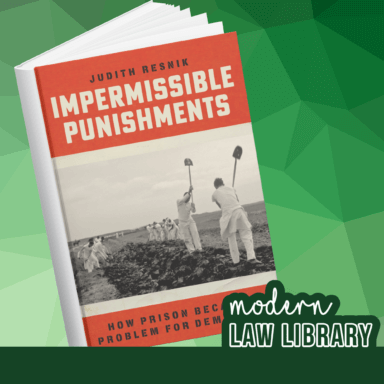
“As Democratic norms turned us all into equal citizens, equal persons in a jurisdiction, the question of government’s relationships in courts, policing, schools and prisons changed over the last hundred years,” says Resnik, author of Impermissible Punishments: How Prison Became a Problem for Democracy.
In this episode of the Modern Law Library, Resnik walks host Lee Rawles through centuries of discussion about how punishments are deemed to be permissible, from a trial about whipping prisoners in Arkansas to the League of Nations’ effort to develop minimum standards of treatment in prisons worldwide.
“People who run prisons have a very challenging time, and there’s a body of data growing that people who work in prisons, like people who live in them, have higher stress, heart attacks, blood pressure, suicide rates,” Resnik tells Rawles. “These are terrible environments of concrete and metal and noise and often dirt and violence. In the United States, many people who are in detention have had mental health issues and behavioral issues of significant kinds. And when you take people with limited training, often with staffs that are too thin, interacting with overcrowded facilities of metal and concrete, with limited resources, you end up generating scary places for everybody.
“So one of the kind of puzzles, if you step back, is how a thing called corrections, that promises safety, has generated institutions that are deeply unsafe for the people who live and work in them.”
Lee Rawles:
Welcome to the Modern Law Library. I’m your host, Lee Rawles, and today I’m joined by Judith Resnik, author of the new book, Impermissible Punishments: How Prison Became a Problem for Democracy. Judith, thanks so much for joining us.
Judith Resnik:
I’m very glad to be here and appreciate the opportunity to talk about this book.
Lee Rawles:
So this is the culmination of many years of research and work. Could you give our listeners an idea about your background and how the book came to be?
Judith Resnik:
I teach law at Yale Law School, and I also have worked as a person representing individuals who’ve been incarcerated, litigating other kinds of lawsuits, including at the Supreme Court of the United States. And I also have thought about the structure in general of how governments treat people in their environments. I think a lot about courts, large scale litigation, individual access, and about prisons are part of government services that have existed over several hundred years. And as Democratic norms turned us all into equal citizens, equal persons in a jurisdiction, the question of government’s relationships in courts, policing, schools, prisons changed over the last hundred years. So those are the general questions I think about. In the context of looking and thinking about the prisons, there’s a US Federal District Court cases in the 1960s in which federal judges were asked to stop the whip. Individual prisoners held in Arkansas’s prisons and disciplined because they didn’t pick enough okra or cotton or cucumbers were mercilessly whipped in the field, sometimes by at the direction always of staff and by other prisoners at times.
And three federal judges said, “You can, as long as there’s no more than 10 lashes and you have some procedural regularity, it’s not cruel and unusual punishment.” And then in 1968, Judge Harry Blackman, before he became Justice Blackman on the Supreme Court, he was sitting on the Court of Appeals, which is the federal oversight circuit for Arkansas and several other states. Judge Blackman writing for the court said, “You can’t whip.” But he didn’t write a paragraph the way that you’re in my face and many others when I say Arkansas with people, people say no, shouldn’t have happened. He had to write a long opinion because he did not want to disturb the authority of corrections any more than he needed to. There’s a profession called corrections that runs prisons, and he wanted to leave the state of Arkansas’s prison officials as unfettered as he could, except he was willing to say, “You can’t whip.” So it’s a long opinion drawing lines.
And in it, he writes, as part of the argument was actually that there were whips with or without studs, as disgusting as it sounds. And he said, “If whipping were to be permitted, how can you tell impermissible from permissible punishments?”
Lee Rawles:
This book covers 300 years of starting with the enlightenment, but you started off with this particular case. And one thing I really appreciate about that is it gives you a visceral sense of just the awkwardness of these questions. How did the three judges come up with 10 lashes? Oh, 10 should be okay. Why is 10 okay? And many, many things about the prison industrial complex do have these awkward dimensions to them, but the whipping is so visceral, as you mentioned, and that Justice Blackman, well, not justice then, but Judge Blackman at the time said, “What’s permissible? What’s impermissible?” And so I really thought that that was a good one to start with.
Judith Resnik:
I want to be clear that first he went through nine reasons about arbitrariness, about control, about emotions, about civilization, about dignity and decency as he was describing the Eighth Amendment, which says in the US Constitution, there shall be no cruel and unusual punishment. And of course, the question is what’s cruel and what’s unusual? And those words come from England to us and are added to the US Constitution in 1791 as part of the Bill of Rights. What I wanted to be clear about, one was how come it wasn’t easy? And one of the answers of why it wasn’t easy is that whipping was not an unusual form of punishment. Of course, we immediately, many of us will leap to the horrible images of slave whipping, but whipping was in addition what the Army and the Navy did till the 1850s to punish people who were soldiers and sailors.
And more than that, the English Commonwealth, the UK in particular, were big champions of things called flogging. If you were under 18, they called it birching. If you’re in Singapore, they still call it caning. So the idea, it’s in the fewer in the United States and you worry about both race and punishment, it could be easy to say, “Let me tell you about Arkansas’s prisons and think it’s a story about Arkansas’s prisons.” It’s not. It’s 300 years. You can read about English debates in the 1940s and ’50s and ’60s about whether or not lashing should be a licensed part of a sentence or something that prison officials could do. You can go to the Commonwealth and think about it in Canada. You can be in the US Supreme Court where the court says that teachers can paddle kids five to four without violating the US Constitution per se.
So to think about this as if it were not an issue crossing the Atlantic and crossing race and class and culture is to miss that it’s really a hard question about how you can punish. I also want to underscore, now I want to come back to Arkansas for a minute. Those at home with parts of US history remember that Arkansas was the epicenter of fights over school desegregation and federal judges were failing and were beleaguered to the extent they were enforcing school desegregation requirements with a fight between the national and the state. These federal judges in Arkansas need to be appreciated because in the 1960s when individual prisoners literally smuggled papers into court, instead of saying, “You’re a prisoner, we won’t listen to you. ” The judges not only took the petitions, but appointed the heads of the Arkansas Bar to represent the prisoners and help them make their case.
And on the light motif of don’t think about this as only Arkansas, similarly, prisoners penned, hand wrote petitions in California, New York, Ohio, many places, and states across the United States stood up in court and said, “People who are incarcerated have no constitutional rights. The US Constitution doesn’t speak to it. ” So the federal judges in Arkansas both recognized prisoners’ right to get into court, gave them substantial resources in terms of excellent lawyers, and then insisted they continued to have rights to be in court while declining to ban whipping. In terms of the procedures they said were required to make it licit under the Eighth Amendment, these judges may well have thought that by ladening it, the prison would say, “Okay, we’re done.” And the executive branch would’ve stopped what they were doing. And in fact, before 68, the executive branch stopped a little bit.
So it’s important to both appreciate what the … And moreover, and this goes to anybody who has appetite to read a 641-page transcript, there’s a transcript of the whipping trial, which I have, which is on the website related to the book, because by having this public trial, they brought into all of our potential knowledge what was going on in Arkansas prisons. And because Arkansas had great newspapers, the Gazette and the Democrat, the daily news coverage, which I read to write this book is graphic and detailed and powerful and important, and it did occasion a statewide debate about what the prisons were doing.
Lee Rawles:
And both Black and white prisoners’ testimonies were considered, although it didn’t seem like the Black prisoners were invited to testify live. Am I correct about
Judith Resnik:
That? The reason I have images and pictures in the books is, of course, we appropriately and really associate whipping with plantation and therefore with people who are dark skin. Arkansas whipped white and Black men all over the place and Arkansas segregated its prisons in terms of sleeping and Arkansas, the prisoners who initially smuggled their papers out and gone into court were three white men, as far as I’ve read all the newspapers I can find about them, lower middle class, not prosperous in any way, nor were they … I mean, their thefts, it was grand larceny was $35 or more, and their initial thefts that bring them into the prison system are bad checks for $15. I mean, just sad, sad, what we think of as petty crime. They get into the system, they walk away, they get escaped, they do something else, they get in and in and in for longer.
They’re in the system and these three white men smuggle their petitions out and they are the three named plaintiffs in the first whipping case. And there’s a newspaper picture of them and the other people who are testifying. In the first hearing, I think in 65, there are only white prisoners testifying. In the whipping trial, there is race mentioned, but they’re mostly all white too. And the race is mentioned by saying the howls from the colored section, quote unquote, which is to say that the segregated prisons had whipping inside as well as on the fields, which were less segregated because people were doing menial field work. They also made prisoners run back and forth to the fields with the horses running after them. So the practice of degradation crossed color lines, yes. The question about whether … I know the book accounts, there was a person who was a lawyer who was also in prison and he was white and given segregation in the legal profession, it may be that in the segregated prison, or most likely, there weren’t black lawyers who were in the prison helping the drafting of papers that got the petitions in.
It’s clear that some of the writing is not from anybody with much education, words misspelled and the like, handwritten cred decor, stop the whip, destroy the whip, WHIPP is the … And the frontest piece of this book is the first page is a copy of what Winston Talley smuggled into court, which is his one-page petition.
Lee Rawles:
And this is a black teenager. Yeah.
Judith Resnik:
That’s a white kid.
Lee Rawles:
Oh, that’s a white kid?
Judith Resnik:
It’s a white kid. Oh,
Lee Rawles:
See, I
Judith Resnik:
Misunderstood. All those initial plaintiffs in these cases were white. If I move forward and it’s worth understanding, initially in 65, three white petitions consolidated, lawyers representing a hearing very much covered, held you can whip with limits. Then petitioners file again three more, bring claims consolidated again with the ABA leading … Actually, for the ABA audience in this, a person who goes on to be the president of the ABA is the court appointed lawyer for the prisoners. And all of the lawyers who are doing this representation in 65 and 67 are the presidents of the Arkansas Bar Association, and one becomes the president of the American Bar Association. So ABA is front and center in providing free legal services of distinguished natures to people who want it, and the judges appoint these lawyers in order to make plain, they take very seriously the claim. So kudos to the professional bar for stepping up then as it steps up now.
The next step is to say that the initial judge who got the case in 65, his name is Judge Henley, Chief Judge Henley, he then presides in addition to the whipping … The sad part, trigger warning, is whipping was just one of the awful things that the prison system did. There’s something called the Tucker Telephone they shocked. There was a sadistic staff who shocked prisoners. They made them stand on boards that had nails on them. They did disgusting things. And the Arkansas Police did an investigation that resulted in state and then later federal indictments, state indictments violating state law and federal indictments from the Nixon White House Justice Department announced violating federal criminal civil rights acts. The sad part of this story is that Chief Judge Henley presided at trials in Arkansas where hearing awful testimony, the jurors acquitted staff and did not convict on claims of brutality.
And through the course between 65 and 69, Chief Judge Henley’s education about both the horrible physical conditions at the prison coupled with the unwillingness of the citizenry to reject them and no legislative funding. Arkansas had no money for its prisons in 1968, no budget line. It was all sweat labor that paid for the prisons. And there were quote 35 free world employees because staff were overseeing prisoners who were called trustees watching over and being violent against each other. It’s in 69 that Chief Judge Henley, having accumulated sad knowledge, enlists two other great Arkansas lawyers, a civil rights lawyer and a criminal defense lawyer, tells them to bring a class action. And in December of 69 and in February of 1970 holds that the entire Arkansas prison system is cruel and unusual a dark and evil world, and the system itself is unconstitutional. I know we have to unpack that, but we need to say one more thing, which is to cheer Robert Sarver.
The case is called Holt v. Sarver. Sarver is the defendant. He’s the head of the Arkansas prison system. And when I talked to the lawyers who represented the prisoners, what they told me was Robert Sarver opened the door and gave them all the information. And if you read his testimony, you are clear that he joins the prisoners in thinking the system is utterly intolerable and has to stop.
Lee Rawles:
So thus far, we have only been talking about a time period of the ’60s. We’ve mentioned that this is international, but there’s been a focus on Arkansas. That’s not the whole book. And I really want us to get to, because I found it fascinating, you go back to essentially the enlightenment, the 18th century, and we’re hearing about all of these horrifying abuses in prisons, some of which still go on. And we think to ourselves, “Ugh, how awful.” The people who in England and Europe were creating these systems in the United States, were creating these systems, were trying to improve matters from what they were, which was executions, amputations of ears and hands and brandings. And you’re sent to Australia without so much as a shovel and a hoe, and they thought that they were doing a good thing. So can you take us back to the reformers who were coming up with the idea of prisons and what their goals were when they did it?
Judith Resnik:
You’re exactly right that there are two threads here that I really want to help people see make one story. And one is this contest in which prisoners say, “You can punish me, but not like that, ” which is the creation of something called prisoners’ rights, which is a post World War II thing that gets judges into the debate. Judge Blackman just would never have been in the debate if prisoners hadn’t been knocking at the door. The other strand, which is what you’ve just invited me to try to unpack a bit, or I don’t know if you unpack a strand, clarify its threads, is about how did punishment become a problem for anybody to think about in which there should be constraints, and how did a thing called prison come into being, and how did a profession called corrections come into being? And that starts in the Europe.
I’m looking transatlantic in Europe and the United States, not the globe. And in transatlantic, it starts with enlightenment thinkers, Cesar Beccaria, who was an Italian marquee who published anonymously a book in 1764 called On Crimes and Punishments. And he did it anonymously because he did not want … He worried that he wouldn’t be safe if they knew that if the powers knew that he was questioning the power of the monarchy to punish. So in the 161700s, you were just describing mutilation, execution for petty crimes, transportation to the Colonies with no sense of anything other than the reigning powers had the authority to do whatever they wanted. Start with the enlightenment, which is pushing about government in a variety of ways. And Becaria, joined by Jeremy Bentham and some others, make arguments that say that the state should not just punish willy-nilly, but should actually have justifications.
Proportionality becomes a new buzzword. What’s the relationship between the nature of the offense and the punishment needed out and justifications. Explain why you’re punishing as you’re punishing. And so the idea of tethering a state to purposeful punishment gains a currency that definitely influences the founders of the United States. And then the next step, so there’s a sense of constraint as a matter of social policy. So these guys put, for your political science listeners, they put punishment on the map as a question for political theory. And pointing to your description of the awful punishments then in place, baselines frame us all. In light of branding, transportation and execution, being confined for a period of time looks like a great leap forward, if you will, because A, you’re alive. Now remember, the utilitarians of whom Jeremy Bentham is a great example are trying to be useful and have pain deter you.
So you want your pleasure, which is to say, “I’m looking to the future and I want to tell you to stop doing the crime.” That’s utilitarians. There are retributivists who say, and some of them are part of one John Howard Protestant ideologue, who says, “You have to repent, you sinner, and as a sinner, you should be doing menial work to repent.” The way of starting with the enlightenment is to develop a secular theory of punishment, not a religious based theory of punishment, and it is trying to get useful, purposeful punishment. They’re the first wave scaling up once prisons come into being, they’re usually just run by sometimes charities, philanthropies, or local sheriffs and judges or whomever. But as the process scales up, a profession that starts calling itself corrections develops, and now we’re in the 18, 1900s with the really 1900s with the growth of social sciences, anthropology, sociology, political science, penology, criminology, and something called corrections becomes a profession.
And so I tell the story by being both in Europe and the United States of the gatherings of people who were prison men, quote unquote, who met together Rutherford B. Hayes, then governor of Ohio before going on to be the US president- And a lawyer. … 70, in 1870 greets about 350 people in Cincinnati, Ohio in the first National Prison Congress. And the idea is a declaration of principles get rid of retributive suffering and go forward to rehabilitation because we’re in the wave of the medicalization and curing crime and the pathologies of all of that and social defense. And then in 1872, they have the first international conference in London and what becomes the International Penal and Penitentiary Commission is born there and meets every five years in grand capitals to talk about norms for prisons. And then if I just flip, I teach law.
For those people who want to think about people thinking about the theories of punishment, a neglected trove of information comes from the people who run prisons who debate whether you should chain, whether you should whip, what about a ball? How about food deprivation? And if you read the huge, boring tomes of their debates and discussions in their Congresses that are available, by the way, online, you can read them with their racism, with their psychology, with their eugenics, with all of their facets, their gender, all those things. You can read them saying, “Oh no, no, you shouldn’t whip, but of course food deprivation’s okay or a chain is this back and forth.” So in the context, and be clear, they all wanted to improve conditions in prisons. They didn’t want people dying in prison and they didn’t want bad air and they wanted funding from the governments to give them the authority to run prisons, but they also came to develop the idea of radical invasions on autonomy as the norm in prison.
So in quest of discipline, as in routine, they impose discipline as in punishment and the disciplines they imposed. I have a picture in the book of a treadwill in England in the early 1900s, men endlessly going in a series of steps for nothing. In the United States, a black man with water torture in the 1860s, terrible intrusions on bodies in the name of control and regimentation, plus remember they’re also trying to fund themselves so they’re pushing forced labor too. So this is a history of the invention of this profession. And if you have appetite for UN archives and you can read some French, you can read the debates that are transnational in shaping norms about what’s normal for prisons, which will get me to the 1940s, but you’ve got a question
Lee Rawles:
First. I do. Well, first of all, I want to thank you, Judith, for doing the reading of those incredibly boring tomes for us. And I don’t speak French. So again, appreciate you doing the legwork. We will discuss more about this after we take a quick break to hear from our advertisers. When we return, we’ll still be speaking about impermissible punishments, how prison became a problem for democracy. Welcome back to the Modern Law Library. I’m your host, Lee Rawles here with Judith Resnick. So Judith, I do want to keep some things for the audience to learn by buying and reading the book, but I don’t think that we’ve touched on yet this idea of rules versus rights. You’ve been talking about how groups of generally pretty powerful men would come together and try and develop a standard of rules, but you mentioned earlier in our discussion, this idea of prisoner rights is much more modern.
Prisoners were not considered to have rights as we think of them. This was just about what you could do to this subsection of humanity that we do not consider as equal to other citizens. So could you talk a little bit about this rules versus rights?
Judith Resnik:
So thank you. Yes. The first word to mention is Alexis DeTokville and Gustte DeBom, who are two French minor members of the aristocracy who are minor in their aristocratic authority, but not minor in political and social theory. And they come to the United States in 183030s to just basically get a little bit away from France and they tour the Unitited States and they tour prisons and they write a monograph to show France that instead of its chaotic me launch, they should use US style penitentiaries. And they’ve seen the terrible isolation at Eastern State Penitentiary and at Auburn. In the context of that, which is exactly to your point about rights, they describe the prisons they’ve seen as despotic despotism. They do not mean that as pejorative. What they are describing are people who in later writings they write about are outside the circle of rights.
So the idea that humanity should do rescue or constraint for prisoners is longstanding, but the idea that there are people who are piers is new. So now we need to get flash forward to both World War I. And after World War I, this International Penal Penitentiary Commission, which has best practices and declarations and all sorts of things, meets in London in 1925. And right after that, fabulous feminists, Marjorie Frey, Sicily, a few other women come together and say, prisoners should have rights and prison can be torture and they draft a short document. This is coming out of their understanding of World War II, World War I, sorry, World War I, and the terrible harms to people, political and non-political who were in prisons around Europe. And also they have examples of the United States of terrible treatment of prisoners. So they pitch this idea, recall that the League of Nations is formed in the early 1920s, and the League of Nations is caring about the opioid trade, for example.
So they’re pitching to the League of Nations to create a standard, an international convention to protect prisoners political and not. The International Penal Penitentiary Commission is worried about being sidelined because these feminists are not only brilliant, they’re astute politicians and they have a popup and they lobby in Geneva, the League of Nations. So the guys come Come on board and in 1934, the League of Nations adopts what the International Penal Penitentiary Commission drafts, which are the first standard minimum rules for the treatment of prisoners, 1934. Those 55 rules do not mention rights. They do not mention prison as torture. They talk about prisoners being taken care of from a humanitarian and social point of view. And under the category discipline, they specifically license corporal punishment by which they mean whipping dark cells as in dungeons and food deprivation. And they do so after a debate because as I mentioned at the outset, the English are quite committed to those forms of imprisoned treatment.
1934. In 1933, Hitler takes Germany. In 1935, I’m sorry to report, the International Penal and Penitentiary Commission meets in Berlin over objections from the feminists, a few Americans, some Jews in different places that say, “What are you doing going to Berlin?” And they are indeed greeted. They meaning representatives of the Unitited States and many other countries, England and the like. France are greeted by people in the name of Hitler describing the great processes that Germany is using to control eugenics, camps and the like. This organization continues working with fascist countries, indeed plans to be in Mussolinis, Italy in 1940. And it’s after World War II with the creation of the United Nations, with the Universal Declaration of Human Rights. The US pulls the plug on support for this International Penal Penitentiary Commission, and the UN in 1955 promulgates its first standard minimum rules for the treatment of prisoners, same title.
And now it’s more than 90, and now it says the words rights, and now it says the word dignity. And now it says self-determination to some extent. And that is an outgrowth of an interaction between the US Civil Rights Movement and the experiences of concentration camps. And here, an important point to make is that the 1950 at the ending swan song of this international organization that meets at the Hague, one speaker, a man named Paul Cornee, who had run the Belgium prison system and who had been briefly interred by the Nazis, stands up and gives a speech. He’s a big important member of this organization and says, “There’ll come a time when incarceration is seen as as primitive as corporal punishment.” And he further says, he goes on to talk about the intrusion on autonomy. So he’s the first speaker in all those pages I found who’d actually been in detention and his takeaway, having been a person who ran a prison system was, “We’ve got to change.
This is outrageous.”
Lee Rawles:
And that’s absolutely what I want to hit on next. Prior to about this time period, you mentioned some of the powerful people who were making these decisions. And again, they were making rules for people that they did not consider would be necessarily applied to them. This isn’t about them. And you brought up early feminists who many suffragettes experienced prison conditions and awful prison conditions. And that brings me to your subtitle, How Prison Became a Problem for Democracy. I’ve been watching Ken Byrne’s American Revolution series over the past several nights, and so this is kind of top of mind, but we have, in the Unitited States, we’re part of what they call the Anglo-American legal system. Much of what we brought over was from the British Empire, British government during a time where, as you mentioned, this was the idea of the monarch was the person who would punish, was in charge of what then became corrections, the punishment.
But in a democracy, we are supposed to be making rules about us. We’re not making rules about them. So I just wanted to talk with you more about this conflict when you are in the United States, which is a representative democracy, but you have these different standards for how some citizens, some residents can be treated. So what are your thoughts when it comes to the democracy portion of this? And we’re going from aristocrats thinking about, well, how can we make it better for the underlings? They aren’t thinking this is going to be applied to them. How can we make things better for our subjects? And we are supposed to be a democracy where we say, how do we want to treat each other?
Judith Resnik:
So the Democratic Project has been unfolding for centuries, as you point out. It’s worth remembering in my head as someone who thinks about parts of constitutions that say, “All courts shall be open and every person shall have a right to redress.” In 1818, in Alabama or Connecticut, every person wasn’t all of us. So if we come to understand that it’s in the 20th century that across race, class and gender and ability lines, all people come to be all people. The problem that’s posed for … If you take seriously, which only happens in the second half of the 20th century, the all people is all people, a movement that grew over centuries, and thank you, appreciate enlightenment figures for the moves that they made with more moves to come, and we’ve got more to do too. As you start thinking through this, you say, “Okay, if I’m part of a Democratic project and everyone is a person to whom respect is owed, dignity protected and rights, how does that change the way that I punish?” It can’t be that it’s the same.
And part of my aspiration is for us to appreciate that people who are incarcerated, including Winston Talley with his handwritten petition, has a different theory of punishment than Bakaria and Bentham looking forward to the future or Howard looking to the past. They are saying, “My present matters.” Their theory of punishment isn’t, “You can’t punish me. You can punish me, but not like this because I’m a person with rights and they tee up and Judge Blackman gets it. ” A huge question about how a government committed to rights bearing for all people has punishment and my answer is that shouldn’t set out to ruin people. So I argue against … What I argue is that enlightenment justifications, which you’ll find them scattered through US Supreme Court opinions for those of the listeners who read those opinions, deterrence, incapacitation, rehabilitation and retribution, they were penned thought about in the Tocqueville era when prisoners were not rights bearers.
And now we have to say, these may be okay reasons for some things, but you got to have another one. How can I express my respect and appreciation for your agency and personhood even when I want to say, “You did terrible things and I insist you be constrained in some ways.” I would ditch the word, by the way, in all these decisions, the minimum civilized needs, civilization. In the name of civilization, awful things have happened. Rehabilitation doesn’t underscore the agency individuals have as they are in detention and as they move out of it. And a word called reentry acts like prisoners aren’t here in terms of transitions. So our vocabulary continues to we, they other what should not be seen as other. And part of the agenda of this book is to help people see viscerally sorry with details how weird prison is. So like if I say, “Oh, whipping is just a piece of it or the disgusting things in Arkansas are just a piece of it.
” This radical intrusion on autonomy of which a horrible example is isolation, solitary confinement should be startling. And I’m aiming aspiring to help that startle. And I want to also be clear with the lawyers and non-lawyers. The point of this isn’t a story about what courts can do. Courts are a venue in which people use the language of rights to generate ideas and constraints on government, but all of these decisions are political decisions. This International Penal and Penitentiary Commission said, “Oh, we don’t have to think about what the Nazis do or fascism because prison management is a political. It’s science, it’s expertise. It may have expertise, but it surely is about the politics and norms of who is a person in your social order.” And it’s because of the relationship between the techniques in concentration camps, the techniques in plantations, and some techniques in prisons, food deprivation, forced labor and the like that has people pushback and then the vocabulary of rights in legal documents.
And now the question is, what does it mean in practice? And we’re in the middle of a conflict vivid in the United States today about what it means to materialize it. And I just will get back and forth across the Atlantic, but I know you have another question.
Lee Rawles:
I do. But first, we are going to take a quick break to hear from our advertisers, but when we come back, we’ll still be speaking about the book, Impermissible Punishments. Welcome back to the Modern Law Library. I am your host, Lee Rawles, here with Judith Bresnick. Judith, one thing that kept coming up for me as I was reading the book is obviously we talk about cruel and unusual, and unusual is the part that can most clearly be seen as changing. One thing that I thought about, particularly when you talk about whipping, you mentioned whipping wasn’t just something that happened to Slaya. Whipping was part of a culture. Whipping was very standard, very accepted. And I think about the change in corporal punishment for children. When you look at the trends, the trends have been that the use of corporal punishment on children has declined. And I would pause, I think I was spanked once, but corporal punishment was not part of my lived experience as a child.
And so as an adult, it’s also not part of my expectation of it happening to other people. When I think about cruel and unusual, if I had grown up and everyone I knew had grown up in a culture where corporal punishment was absolutely part of the norm, you experienced it when you went to school, you had it during your life, then a prisoner having it happen to them probably did not seem as shocking because it was part of this norm. And when I thought about children and how children as part of our democracy, they have this status of dependency, they have controlled rights, less of power to assert their rights, the inability to control their environment. In many ways, they’re limited in the same way that prisoners are. Do we think that the change in standards of how we treat children can impact the way we treat prisoners?
Judith Resnik:
Well, first I need to underscore that in the transcript of the whipping trial, the defense is, “I was raised by the whip, I whipped my children.” So you’re drawing a parallel that says how you treat people in your households affects how you think people can be treated in forms of punishment. So one is, as of within the last decade, at least 16 school districts continue to paddle quote unquote kids disproportionately of color, disproportionately in the South. And the extrication and the Canadian Supreme Court also didn’t ban parents using physical, no whips, no belts. I mean, they developed a set of rules about what it meant to hit somebody. So the idea that there’s a general move away from hitting is important, but we shouldn’t … I never use the word corporal punishment to mean whipping alone, even though the prison people did. Because of course, what I’m hoping people see is the corporality of incarceration, that it is viscerally and physically stunning to be in a room that’s six by the size of a parking lot, space, and with no windows and encased.
So the corporality and whipping aren’t the same thing. Next is, what do we think about the world of children and their authority and capacity? Well, we’re watching debates about both ability to make healthcare decisions, ability to be charged criminally, a variety of debates as kids do different things, and watching also debates about whether to move the age of enfranchisement back to 16 versus 18 as contrasted to 21. So yes, there is a continuum in which some people are vividly dependent. The idea of taking care of children is to enable them to flourish to become adults. The issue of taking care of other adults to punish them is a question about how you’re going to respect their adulthood
And agency. And I actually also need to be clear, people who run prisons … I just came back … Let me finish sentence. People who run prisons have a very challenging time, and there’s a body of data growing that people who work in prisons, like people who live in them, have higher stress, heart attacks, blood pressure, suicide rates. These are terrible environments of concrete and metal and noise and often dirt and violence. In the Unitited States, many people who are in detention have had mental health issues and behavioral issues of significant kinds. And when you take people with limited training, often with staffs that are too thin, interacting with way crowded facilities of metal and concrete, with limited resources, you end up generating scary places for everybody. So one of the kind of puzzles, if you step back, is how a thing called corrections, the promises safety, has generated institutions that are deeply unsafe for the people who live and work in them.
Homicide rates are higher inside than on the streets and how we think this system can continue to be viable. So the question is, how are we going to fix and change? And what are the things that became normatively assumed as if this is just what prison is, which is by the way, US constitutional law is dripping injustices, assuming this is what prison is. How do we unpack that and say, no, no, no, we made it up and we have to make up something else. We have to punish people in a way that isn’t this harmful to the body politic, as well as to the people who live and work in it. I
Lee Rawles:
Loved what you said in the book about the justices looking at, they’re not asking themselves how strange shocking to the conscience different from how we would expect to be treated in quote unquote the outside world, which again, this is all one world, we’re all in it together. They are saying, “Well, what’s the norm within prisons, not what’s the norm within our society?” And so if it’s not unusual in prisons, they are more reluctant to address it.
Judith Resnik:
They also are bad empiricists and they’re bad political philosophers because they don’t actually ask seriously, tell me something about what the data shows you about what’s normal and what’s not. So let’s hang on there. The reason I’m not starry-eyed about Europe, the European prison rules from … We all come out of World War II. Europe comes out with a commitment to social services for people in and outside of prison in terms of many countries in Europe, in terms of healthcare, education, and the like. And that becomes normatively regularized to some extent in some prison systems in Europe. Moreover, the rules, they have the European prison rules of 2006 modified in 2020. They talk about normalization and regularization, and there, per your comment and point, is normal as related to the world. And part of it, to be very self-servingly utilitarian, is most people in prison don’t live their whole lives in prison and are on streets and want to be good neighbors and workers and the like.
A second part is, so the idea is how can we make life in prison as normal and regular as possible as like life outside of prison? So in many countries I’ve been in, you walk in and people wear their own clothes. In some places they cook and open doors. I mean, you can think about the ways, and I just always want people to translate in their own life. I got up this morning and could take a shower without anybody’s permission. The things that we take for granted and those with challenged health problems take it less for granted. But the ways we move in space and decide things as adults is what prison disables in some countries and not in others. And disabling adulthood is not enabling a functioning social order.
Lee Rawles:
Yeah, that’s powerful. So I want to talk now about what you see as being next. One major point you wanted to make in the book was when we are talking about harm, we are not only talking about the people who enter prison as prisoners. The harm can come to the children whose parents are in prison and as part of their punishment are not allowed to see their children, therefore the child doesn’t see the parent. We talk about the corrections officers who are experiencing these conditions alongside and having these impacts. I think too about mostly in the United States, we locate prisons in economically disadvantaged small town, rural areas where there aren’t a lot of other employment opportunities and it can really change and impact an entire geographical area. So you do this wonderful deep dive into kind of how we got here, the theories behind what next?
This is not just a history, this is a call to action. So what are you hoping comes of this research and of this book?
Judith Resnik:
Point one, it’s a mistake to think that nothing changes. Punishments, you helped underscore this with your description of transportation and branding and mutilation. Punishments have changed. And to be clear, Jeremy Bentham was an abolitionist in our terms about transportation to the colonies. He thought it was useless because we wouldn’t see anybody and we wouldn’t be deterred was one of it. Plus he thought it was illegal because people would die on rude or be gone forever. Second, Bakaria was an abolitionist about capital punishment, about execution. So this idea of change, it’s important not to think that nothing can change. And when I talk about agency, we all as political actors have agency in terms of figuring out how much money to spend on what, because state budgets and federal budgets go into forms of policing and detention. And the easy and obvious in the current contemporary environment is to put less people in detention and then reconfigure what detention means.
So assume that it’s dark dank, dreadful, health harming, it is what a prison is a construct that we constructed. And so how to build and what to build. I’m not a person who says you cannot punish. I want a state government, state and federal in the United States context to be vital creative parts of our lives. I’ve written about the post office. It’s a remarkable social service. Somebody comes to my door and brings me something from government subsidies and it cross subsidizes across the world. So just in the same year in the 1880s, 70s, 80s, when this International Penal Commission is being generated, so is the Universal Postal Union being generated that is a international currency and helps literacy and does some cross subsidies. So if we think about government as a potential form of generativity, be it public schools, be it public services, and we think we don’t want a $1.5 million housing project called prisons, we want a 1.5 million, sorry, housing project with many, many gazillions and billions of dollars.
We want to do housing that isn’t detention housing as government subsidies. How can we think about a generative government in relationship to communities, in relationship to the private sector that insists on decent treatment of everyone? And here, the lesson that we’re all in this together is ever more vivid as the current US federal government demonizes people in detention, shows us gross pictures of head shaved, a concentration camp practice of crouching bodies and of celebrating degradation in places alligator alcatras being a new word that hadn’t existed in our lexicon a year ago. And we’re also seeing that the people subjected to this are not only people who have been convicted of crimes, but people who may or may not have any basis to be in any form of detention and some of whom are much more than clearly lawfully in the Unitited States. So the question is we’re all in this together and if we’re going to keep commitments to rights bearing individuals and social government of a decent kind as compared to deregulating degovermenting, we have to see the relationship between how we treat people inside and outside and understand that what we tolerate inside dribbles out.
It’s not like it’s somehow contained. So this continuum, and that’s where I want to come back to the corrections profession and realize that in the 1870s Declaration of Principles, there are a lot of good things about trying to treat people decently. In the 1930s, there’s some good things. And by the 1950s and now Nelson Mandela, the UN has revived its rules, revived and revised them in the 2015. They’re named after Nelson Mandela. Well, my argument is that Winston Talley and Nelson Mandela are both political theorists of punishment, and they both have ideas about how to treat individuals in non-racist, non-degrading ways, and we should appreciate their guts because they are boy retaliated against physically, both of them, and their insights. And think about how we want a government to maybe constrain and confine without setting out to harm individuals. And more than that, realizing just on the self-interested utilitarian that harming those individuals harms ourselves.
Lee Rawles:
Judith, we’ve mentioned solitary confinement a couple times during our conversation, and I don’t want to let you leave without discussing really briefly a very cool website project by Yale Law School, Seeing Solitary.
Judith Resnik:
One of the things that has struck me as horrific is the profound isolation of solitary confinement. I was able over a decade with the Arthur Lyman Center for Public Interest Law, which I helped found, and I’m the Arthur Lyman professor of Law, to work with people who run corrections systems around the United States to try to gather data on how many people were in profound isolation 24 or 22 hours a day, 15 days or more, or 30 days or more, including seriously mentally ill people and the like. We developed information over a decade every two years doing surveys, recounting and accounting for tens of thousands of people. And that was just what the people who run prisons tell us, not necessarily the full count, plus it’s hard to count, and there are also variations. And we generated a website called Seeing Solitary that puts together information about the practice, the numbers, the size, the conditions, and some of the legislation to move forward and limit the use of it.
There are a few states that say we’ve completely abandoned this kind of profound isolation. There’s a big fight in New York over something it calls Halt, Connecticut has an act called Protect. The idea that there are people who’ve been in for decades and years and months in literal isolation, and that’s a weight on all of us. So seeing solitary invites information and mechanisms to push back. A man named Wood Fox wrote a book. He was in Louisiana solitary for decades, and when he inscribed it to me, the front of it says, “Stay strong.” And I think of him holding my hand now and helping us to see that we must move forward.
Lee Rawles:
Well, Judith, I want to thank you for coming on the show to talk about impermissible punishments, how prison became a problem for democracy. If folks were interested in hearing more from you or in just getting involved in some of these discussions as you urge everyone in this democracy to do, where would you point them?
Judith Resnik:
Well, first of all, you’re welcome to email me. And there is a website connected to the book which gives you some of the original documents in the litigation because I’m pushing forward the idea that we want people to have direct access. Second, political and social engagement at the local and national level around punishment practices, appreciating the race class, gender dimensions of these policies and understanding. And as much as I live in a law school, not law centric in the sense of courts, legislators are key actors in this story. So I want to encourage people to think about how they want to see themselves. And I’ll give you a very quick example. New York State is currently considering a rule for its judges that every judge who sentences somebody should visit the facilities to which they sentence someone. There’s a good move forward in bringing the inside out and the outside in.
Lee Rawles:
Well, thank you to Judith and thank you listeners for joining us for this episode of the Modern Law Library. If you enjoyed this episode, please rate, review, and subscribe in your favorite podcast listening service.
Notify me when there’s a new episode!

|
Modern Law Library |
Modern Law Library features top legal authors and their works.