|
|

Katie Kinsey is Chief of Staff and Tech Policy Counsel at the Policing Project at NYU School...

J. Craig Williams is admitted to practice law in Iowa, California, Massachusetts, and Washington. Before attending law...
| Published: | September 18, 2026 |
| Podcast: | Lawyer 2 Lawyer |
| Category: | News & Current Events |
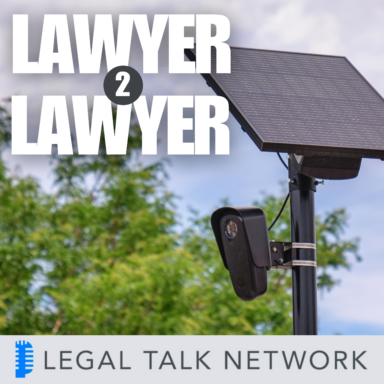
Flock Safety is a surveillance technology company that manufactures cameras and automated license plate readers used by law enforcement, neighborhoods, and businesses to deter crime, respond to emergencies, and investigate safety incidents. “Flock cameras” have been a source of controversy in communities across the nation, with critics arguing the constant tracking violates civil liberties and builds massive location histories without warrants, where supporters of flock cameras see it as an essential tool to combat crime.
On this Lawyer 2 Lawyer episode, Craig welcomes Katie Kinsey, Chief of Staff and Tech Policy Counsel at the Policing Project at the New York University School of Law. Craig & Katie spotlight flock cameras, examine the use and misuse of flock cameras in our communities, and discuss the pushback against surveillance, data privacy laws, the Fourth Amendment, and the potential impact on our citizens.
Special thanks to our sponsor 8am.
Katie Kinsey:
When police can do these things, they have unique powers that your average neighbor doesn’t have. Police can arrest you. They can put you into jail. They can take away your liberty. There might be nuisance elements to what would arise from a neighbor being able to look at you, but your neighbor can’t arrest you and they can’t take away your liberty in the way that police can. And that’s why we’re particularly concerned about the use of surveillance technology by the state.
Announcer:
Welcome to the award-winning podcast Lawyer to Lawyer with J. Craig Williams, bringing you the latest legal news and observations with the leading experts in the legal profession. You’re listening to Legal Talk Network.
J. Craig Williams:
Welcome to Lawyer to Lawyer on the Legal Talk Network. I’m Craig Williams coming to you from Cape Cod, Massachusetts. Flock cameras which serve as automated license plate readers and video surveillance systems used by law enforcement, neighborhoods, and businesses have been a source of controversy in communities across the nation. Over 120,000 automated license plate reader cameras are active across some 49 states. Critics argue this constant tracking violates civil liberties and builds massive location histories without warrants where supporters of flock cameras see it as an essential tool to combat crime. In this episode, we will spotlight FLOC cameras and surveillance. We’ll examine the use and misuse of FLOC cameras in our communities, the pushback against surveillance, data privacy laws, the Fourth Amendment, and the potential impact on our citizens. And to do so, we’re joined by guest Katie Kinsey. She is the Chief of Staff and Tech Policy Council at the Policing Project at the New York University School of Law.
Her work focuses on emerging policing technologies and their impact on civil rights, civil liberties, and racial justice. Katie frequently testifies before state and local legislatures to advocate for democratic accountability in the acquisition and use of AI-powered policing technologies. Welcome to the show, Katie.
Katie Kinsey:
Thank you for having me. Happy to be
J. Craig Williams:
Here. Let’s start off by discussing FLOC cameras and their uses. What are they, where are they, and what are they doing?
Katie Kinsey:
So FLOC is a policing technology company that makes a variety of surveillance technologies, including drones and cameras. But why we’re here today is to talk about another product they make, automated license plate readers. They are one of many different companies that make this kind of policing surveillance technology, but FLOC has been in the news lately because of a few approaches to their business model that have set them slightly apart from other companies, although maybe not as far apart as the current articles make it seem. They make these products which are really just high quality cameras that can be placed on entrance and exits of highways, on police vehicles, you name it, the cameras can be placed wherever. And what they do is they snap images of any vehicle that passes by the camera and then they rely on an AI-powered software to interpret information in that image.
So the images will capture license plates, they’ll capture more than that though, the make, model, type of car that passes it. They might capture dents in the vehicle body, bumper stickers, and all of that information gets interpreted by an AI model to read a license plate. These images are location and timestamped as well, so they come with a lot of information and then they’re stored in databases where all these license plate reads and images live for different amounts of time depending on the agency. And police use them to search against different hot lists of things like stolen vehicles or to just use them for investigative purposes later on. So that’s the automated license plate reading system that they make and many other vendors other than FLOC also make the same technology.
J. Craig Williams:
How are these different from red light cameras? I mean, we’ve been used to those for a long time where you get pulled going through the red light, they catch your license plate and they send you a ticket. How is this any different?
Katie Kinsey:
In some ways, the technology is not necessarily all that different. Red light cameras can be a less sophisticated camera technology potentially, but some of the difference comes down to just what the permissible uses are and what kind of cars doing what kinds of things the camera might actually capture. So in a red light camera situation, you’re going to have a much more limited capturing of what car activity you’re looking at. You’re really just looking at cars that are speeding through a red light as the name would imply. Automated license plate reader cameras are going to be set up all over the place. They’re not just looking at traffic intersections where light changes are happening. And then there’s going to be different rules around what police can do with the data once it’s captured. A lot of states have legislation around red light cameras that really limit their usage and storage of that kind of data and information.
So there’s a little bit of a technology difference, but often it really comes down to more of what’s the purpose and what is the scope of what’s being captured in the images.
J. Craig Williams:
Well, on the other side of this, police and the vendors say that they need secrecy on the ground that any kind of disclosure of the information that’s gathered would compromise their investigative methods or some kind of proprietary information that they have. But on the other hand, defense counsel in trial need to have access to this algorithmic policing tool and the public needs to know about this adversarial testing and brings up issues like due process as well. How do we get this to be real rather than theoretical? What I mean by in terms of real versus theoretical is that we have the concept of this is good for us, that’s the theory. But on the other hand, there’s a lot of people complaining that it’s not good for us, that there’s gathering too much information. Police need this information, they need it to be secret. Where do we draw the line between secrecy and disclosure so that people can know what’s going on and defense lawyers can try their cases in court?
Katie Kinsey:
Yeah, so we hear this argument a lot when it comes to police use of surveillance technologies, not just with license plate readers, you hear a lot in the context of facial recognition or really any kind of technology that police are using. You often hear law enforcement say, “Well, we can’t be more transparent about our use of these tools because then the bad guys will know what we’re doing.” And look, we take seriously at the Policing Project that there are some real needs for law enforcement to be able to do its job with a certain level of secrecy for some information and for some tactics. So specific case level information about how they’re investigating a known target, that’s not the kind of transparency that we believe is necessary and are advocating for at the Policing Project. The kind of transparency that we think is necessary and really has nothing to do with the ability of police to do their jobs well would be basic level transparency around what are the tools that you’re using in general.
So that kind of public transparency just to know what is an inventory of the technologies that you even have available to you, not necessarily exactly how are you using it in this particular case, not everyone might need to know that, but base level transparency so that we know what these agencies are using who are supposed to be accountable to the public and we can start to have some of those conversations in our legislatures about the benefits and costs of some of these tools. Now what we also advocate for at the Policing Project and we think is important is disclosure in particular criminal cases to the defendant in that case when an investigative surveillance tool has been used to inculpate them in a case. So just in the same way that Brady requires disclosure of material that could be exculpatory in a case, we think that has to apply equally to the use of technologies that are used to actually serve as one of the basis of accusing someone in their case.
That we believe is what due process requires. And it really just would bring surveillance tools on par with prior police methods and lead generating activities to say we think they should be disclosed equally, that defendants need to be able to know what was used against them so that they can advocate for themselves in an adversarial system.
J. Craig Williams:
What are the issues around profiling here? I mean, you mentioned that these cameras can do things like tell you how many dents you’ve got in your car. We used to joke about profiling in the area where I live because you generally only see Mercedes and expensive cars. And if you suddenly see an inexpensive car, then you think, what is this person doing here? What is that car doing here? How do police use that type of information? Are they gathering too much information? Should there be a limit on the amount that they gather so that they can’t profile us or what’s the range on this?
Katie Kinsey:
We definitely feel like police are gathering too much information in the absence of there being sufficient regulation to make sure that there are safeguards in place. That we think is a major issue that we see today with the advance of a lot of these surveillance tools. In terms of applying that issue to the particular use case of ALPRs with the fact that it’s maybe able to identify a particular car type or the condition that a car might be in, I haven’t really seen that as an issue that we’re concerned with misuse and abuse of ALPRs because what is happening on the other end is they’re taking these images, but these images are being compared to some list. So typically it’s a hot list of stolen vehicles where you’re matching license plate reads or they’re using a database that they’ve maintained of these license plate reads to look for a car that they’ve identified as being part of a criminal case.
So someone might say, we saw the yellow Ford Bronco leave the site of the bank and now they’re going to look through their license plate reads and their database to try to figure out what yellow Ford Broncos are around in town. So it’s an interesting point. Could they be using it in some sort of equity based way that would be concerning to use that qualitative information about cars? For now, I would say our much bigger concerns are just the ability of police to use the information to track people indiscriminately because it has location information associated with it. So not so much about profiling in that way, but profiling kind of all of us because all of our car images are being captured and location tagged and searchable without a warrant.
J. Craig Williams:
We’re going to take a quick break to hear a word from our sponsors. We’ll be right back. And welcome back to Lawyer to Lawyer. I’m joined by Katie Kinsey. She is Chief of Staff and Tech Policy Counsel at the Policing Project at NYU School of Law, New York University. We talked just momentarily, or you did, about warrants. Now, all of this surveillance is going on just 24 hours a day, seven days a week, 365 days a year. That tells me there’s probably not a warrant involved. Where does that come into place and how does the Fourth Amendment deal with this?
Katie Kinsey:
So it’s a really interesting and important question to be asking. I think I’ll start with where does the Fourth Amendment play into this because that’s kind of how we’re going to get to our warrant issue. It really is an open question right now from the standpoint of where is the doctrine? Where is the Supreme Court weighed in on how Fourth Amendment protections may or may not apply to something like an automated license plate reader? What we do know is that in recent years, including as recently as just this summer, the Supreme Court has recognized that we do have a reasonable expectation of privacy in our movements across space and time as they are tracked by emerging technologies, in particular cell phones. So there’s a couple major cases out of the Supreme Court. One of the first major ones was Carpenter back in 2018, which to summarize quickly was basically the court saying law enforcement cannot just get detailed records of our locations that lives on our cell phone when it pings different cell phone towers without a warrant, that we have a reasonable expectation and privacy to that information, even if we’ve disclosed that information to our cell phone carrier, that police still need to have a warrant if they want to access that information.
Just this summer, the Supreme Court decided another case that’s really relevant to the question of location tracking ALPRs in the Chatri case, which looked at a different issue, this issue of what’s called geofence searches where the police create a radius around a crime area where they start to try to look for cell phones that were in that area to try to get location information about the cell phones that were in that area. So through our devices, either through apps like Google Maps or other ways in which you might connect with Google services, Google’s actually tracking a lot of location information about their users that way. And in this case, law enforcement got access to that information to try to figure out who was around the site of a bank robbery. And what the court said in Chatrie this summer was that access of law enforcement to that cell phone based location information is a search that deserves Fourth Amendment protection and the police needed to get a warrant supported by probable cause to actually access that information, which they had not in that case.
And so the Supreme Court hasn’t weighed in on license plate readers directly yet, but they are another similar location tracking surveillance device that has lots of information about where we go, where we are, all about town. And we at The Policing Project think that when police want to query that information about us, they should have a warrant. They should have to go get a warrant before they can access that information about our location. It doesn’t mean they can’t get it, they just have to get a warrant that’s supported by probable cause that explains why they have a good reason to need this information on us so that we can feel more safe in our movements about town. But it’s an open question. We don’t think we need to wait for the Supreme Court to decide that question for us. We advocate for states and localities to pass laws that require police to get a warrant for that information and not to just have to wait until the Supreme Courts decide someday, hopefully in the future.
J. Craig Williams:
Let’s talk about some of those potentially nefarious uses of this technology. We’ve seen Boston recently terminate their contract with flock cameras because they violated the trust of, they said, we’re not going to share this with other states, but all of a sudden Boston found out that their flock camera information was being shared with other states. There’s certainly a trust issue. There’s certainly the constant surveillance sounds to me like a search. Where are we? Are we watching the movie enemy of the state? That’s kind of what I feel like, the constant surveillance and now they’re going to turn against us. We’ve got cops that are tracking their ex-girlfriends or ex-boyfriends. There are a lot of hackers that have gotten passwords, even the basic trust levels of a full-on contract has been violated up in Boston. What’s the safety issue here and where do we draw that line?
Katie Kinsey:
I think there definitely are good reasons to be concerned with the current state of play when we think about police use and access to these powerful surveillance technologies like license plate readers. And I think a big reason for these concerns really lies in the fact that there’s an absence of governance. So it’s not that we don’t have good models for what safeguards could be so that our information is better protected, so that it’s only used for good reasons, so that we have an ability to challenge this use. We know what those safeguards are and should be. Some states have passed laws that reflect some of these key safeguards, whether it’s warrant requirements are really creating short data retention limits. So there just isn’t that much information for police to access. The problem in our view is that too much of this use is happening in a completely unregulated state.
And until we have policy, public policy in place, have laws in place that reign in these harms, you’re going to see these kinds of violations that are being reported, these kinds of risks that we’re seeing come to the fore, whether it’s misuse and abuse by officers to use this information to stalk partners. As the Washington Post has reported, there’s at least over 70 cases that they’ve tracked of officers using license plate reader technology to stalk exes. I think what we’re even more concerned about than those incidents is the vast ability of law enforcement to track us without any sort of rules in place and to maybe share some of that information with federal law enforcement for certain activities that local communities have decided they don’t support, whether that’s immigration enforcement or targeting folks for getting abortions. We’ve seen a lot of these concerning uses and I think they will continue to happen so long as we continue to not make sure that these tools are regulated.
But we have the answers. We luckily, at last I checked, do still live in a democracy. And I think what’s beneficial for us about that is we can use the rule of law. We can use regulation and governance to reign in a lot of these harms that we’re seeing.
J. Craig Williams:
Is this really a democratic question? I mean, we have police departments putting these cameras into play without much more than just a by your way, we’re going to add this without disclosure. There’s been a significant amount of that kind of behavior across the country. AI is moving so fast, we don’t even know about it. How do we slow this down?
Katie Kinsey:
It’s a great question and I think it really is a democratic question. And for example, to that very point, we recently filed a lawsuit against Westchester County with the New York Civil Liberties Union and Knight First Amendment Institute where we’re challenging the Westchester County Police Department’s use of an automated license plate reader system. And we challenge it on two bases. One is a Fourth Amendment, essentially a privacy basis to say that it’s impermissibly tracking citizens and it’s indiscriminate surveillance in that way. But the other basis that we’re bringing this lawsuit is to say there is no law authorizing Westchester County to use this system. And that’s anti-democratic and that’s actually not how our administrative state works. There need to be laws that delegate this authority to agencies to be able to use such a powerful surveillance system. So I definitely think there’s the ability to appeal to the democratic process to say to policing agencies, “You are a public agency.
You need to be authorized by a legislature to do this really impactful activity. And until that law is on the books, what you’re doing is illegal essentially.” And that’s kind of our whole theory of litigation that we’re pursuing. And I think that just because something’s happening that an agency is doing something already that we don’t agree with, it doesn’t mean that that can’t be rolled back, that policy can’t be put into place even after the fact to make sure that we don’t continue to see these kinds of civil rights and civil liberties harms going forward.
J. Craig Williams:
Katie, we’re going to take another quick break to hear a word from our sponsors. We’ll be right back. And welcome back to Lawyer Lawyer. I’m back with Katie Kinsey. She is Chief of Staff and Tech Policy Council at the Policing Project at the NYU School of Law. We were talking about how these cameras get used. There are a group of people that say, “If you have nothing to hide, why should you worry?” What’s your response to them?
Katie Kinsey:
We get this question a lot, and I kind of think about it in two ways when it comes to these really pervasive and discriminate surveillance technologies. One would be that, look, tech gets it wrong sometimes and the police get it wrong sometimes. Humans get things wrong. So even if you’ve done nothing wrong, there are errors in the system and the process that you could be subject to because what’s happening is, as we described with license plate readers, it’s collecting the images of every car that’s passing by that camera, not just cars of people who committed a crime or have done some other bad activity that we think the police should be watching them for. It’s every single vehicle that passes by this camera, your license plate is being read and it’s being stored in a database for police to search later. And these tools don’t get everything right all the time.
So if you’re in that database, you’re subject to potential errors that could come from that database. The other reason I think that argument gives us a lot of pause, which is if I didn’t do anything wrong, why should I worry about it? Well, it kind of gets it backwards when we think about how we as a country have organized how we think about state power. It’s not that the state should be able to do whatever it wants except for a certain number of things. We think that there should really be an ability for folks to live their lives freely, to conduct themselves how they want, to go hang out with pretty much who they want, to be able to go worship where they want without the state having eyes on you doing those kinds of activities. And that’s the kind of pervasive surveillance and tracking that we’re enabling with these tools without regulation.
So I think that you can experience what we would say in First Amendment law, the chilling effects of wanting to associate in certain ways to really feel free in society to do what you want, even if you’ve done nothing wrong, because you’re worried about this powerful actor kind of keeping tabs on you and watching you wherever you go.
J. Craig Williams:
Let’s draw this down to the individual and neighbors in their backyards. If this is allowed, if police can put up cameras on telephone poles and light poles across the country, what’s to prevent me from putting up a camera and shining it into my neighbor’s backyard and watching what they’re doing?
Katie Kinsey:
Unfortunately, we do see a lot of that kind of activity with whether it’s the rise of Ring doorbells and neighbors kind of spying on neighbors. There might not be anything in the Fourth Amendment that would prevent you from doing that because that only applies to state actors. So you might be able to do that as a private citizen or at least to some extent. I wouldn’t recommend it as a good neighborly thing to do, but I think the distinction that we would make and why we spend so much time talking about why we exist as the policing project and not the neighbors project is that when police can do these things, they have unique powers that your average neighbor doesn’t have. Police can arrest you. They can put you into jail. They can take away your liberty. There might be nuisance elements to what would arise from a neighbor being able to look at you, but your neighbor can’t arrest you and they can’t take away your liberty in the way that police can.
And that’s why we’re particularly concerned about the use of surveillance technology by the state.
J. Craig Williams:
We’re basically talking about privacy. We’re talking about privacy in my own backyard and privacy when I’m out in public. How does the Constitution deal with me being out in public and my right of privacy? Where does that fit in?
Katie Kinsey:
I kind of get in this fight with my dad a lot of times. He’s a lawyer and I think he comes from thinking of when the traditional idea of what we might call the public observation doctrine. If you’re doing something out in public, you no longer have a reasonable expectation of privacy because privacy is not out in public. And I think for a long time in our sort of democratic tradition, that was mostly true, that private stuff happened behind closed doors and you needed to be out in public for police to be able to see what you were doing. With the rise of digital technologies and the way that we give information over to various devices, cell phones, our computers, you name it, there’s a lot more information on us that’s available to police to get. I think traditionally you had this idea also the third party doctrine that if you as a person gave information over to a bank, the police could get it because you already kind of relinquished your privacy interest in that information by giving it over to somebody else.
I think what we’re seeing there, and the court started to recognize this too, the Supreme Court, you see this in Chatri, is that the third party doctrine doesn’t really work well in the digital age where just to exist, you have to have a cell phone where you’re constantly giving information over to another company. So we’re seeing the court start to reckon with the fact that, well, that kind of old tenant of the Fourth Amendment isn’t really holding out well in digital life. And then I think the other thing about the public observation doctrine, the idea that we’re doing something in public, so haven’t we kind of disclaimed our privacy rights? Well, with the advent of tech and AI, you are now enabling this technology to track you over space and time and public in a way that police never could on their own. So it’s totally different to say, “Well, you’re in public, so a police officer could follow you around.” Well, they could, but not really twenty four seven, and they’re not going to follow hundreds or thousands or whatever numbers of people over space and time.
And AI can do that with very little workload. The AI doesn’t get tired. It can follow you all day, every day. And that amplification of police power to surveil and track us, it kind of really starts to call into question the public observation doctrine when we think of these technologies because there are no limits anymore on what the police can do in public because it’s beyond human limitation. So I think we have to really rethink that. I think a reasonable expectation of privacy today in the face of a digital world is not the same thing as something that’s not done in public. There are things that you can do in public that AI can track you doing that I think you would have an expectation to keep that private.
J. Craig Williams:
And given the technology, there are things that can be done in the public that invade my private space. They have now cameras that can see heat signatures. They have sound devices that can listen through walls. Where do we deal with that? How does that fit into the whole flock camera discussion? Because that’s just the next step. Flock cameras are going to be enabled with heat sync and all these other things. Right now, the police in my town can track fireworks by the helicopters and tag you individually if you set off a firework at your house.
Katie Kinsey:
All of these are sort of, I would say to some extent, open questions, and I guess there’s something scary about that, but there’s also something, it’s a real opportunity we think, to think about how we want to be governed and kept safe and how we think of privacy today and how that’s evolved. And I think it’s an opportunity to start to think about these concerns in the context of how do we want our laws to keep us safe. So we might need to. The fourth amendment you can really think of as a floor of privacy protection. Legislatures can go well above that floor to protect what we might think now is evolving norms of how we want to be kept private. And that changes with how technology changes and what it enables. You go back to the case where the Supreme Court came up with the reasonable expectation of privacy concept and it was a wiretap of a public phone in the Cats case.
And at the time that was kind of a shocking new technology to say we can wiretap public payphones, which we don’t even have anymore. So I think technology is going to continue to force these questions about what does privacy actually mean, what are the normative expectations and how do we want to protect them in law? And I think that’s why legislation and regulation versus relying on constitutional doctrine to keep us safe, legislation and regulation can be more nimble, they can be adapted, they can flex to these evolving norms. And I think that’s where we would say the answers need to lie in us thinking about as a society, what do we feel like is important to protect our privacy interests?
J. Craig Williams:
I’m going to have to disagree with you on that nimble statement because I have yet to see a legislature or a court that is at all nimble about the way that they handle things. And it really kind of raises my last question, I think. There is such a gap between the progress of technology and the reaction of legislatures in courts that leave us unprotected for years and then it becomes somewhat normalized. How do we fent that?
Katie Kinsey:
I will say I’ll concede. I guess legislatures I would say are maybe comparatively nimble compared to court rules. I think you’re right. They don’t move incredibly fast, but I will disagree on two counts. One is I think that legislatures can move more quickly, maybe not quite as quickly to keep pace, but we have seen just last year, Utah and California enacted laws that require policing agencies to disclose when they’re using generative AI tools like your ChatGPTs, let’s say, to write police reports. That’s a pretty new technology. Axon, who’s the biggest policing tech vendor, only integrated and created a product that uses generative AI to write police reports in the last few years. And these legislatures in these states have already responded. So I do think it’s possible. I think when the salience is there, lawmakers act quite quickly. And I think the other thing we should not forget is that we have existing answers in existing laws and existing practices.
So whether it’s tort law or we’ve seen, maybe not under this administration, but under the previous administration Really effective uses of consumer protection laws at the federal level to go after algorithmic discrimination. So we have existing principles in legal instruments and in agency powers that can get at, it’s a lot of the same harm that we’re talking about. So I don’t think the harm’s changed so much. It’s privacy violations, it’s First Amendment concerns, it’s equity concerns. We have a body of discrimination law, we have consumer protection laws. It’s a matter of applying them to AI products and making regulatory authorities realize that they can use some of the same existing statutes, existing powers to go after tech companies. So it’s a combination of both. Let’s use what we already have that’s effective and we might need to legislate in some areas to protect against some of these newer tools too.
Well,
J. Craig Williams:
Katie, we’ve just about reached the end of our program. It’s time to wrap up and get your final thoughts as well as anything else you’d like to let us know.
Katie Kinsey:
I think something, I’m thrilled to be talking about the need to govern automated license plate readers and the problems that we see with a company like Flock and the surveillance capabilities that they’ve enabled. I think it’s really important that we’re having these conversations. What we also think at the Policing Project is that Flock is the tip of the iceberg when it comes to automated license plate readers, and automated license plate readers are really just one among many tools in the surveillance toolkit that exists that law enforcement have access to. And I think the same kind of level of scrutiny and attention should be paid to these other ALPR vendors, to surveillance tools in general. And that I think the public should understand that there are real reasons to be concerned about law enforcement use of these tools, but there’s also real answers and that lies in governance and that lies in the democratic process and really making sure that we put some of these safeguards in place.
J. Craig Williams:
Right. Well, Katie, thank you very much. It’s been a pleasure to have you on the show. I’m going to take a moment here and let our listeners know a little bit about Craig’s Rent, what he thinks about or what I think about this topic. I think technology is moving way too fast and I don’t think that the legislatures, in fact, I don’t think that the courts are really even able to keep up with it. We’re languishing behind dealing with cases. It takes a long time to get things up to the Supreme Court and people are not paying attention. These things are occurring without us knowing about it. Police departments are slipping them in under the radar, so to speak. And we don’t get to learn the amount of information that agencies, government agencies have about us. We need to wise up, pay attention and act.
And I don’t think that the vigilante actions of spray painting the front of the cameras and tearing them down are the actual solution. Let’s go to the people that can solve these problems for us, our city councils, our county board of supervisors, our state legislatures and our congressmen like we’re supposed to and deal with them and get it handled. But we need to act quickly. Otherwise, this is going to turn into that movie, Enemy of the State. Well, that’s it for Craig’s Rent, but please let us know on Apple Podcasts or your favorite podcasting app, what you think. You can also visit us at legaltalknetwork.com where you can sign up for our newsletter. I’m Craig Williams. Thanks for listening. Please join us next time for another great legal topic. Remember, when you want legal, think lawyer to lawyer.

Notify me when there’s a new episode!

|
Lawyer 2 Lawyer |
Lawyer 2 Lawyer is a legal affairs podcast covering contemporary and relevant issues in the news with a legal perspective.