

|
|

Phillip Vaden is a licensed Texas attorney turned legal tech insider — specializing in the intersection of...
| Published: | October 6, 2026 |
| Podcast: | The AI Sidebar |
| Category: | Legal Technology |
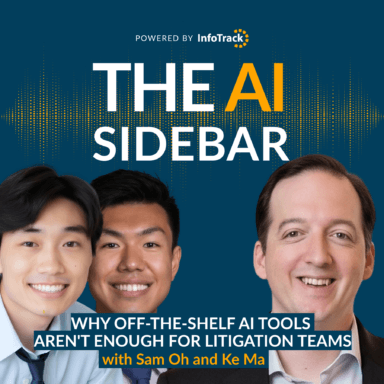
Recorded at Concorda’s booth in Startup Alley at ILTACON, this conversation with founders Sam Oh and Ke Ma digs into the gap they saw in legal AI tools built mostly for transactional work while litigation teams were left without platforms that understood local court rules, judges’ standing orders, and the formatting requirements tied to filing and service. Oh and Ma, both licensed attorneys, walk through how they built out that database starting with PACER and federal courts before expanding state by state to national coverage, and why their approach to firm adoption leans on embedding directly with attorneys and mapping the technology to a firm’s actual workflows rather than dropping in an off-the-shelf tool. The conversation closes with their shared warning about the industry’s biggest blind spot: no matter how advanced the models get, hallucination risk never fully disappears, which is why Oh argues that quick, visual source verification matters more than trusting a tool at face value.
Special thanks to our sponsor InfoTrack.
Sam Oh [00:00:00 – 00:00:36]
My big thing would be verify your sources. I mean, we’ve seen some of these high-profile cases come out where people haven’t verified it, and that’s how we’re building our platform, is you can very quickly verify the original source that any of the facts are coming from, or also the case law is coming from. And I’d say that that’s kind of the key moving forward because, I mean, this technology, the way that it’s built, it’s always going to have the risk of those hallucinations, and that’s not going to go away no matter how much better these models get over the next, you know, years and decades. So the only really way to be absolutely certain that it’s correct is to be able to quickly verify on the platform visually. So.
Phillip Vaden [00:00:45 – 00:00:52]
Hey, this is Philip Vaden with the AI Sidebar, and I’ve stopped by Concorda’s booth here to visit with the founders. Hey guys, how’s it going?
Ke Ma [00:00:53 – 00:00:54]
It’s going well, yeah.
Phillip Vaden [00:00:55 – 00:01:12]
Excellent. So congratulations on being in Startup Alley here at ILTACon. So I wanted to talk to you guys a little bit about, well, what did you see in the marketplace that you thought, hey, this is a problem we want to solve? What was that problem and how did you guys approach solving that?
Sam Oh [00:01:13 – 00:01:51]
Yeah, I’d be happy to talk to you about that. We’re Concorda. We help litigation teams win. That’s our baseline, and that’s how we started. The problem that we saw in the market was specifically for litigation. There were many tools for transactional practice, but in litigation there are specific pieces that like help quite a lot that you need to know that a lot of these tools weren’t actually addressing. Things like understanding a local court’s rules, judges’ standing orders, and then pulling that in in order to know how to actually draft. Things like interactive drafting around specific types of documents like For example, expert reports, briefs, motions, letters, each of those are slightly different.
Sam Oh [00:01:51 – 00:02:09]
And then the formatting for them when you’re actually filing or serving is different based on the rules themselves. So that’s one of the places that we started was building the legal database and all the rules and understanding that so that from end to end we can help collaborative teams build on and draft different things that are ready for service and also for filing.
Phillip Vaden [00:02:09 – 00:02:17]
That’s amazing. Yeah. So how did you guys go about aggregating that data? Was it just a slog of setting up different things to go in and comb the internet and bring all of that in?
Sam Oh [00:02:18 – 00:02:20]
Well, we started from our own experience and practice.
Phillip Vaden [00:02:20 – 00:02:21]
Okay.
Sam Oh [00:02:21 – 00:02:28]
So originally, what are the biggest pain points that we needed? So first was PACER for federal courts.
Phillip Vaden [00:02:28 – 00:02:28]
Yeah.
Sam Oh [00:02:29 – 00:03:14]
We found that we spent a lot of time going back and forth in PACER with a 2-factor in order to pull documents back and forth. So that’s one of the ones where we started. And then from there, we went through and thought about, okay, we also spend a lot of time on court websites figuring out what the standing orders are for different judges that were before. And so that’s the second piece where we just went to the websites and we built out this connection so that we can have that data up to date regularly when we do it. In terms of case law and regulations, we looked out at the market and looked at what different sources we could look at. There was a few really good ones for regulations. There’s one called Open Laws, it’s a PBC, and they do a wonderful job there. And then we also worked with and have enterprise agreements with different data solutions depending on where we thought in the market, there is the best coverage.
Phillip Vaden [00:03:15 – 00:03:24]
Yeah, awesome. And then did you guys focus on a specific state first and then just kind of build all of that out? And then what is you guys’ coverage like now? Is it national now, or?
Sam Oh [00:03:24 – 00:03:25]
It is national now.
Phillip Vaden [00:03:25 – 00:03:25]
Okay.
Sam Oh [00:03:25 – 00:03:27]
We started with federal courts, actually.
Phillip Vaden [00:03:27 – 00:03:27]
Yeah.
Sam Oh [00:03:27 – 00:03:29]
And then from there we went state by state.
Phillip Vaden [00:03:29 – 00:03:52]
State by state, okay, great. That is amazing. That’s a big undertaking because, you know, you get to states like Texas, there’s 254 counties, there’s a lot of judges. And some of them will put out orders that may or may not be actually legally allowed because they haven’t been blessed by the Supreme Court. But when you’re practicing, you better know about it because you don’t want to be the attorney that’s like, I don’t care about this one. Yeah.
Sam Oh [00:03:52 – 00:04:05]
And it’s also hard to find them. You don’t know exactly where you’re going to find this on the website. So you have to click through it. It’s usually a junior associate who is going to have to spend the time to figure out which court standing order is the one that trumps over the different local rules even.
Ke Ma [00:04:05 – 00:04:05]
Yeah.
Phillip Vaden [00:04:05 – 00:04:25]
Yeah. Absolutely. All right, and then in terms of the technology, so what do you guys see coming down the pipeline that you’re like, I think this is going to really accelerate people’s adoption of AI tools or like just kind of blow the roof off of the market and make adoption easier? Do you see anything coming?
Sam Oh [00:04:26 – 00:04:56]
In terms of adoption, we believe that a lot of that has to be just in person. So we spend time with teams, with the specific practice areas, walking them through how they do use certain aspects of the technologies. I think the technology is there. A lot of it now is also just working with lawyers, as, you know, Key and I both are licensed attorneys and we’ve practiced in the past. So then we can go in and talk to lawyers about different ways to basically meet people where they’re at and then help them to learn the new tools that are coming out.
Ke Ma [00:04:57 – 00:04:57]
Yeah.
Phillip Vaden [00:04:58 – 00:05:11]
And do you guys find that it’s, um, like, what’s your approach whenever you’re going and visiting with firms? Is it, is it just attorneys first, or is it, are you looking for CIOs within the firm, or CTOs, paralegals, all of it?
Sam Oh [00:05:12 – 00:05:15]
Do you mean in terms of like how we’re building the tool, or more so?
Phillip Vaden [00:05:16 – 00:05:24]
Yeah, I guess the approach there, like whenever you’re going to, to start, start the pitch and everything, what do you, how do you approach that?
Ke Ma [00:05:24 – 00:05:32]
Yeah, I mean, so because Sam and I are both attorneys and like at the end of the day, like the end user is the attorney. Like I think we really have like an attorney-first approach.
Sam Oh [00:05:32 – 00:05:32]
Yeah.
Ke Ma [00:05:32 – 00:05:53]
And it really is about building strong relationships with them like from the first call and then continuing to like build on that and then have them, like we work together to build, you know, consensus with their team, with their firm to get other people on board. But really at the end of the day, what we’re trying to do is, you know, help attorneys win and make their lives better.
Phillip Vaden [00:05:53 – 00:06:17]
Nice, I love it. And that keeps it really simple for everybody. It’s like, we’re gonna make your life easier and you’re gonna win. These are 2 things that attorneys really like to hear. So then in embedding with the attorneys and, and getting in with them and, and having that, that personal focus, what does the timeline look like for you guys? Is that, is that, you know, you spend a week with them, 2 weeks with them, you know, a day a week for a couple of months? What does that, uh, setup look like?
Ke Ma [00:06:17 – 00:06:40]
Yeah, I mean, I think it really depends on you know, the size of the firm, type of the firm, and like what their arrangements are. I mean, our— the first client that we have and we’re continuing to work with, like we go see them in person like every couple of months. We do like weekly calls with them. And so it’s like an ongoing support that we build and it helps them, but honestly it helps us like get feedback on our product.
Phillip Vaden [00:06:40 – 00:06:41]
Yeah.
Ke Ma [00:06:41 – 00:07:01]
Improving it over time. I think what you see with larger firms is that definitely the relationship is like longer spanning. Maybe, you know, they’re evaluating a lot of different tools on the market and we’re just like continuously like working with them and like getting their feedback.
Phillip Vaden [00:07:02 – 00:07:16]
All right, awesome. That’s great. Well, guys, thank you so much for the time. I really appreciate it. If there’s one thing that you guys want everyone to think about whenever they’re thinking about artificial intelligence tools and the law, What kind of, what kind of advice would you guys give people?
Ke Ma [00:07:17 – 00:07:18]
Yeah, I mean, I think it’s—
Phillip Vaden [00:07:18 – 00:07:19]
I’m gonna put you on the spot.
Sam Oh [00:07:21 – 00:07:21]
Yeah.
Ke Ma [00:07:21 – 00:07:50]
I think it’s really easy to take something off the shelf from the market right now. I mean, people just do straight Claude, for example, but I would even put Harvey and Legora in that bucket where you just drop a solution in. But if it’s like not being implemented well, if it’s not being mapped to specific workflows and specific systems of your firm, it’s just not gonna be as effective. And Concorda, like, we work with you and we embed deeply into how you do things existingly.
Phillip Vaden [00:07:50 – 00:07:51]
Yeah, makes sense.
Ke Ma [00:07:51 – 00:07:51]
Yeah.
Sam Oh [00:07:52 – 00:08:07]
And for me, my big thing would be verify your sources. I mean, we’ve seen some of these high-profile cases come out where people haven’t verified it, and that’s how we’re building our platform, is you can very quickly verify the original source that any of the facts are coming from.
Ke Ma [00:08:07 – 00:08:07]
Yeah.
Sam Oh [00:08:08 – 00:08:17]
Or also the case law is coming from. And I’d say that that’s kind of the key moving forward because I mean, this technology, the way that it’s built, it’s always going to have the risk of those hallucinations.
Phillip Vaden [00:08:17 – 00:08:17]
Yes.
Sam Oh [00:08:17 – 00:08:32]
And that’s not going to go away no matter how much better these models get over the next, you know, years and decades. So the only really way to be absolutely certain that it’s correct is to be able to quickly verify on the platform visually. So that’s the concern that I would have and what I would leave away.
Phillip Vaden [00:08:32 – 00:08:36]
Yeah. The trust and don’t verify. Don’t do that. Yeah, exactly.
Ke Ma [00:08:37 – 00:08:37]
All right.
Phillip Vaden [00:08:37 – 00:08:41]
Awesome. Hey guys, thank you very much for the time. I appreciate it. Yeah, keep crushing it, guys.
Sam Oh [00:08:42 – 00:08:42]
Yeah, thank you.
Phillip Vaden [00:08:42 – 00:08:44]
Yep, thanks guys. All right.

Notify me when there’s a new episode!

|
The AI Sidebar |
AI isn’t coming for the legal profession. It’s already changing it. The AI Sidebar cuts through the noise around legal AI and legal technology. Hosted by Philip Vaden, each episode explores how lawyers and litigation teams are using artificial intelligence in legal research, drafting, discovery, and practice management through honest conversations, real workflows, and practical takeaways you can apply immediately. Understand what AI actually means for legal practice and navigate the future of law with clarity and confidence, not hype. Presented by Infotrack.